A daily health journal: why it works and what to write in 2 minutes
 Checked by Adrian Ienin, pharmacist · updated
A daily health journal works because it shows you what you actually do, not what you think you do. A review of 138 studies, with almost 20,000 people, found that those who tracked their progress reached their goals more often, especially when they wrote it down. Two minutes a day is enough: sleep, movement, meals, energy and the habit you're working on. A journal with a few gaps still helps.
Want to see what this means for you? Start for free →
Why does a daily health journal help?
Memory plays tricks on us. We think we sleep 7 hours when it's 6, that we eat vegetables “most days” when it's twice a week, that we move “enough”. A journal puts the numbers on paper, so there's nothing left to argue about.
In 2016, the journal Psychological Bulletin published a review of 138 studies with 19,951 participants, in which people were randomly split into two groups: some were helped to track their progress, the others weren't. What they found:
- people who tracked their progress reached their goals more often;
- the more often they tracked it, the bigger the effect;
- the effect was bigger still when progress was written down or shared with someone.
Another review, of 22 weight-loss studies, found the same thing: people who regularly logged their meals and activity lost more weight, even though the studies were small.
What do you write in your journal, in 2 minutes?
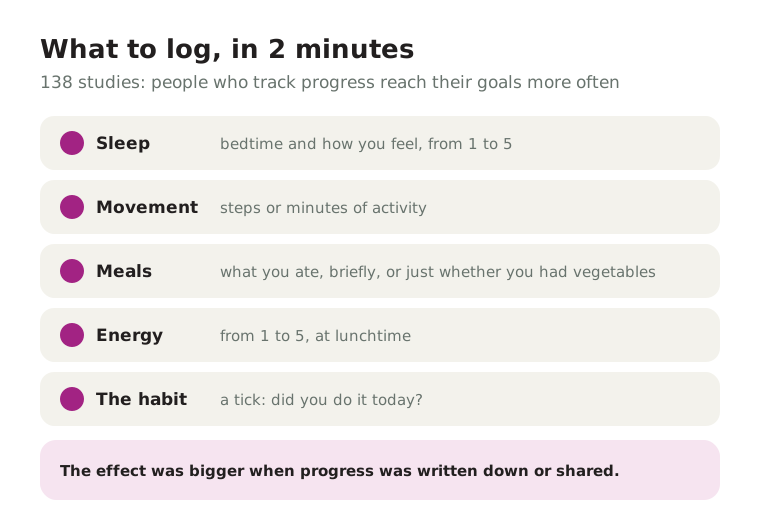
You don't need dozens of questions. A long journal is one you'll give up within a week. Pick a few things, always the same ones, and note them at the same time each day: in the evening before bed, or in the morning over coffee.
- Sleep: when you went to bed, when you got up and how you feel, from 1 to 5.
- Movement: the steps on your phone or your minutes of activity.
- Meals: briefly, or just the answer to one simple question, such as “did I have vegetables at two meals?”.
- Energy: from 1 to 5, at lunchtime or in the afternoon.
- The habit you're working on: a tick, yes or no.
Paper, phone or an app?
| Option | Good for | Less good for |
|---|---|---|
| Notebook | simple, no screen, easy to keep by the bed | hard to spot trends over months |
| Phone notes | always to hand | get lost among other notes |
| Dedicated app | reminds you, draws charts, links things together | can ask for too much data if badly designed |
Go with whichever you'll actually use. If you'd rather not do the sums yourself, the daily journal in your free MentorSano account asks you a few short questions each day and then shows you how sleep, movement, meals and energy connect.
How do you read what you wrote after a week?
A journal becomes useful when you look back at it. Once a week, take 10 minutes and ask yourself three questions:
- What went well? On which days did you have the most energy? What was different about them?
- What keeps coming up? For example: after evenings with your phone in bed, your energy is lower the next day.
- What will you change next week? One small thing you can stick to.
Look for patterns, not someone to blame. Nobody grades your journal. It just helps you see how things are going.
What mistakes do people make with a journal?
- They write too much. Twenty lines a day wear you out. Five are enough.
- They stop after missing a day. One missed day changes nothing. Just carry on the next day.
- They judge themselves. “I ate badly” doesn't help. “I ate at my desk, in a rush” shows you what you can change.
- They never look back. Without the end-of-week review, a journal is just a list.
- They only track their weight. The scales move slowly. Sleep, energy and habits change faster and keep you motivated.
How long should you keep a journal?
At least a few weeks, so you see trends rather than just good or bad days. A new habit takes around 10 weeks on average to become automatic, and a journal helps you through the weeks when motivation dips. After that, you can write less often, or only about what you still want to change.
What else could you note, if you want to?
After the first few weeks, some people want to dig deeper. A few useful extras, each only if it interests you:
- Water: how many glasses you drank, if you tend to forget.
- Mood: from 1 to 5, to see how it ties in with sleep and movement.
- Symptoms: headaches, bloating or other signs that come and go, with the time they appear.
- Data from a watch or ring: resting heart rate, hours of sleep. Look at the trend, not a single night.
- Your menstrual cycle: many women notice their energy and sleep change on certain days.
Add one thing at a time. A journal that grows too quickly ends up too long again.
When to see a doctor
A journal is no substitute for seeing a doctor, but it can help at your appointment. See a doctor, and take your journal along, if:
- you notice tiredness, poor sleep or pain coming back for weeks;
- your energy drops a lot for no reason you can see in the journal;
- you've lost or gained a lot of weight without changing what you eat;
- keeping a food diary makes you feel guilty or anxious about food.
Frequently asked questions
What time of day should I fill in my journal?
The same time every day, so it becomes a habit. The evening, before bed, works for the day that's ending. Note your sleep in the morning.
Do I need to count calories?
Not necessarily. For many people it's enough to note briefly what they ate, or whether they had vegetables and protein. Counting calories only helps if it's useful to you and doesn't stress you out.
What if I forget for a few days?
Start again today. Don't fill in the missing days from memory, because memory gets it wrong. A few missing days don't spoil the overall picture.
Does it help to show my journal to someone?
Yes. The review of 138 studies found a bigger effect when progress was shared with someone. It could be a friend, a family member or a professional who's helping you.
Start from where you are today
MentorSano brings together your blood tests, sleep, meals, movement and habits, and Adrian Ienin checks your plan before it reaches you.
- 15-minute questionnaire
- Blood tests, explained
- Daily journal
- Lesson of the day
- An expert by your side
Adrian Ienin
Naturopathic pharmacist, nutrition and holistic health consultant, co-founder of MentorSano. He checks the articles here and the plans in the platform before they reach people.
Sources
- Harkin et al. Does monitoring goal progress promote goal attainment? A meta-analysis of the experimental evidence, Psychological Bulletin, 2016
- Burke, Wang, Sevick. Self-monitoring in weight loss: a systematic review of the literature, J Am Diet Assoc, 2011
- Gardner, Lally, Wardle. Making health habitual: the psychology of “habit-formation” and general practice, British Journal of General Practice, 2012