How to build a habit that actually sticks
 Checked by Adrian Ienin, pharmacist · updated
A habit forms through repetition, in the same situation, until you do it without thinking. In a University College London study, that took 66 days on average, not 21. How to build a habit, in short: pick a very small step, tie it to something you already do every day and write it down. One missed day does not break the habit. Giving up after it does.
Want to see what this means for you? Start for free →
What is a habit?
A habit is something you do automatically when you find yourself in a certain situation. You no longer think about it and no longer need willpower. You brush your teeth after breakfast, you put on your seat belt when you get in the car.
Psychologists who study health habits describe three parts:
- the cue: the moment or place that starts the habit (after coffee, when you get home);
- the action: what you do (drink a glass of water, go out for a 10-minute walk);
- repetition: the same action after the same cue, day after day, until it is automatic.
Motivation gets you started. The habit keeps you going when motivation fades, and it fades for everyone after the first few weeks.
How long does it take to form a habit?
You have probably heard 21 days. The number comes from a 1960s book about how long a plastic surgeon's patients took to get used to their new appearance. It is not about habits.
In 2010, a University College London team followed 96 people who each chose a new health habit: a piece of fruit at lunch, a glass of water, a 15-minute run. Every day they rated how automatic it felt.
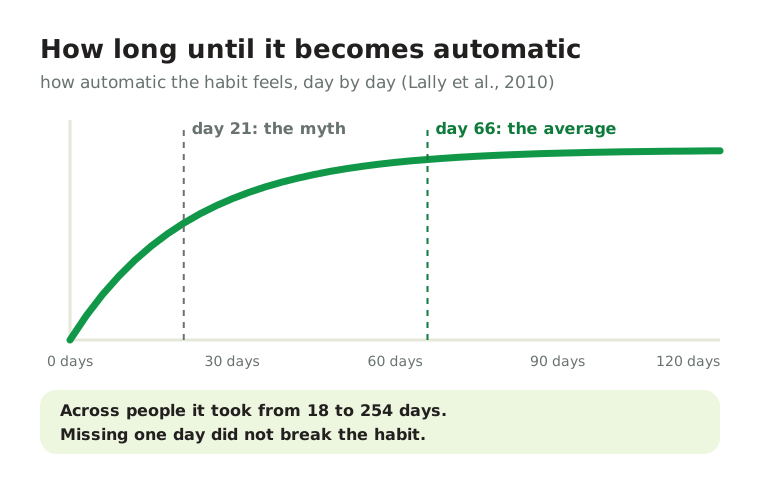
The result, summarised by the same researchers in an article for family doctors:
- automaticity rose fast at first, then more and more slowly, until it levelled off;
- on average, that happened after 66 days, but people differed a lot, from a few weeks to over eight months;
- simple things (a glass of water) became automatic faster than complex ones (exercise);
- one missed day did not spoil the process. Automaticity rose again afterwards.
So you can tell yourself: “I am giving this ten weeks”. That is more realistic than three, and it spares you the guilt on the day it does not happen.
How to build a habit: 6 steps
- Pick one habit. Not five at once. The one that would change your day the most.
- Make it ridiculously small. Not “I will walk for an hour a day”, but “I will go out for 10 minutes after lunch”. You can grow it once it has stuck.
- Tie it to something you already do. “After I make my coffee, I drink a glass of water.” The cue already exists; you just add the action.
- Set up your surroundings. A water bottle on the desk, trainers by the door, fruit in sight, sweets in the cupboard.
- Write it down every day. A tick is enough. A review of 22 weight-loss studies consistently found that people who logged their meals and activity lost more weight, even though the studies were small.
- Do not miss twice in a row. One missed day is normal. Just pick it up again the next day.
If you would rather not keep track on your own, your free MentorSano account does it for you: the daily to-do tells you today's step, the journal keeps the ticks, and your Journey and the weekly challenge keep you going.
Why do we give up after a week?
| What happens | What to do instead |
|---|---|
| You picked something too big | Cut it in half. Then once more. |
| You have no fixed moment | Tie the habit to a cue from every day. |
| One missed day feels like failure | The study shows it is not. Come back the next day. |
| You see no progress | Look at the ticks you have collected, not at the end result. |
| You changed everything at once | One new habit every few weeks. |
Why does tracking your progress help?
What you write down, you see. When you see 20 ticks in a row, you do not want to break the streak. And you see the links: in the week you slept better, you also felt like going for a walk.
The journal does not need to be complicated. Two or three questions a day are enough: did you do today's step, how did you sleep, how do you feel. What matters is keeping it, not making it perfect.
Examples of small habits, for each area of health
| Area | The small habit | The cue |
|---|---|---|
| Sleep | screens away 30 minutes before bed | when you brush your teeth at night |
| Food | one vegetable at lunch | when you put your plate on the table |
| Movement | a 10-minute walk | right after lunch |
| Water | a glass of water | after your morning coffee |
| Learning | a short 3-minute lesson | during your coffee break |
Pick just one from the table, the easiest for you. Once it happens on its own, move on to the next.
When to see a doctor
Everyday habits do not need a doctor. Do see a doctor or psychologist, though, if:
- you want to stop smoking, drinking or another addiction: dedicated treatments and programmes help there;
- you have a chronic condition and want to change your diet or activity a lot;
- you have felt low on energy and interest for several weeks.
Frequently asked questions
Does a habit form in 21 days?
Usually not. In a University College London study, automaticity levelled off after 66 days on average, with big differences between people and between habits.
What if I miss a day?
Come back the next day. In the same study, one missed day did not spoil habit formation. Just try not to miss two days in a row.
How many new habits can I start at once?
Ideally one. Once you do it without thinking, add the next.
Do habit apps help?
They can, because they remind you and show your progress. The app matters less than choosing a small step tied to a fixed moment of the day.
Should I reward myself for keeping a habit?
A small reward can help at the start, especially one that comes right after the action. Over time, the habit itself and the progress you see become the reward.
Start from where you are today
MentorSano brings together your blood tests, sleep, meals, movement and habits, and Adrian Ienin checks your plan before it reaches you.
- 15-minute questionnaire
- Blood tests, explained
- Daily journal
- Lesson of the day
- An expert by your side
Adrian Ienin
Naturopathic pharmacist, nutrition and holistic health consultant, co-founder of MentorSano. He checks the articles here and the plans in the platform before they reach people.
Sources
- Gardner, Lally, Wardle. Making health habitual: the psychology of “habit-formation” and general practice, British Journal of General Practice, 2012
- Lally et al. How are habits formed: Modelling habit formation in the real world, European Journal of Social Psychology, 2010
- Burke, Wang, Sevick. Self-monitoring in weight loss: a systematic review of the literature, J Am Diet Assoc, 2011