Health information: how to check it before you believe it
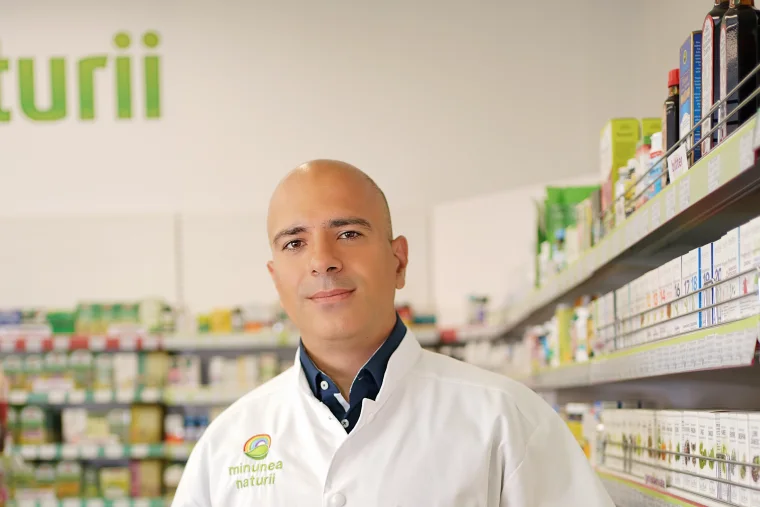 Checked by Adrian Ienin, pharmacist · updated
Before you believe health information from the internet, ask five questions: who wrote it, what it is based on, how recent it is, whether the page is selling you something and whether it promises too much. The list comes from MedlinePlus, the service of the US National Library of Medicine. A good tip has an author, sources and a date. One to avoid promises quick results for everyone.
Want to see what this means for you? Start for free →
Why is it hard to find reliable health information?
It has never been easier to find an answer. And it has never been harder to know whether it is right. The same search page shows a medical guideline, a blog selling a supplement and a video filmed in someone's kitchen.
The World Health Organization calls the ability to find, understand and use health information “health literacy”. The WHO says it shapes how we look after ourselves, and that people with less of it usually have poorer health. It can be learned, like anything else.
How do you check health information?
MedlinePlus, the service of the US National Library of Medicine, has a list of questions for any health page. We have gathered it into five questions.
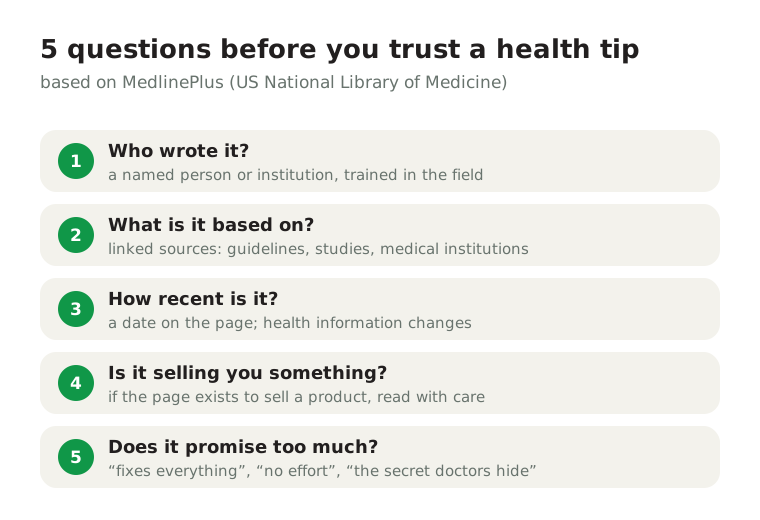
1. Who wrote it?
Look for the author's name and training. A medical institution, a hospital, a university or a named professional are a good start. A page with no author and no “about us” is a question mark.
2. What is it based on?
A serious text says how it knows what it says: guidelines, studies, institutions, with links. “Studies show”, with no study named, is not a source.
3. How recent is it?
Medicine changes. Advice from 15 years ago may be out of date. Look for the publication date and the date it was last checked.
4. Is it selling you something?
Not every page that sells something is lying. But if the whole text leads to a single product, read it more carefully and look for other opinions too.
5. Does it promise too much?
Warning signs: “results in 3 days”, “no effort at all”, “works for everyone”, “the secret doctors don't want you to know”. The body does not work like that, and scientists rarely speak with such certainty.
What do you do with a tip from social media?
- Pause before you share it. A wrong tip, shared, reaches people who may have an illness or be on treatment.
- Look for the same information in a trusted source. MedlinePlus, the NHS, the WHO or the website of a large hospital.
- Be careful with personal stories. “It worked for me” is an experience, not proof that it works for you.
- Ask a professional before you change a treatment, start a supplement or stop a medicine.
How do you keep learning about your health without getting lost?
You do not need hours of reading. You need a little, often, and tied to what concerns you.
| What you do | Why it works |
|---|---|
| One short lesson a day, 3–5 minutes | Learning in small pieces, with breaks, sticks better than all at once. |
| Learn about what you are working on | If you are changing your sleep, read about sleep. What you apply the next day sticks. |
| Come back to the same idea a few days later | Spaced repetition strengthens what you learned. |
| Write one idea down and try it | Trying it out is what makes it stick. |
An analysis of 317 memory experiments found that learning spread out over time, with breaks between repetitions, beats learning crammed into a single day. The same goes for what you learn about health.
In your free MentorSano account you get a short daily lesson and the thought of the day, tied to what you are working on at the time. What you read relates to your own blood tests, sleep and habits, not to whatever is trending.
How should you read an article on this site?
We wrote the MentorSano articles by the same rules: each has linked sources, the date it was last checked and a box with what is for your doctor. They are checked by Adrian Ienin, pharmacist. If you spot a mistake, write to us at portal@mentorsano.ro.
How do you read a study mentioned in the news?
Headlines often say “a study shows that…”. Four questions help you see how certain the result is:
- Who was it done on? A result in mice or in cells does not mean it works the same in people.
- How many people took part? A study of 20 people is a start. One of tens of thousands carries more weight.
- What kind of study is it? An observational study shows a link. A study in which people are randomly split into two groups can show a cause.
- Relative or absolute risk? “Risk falls by 50%” may mean from 2 to 1 in 1,000 people. Look for the whole numbers.
The most solid answers come from guidelines and from reviews that pool many studies, not from a single new study.
When to see a doctor
No web page replaces a consultation. See a doctor:
- before you change or stop a treatment because of something you read;
- before you start a supplement if you take medicines, are pregnant or have a chronic condition;
- if you have new symptoms that do not go away or get worse.
Frequently asked questions
Where can I find reliable medical information?
On the websites of medical institutions: MedlinePlus, the NHS, the World Health Organization, large hospitals and medical societies. And from your own doctor or pharmacist.
How do I spot fake health news?
It has no author or sources, promises quick results for everyone, frightens you or says doctors are hiding something, and it often ends with a product to buy.
Can I trust answers from artificial intelligence?
Use them as a starting point, not a verdict. Check what they say in a trusted source and ask a professional before making a decision about your health.
Why does health advice change over time?
Because new, larger and better studies appear. Science updates its conclusions when better data come in. That is why the date of the information matters.
Start from where you are today
MentorSano brings together your blood tests, sleep, meals, movement and habits, and Adrian Ienin checks your plan before it reaches you.
- 15-minute questionnaire
- Blood tests, explained
- Daily journal
- Lesson of the day
- An expert by your side
Adrian Ienin
Naturopathic pharmacist, nutrition and holistic health consultant, co-founder of MentorSano. He checks the articles here and the plans in the platform before they reach people.