Stress and health: what happens in your body and what helps
 Checked by Adrian Ienin, pharmacist · updated
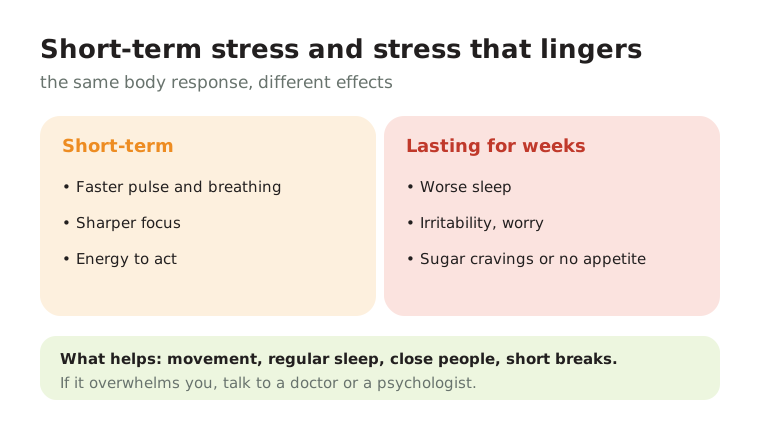
The link between stress and health comes down to how long it lasts. Short-term stress is a normal body response: your pulse goes up, your focus sharpens and you have the energy to deal with the problem. When it lasts for weeks, the same response starts to affect your sleep, appetite, mood and concentration. The World Health Organization recommends a few simple things that help: a daily routine, movement, regular sleep and staying in touch with people close to you.
Want to see what this means for you? Start for free →
What is stress?
The World Health Organization describes stress as a state of worry or mental tension caused by a difficult situation. It's a natural response that helps us deal with challenges and threats in life. Everyone feels stressed from time to time.
What makes the difference is how long it lasts and how heavily it weighs on you. A work deadline that passes in a week is one thing; months of worrying about money, a loved one's health or an uncertain job are another.
What happens in your body when you're stressed?
When the brain senses a threat, the body releases stress hormones such as adrenaline and cortisol. Within seconds:
- your heart beats faster and blood pressure rises;
- your breathing speeds up;
- your muscles tense;
- more sugar is released into the blood for quick energy;
- digestion slows down, because it isn't a priority right now.
This response is very useful in the short term. It helps you brake in time, speak in front of a room or finish a project. Once the situation is over, your body goes back to normal.
How can you tell stress has become too much?
The UK's National Health Service (NHS) lists the most common signs. They often build up gradually, so many people don't connect them with stress:
- in your body: headaches, tense muscles, an upset stomach, tiredness, poor sleep;
- in your mind: worries that won't stop, trouble concentrating, feeling you can't cope;
- in what you do: irritability, pulling away from people, more coffee, alcohol or sweets, less movement.
A short journal helps you see the link. If you sleep worse, eat differently and move less in the hard weeks, that's simply how the body reacts to stress, for almost everyone.
How does stress affect sleep, meals and movement?
| Area | What happens | What you can try |
|---|---|---|
| Sleep | you struggle to fall asleep, wake up at night with thoughts | write your worries on paper before bed; a fixed wake-up time |
| Meals | cravings for sweets and snacks or, the opposite, no appetite | regular meal times; snacks prepared in advance |
| Movement | it's the first thing you drop when you're busy | 10 minutes of walking, even on hard days |
| Energy | tiredness, even after resting | short breaks during the day, getting outside in daylight |
They're all connected. Poor sleep raises the next day's stress, and stress spoils sleep. That's why one small step in a single area, such as a daily walk, can help the others too.
In your free MentorSano account, the daily journal shows how your sleep, energy and movement change from week to week, and the daily lesson briefly explains why you feel the way you do.
What helps you manage stress day to day?
The WHO put together a simple guide, “Doing What Matters in Times of Stress”, with techniques anyone can use. Here are some of them, together with NHS advice:
- A daily routine. Regular times for waking up, eating and going to bed give your body a steady rhythm when everything around you feels chaotic.
- Movement. Any kind of activity eases tension in the body and helps you sleep.
- People close to you. Talking to someone you trust takes a lot of the weight off.
- The present, not the future. When your thoughts race towards what might go wrong, bring your attention back to what you can see, hear and feel right now, for a few breaths.
- One thing at a time. Write down what you have to do, break it into small steps and do the first one.
- Less news and screen time, especially in the evening.
- Watch what you use as a crutch: alcohol, smoking and eating on the go seem to help in the moment, but they increase stress in the long run.
What can stress teach you about yourself?
Stress usually shows what matters to you and where you need support. Look at the situations that stress you most often: are they about time, people, money, health? Some can't be changed, but how you prepare for them can. Learning how your body reacts is the first step to no longer being caught off guard by it.
When to see a doctor
See your GP or a psychologist if:
- stress has been overwhelming you for several weeks and you can no longer enjoy things;
- you sleep badly almost every night;
- you have palpitations, chest pain or panic attacks;
- you use alcohol, medicines or food to cope;
- you have thoughts of harming yourself. In that case, get help straight away: call your local emergency number (112 in Europe).
Frequently asked questions
Is stress always harmful?
No. Short-term stress is a normal response that helps you cope with a difficult situation. It becomes a problem when it lasts for weeks and you have no time to recover.
Can stress cause physical symptoms?
Yes. Headaches, tense muscles, an upset stomach and poor sleep are common signs. If your symptoms are new or severe, see a doctor so other causes can be ruled out.
Does breathing help reduce stress?
Slow breathing, with the out-breath longer than the in-breath, can slow your pulse and calm your body within a few minutes. It's a useful tool, not a fix for whatever is causing the stress.
How quickly does exercise help with stress?
Many people feel a difference after just a 10 to 20-minute walk. The biggest effect, though, comes from regular movement several times a week.
What can I do in 5 minutes when I'm very stressed?
Stop and breathe slowly for a few minutes, with the out-breath longer than the in-breath. Then step outside or go to a window, drink a glass of water and pick one small thing to do. It helps to put what you feel into words, even just to yourself.
Does coffee help when I'm stressed and tired?
It may seem to help in the moment, but too much coffee can make you more anxious and spoil your sleep, which makes the next day's stress harder to handle. Keep it moderate and before 2 pm.
Start from where you are today
MentorSano brings together your blood tests, sleep, meals, movement and habits, and Adrian Ienin checks your plan before it reaches you.
- 15-minute questionnaire
- Blood tests, explained
- Daily journal
- Lesson of the day
- An expert by your side
Adrian Ienin
Naturopathic pharmacist, nutrition and holistic health consultant, co-founder of MentorSano. He checks the articles here and the plans in the platform before they reach people.