How many steps a day is enough? What the research shows, in plain words
 Checked by Adrian Ienin, pharmacist · updated
For your health, you do not necessarily need 10,000 steps. An analysis of 47,471 adults found that the risk of death falls as steps go up, until about 6,000–8,000 steps a day over age 60 and 8,000–10,000 under 60. How many steps a day you take now matters: if you start at 3,000, every extra 1,000 helps. Pace comes after the habit.
Want to see what this means for you? Start for free →
Where does the 10,000-step rule come from?
The number 10,000 does not come from a study. It comes from a 1960s marketing campaign in Japan for a pedometer whose name meant “10,000-step meter”. The number was round and easy to remember.
Only in recent years have large studies appeared with people wearing devices that counted their steps. They show that the benefit starts well below 10,000.
How many steps a day does the research recommend?
In 2022, Lancet Public Health published an analysis of 15 studies with 47,471 adults followed for 7 years on average. People were split into four groups by how many steps they took a day.
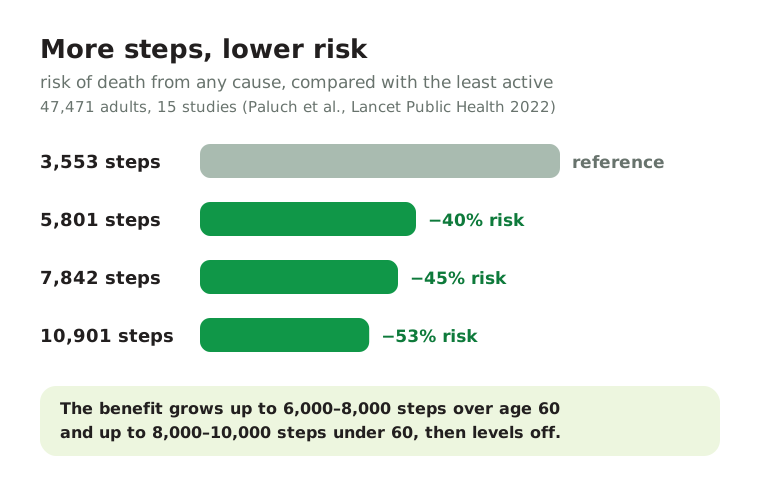
In plain terms, the results say three things:
- The biggest gain is at the start. The difference between 3,500 and 5,800 steps was the largest.
- The benefit stops growing at some point. Over 60, around 6,000–8,000 steps. Under 60, around 8,000–10,000.
- Speed mattered less than the number. Once the number of steps was taken into account, walking pace changed the result little.
It is an observational study: it shows a link, it does not prove that steps alone are the cause. People who walk a lot may have other healthy habits too. The results match many other studies on physical activity, though.
How many steps do you actually take on a normal day?
Many people who work at a desk and drive take 3,000–5,000 steps a day. Your phone counts them anyway, if you carry it. Look at the weekly average, not a single day.
As a rough guide, 1,000 steps is about 10 minutes of normal walking and about 700–800 metres.
How do you get more steps without a gym?
The World Health Organization recommends 150–300 minutes a week of moderate activity for adults, such as brisk walking. That is about 30 minutes, 5 days a week. Everyday steps add up towards that target.
| What you change | Extra steps, roughly |
|---|---|
| A 10-minute walk after lunch | 1,000 |
| Get off the bus one stop early | 500–1,000 |
| Walk while you talk on the phone | 500–1,500 |
| Park at the far end of the car park | 200–400 |
| Stairs instead of the lift | 100–300 |
| A 20-minute evening walk | 2,000 |
Do not do them all at once. Pick one, keep it for a week, then add another. If you take 4,000 steps now, a good first target is 5,000, not 10,000.
In your free MentorSano account, the daily to-do gives you one small movement step, and the journal shows your steps next to sleep and energy. That way you see what one more walk changes for you.
Does other movement count?
Yes. Steps are easy to count, but they are not everything. The WHO also recommends:
- strength exercises for all major muscles, at least twice a week (squats, supported push-ups, resistance bands);
- over 65, balance exercises too, to prevent falls;
- as little time as possible sitting without a break: stand up at least once an hour.
Swimming and cycling do not show up as steps, but they count just as much towards your minutes of activity.
How do you build a 4-week plan?
Start from your current average and add a little each week. An example for someone who takes 4,000 steps a day now:
| Week | Daily target | How |
|---|---|---|
| 1 | 4,500 | a 5-minute walk after lunch |
| 2 | 5,000 | the walk grows to 10 minutes |
| 3 | 6,000 | walk one bus stop, there and back |
| 4 | 7,000 | a 10-minute evening walk |
If a week was hard, stay at the old target for another week. The main thing is not to stop. Speed comes later.
How do you know your walking is brisk?
A simple check is the talk test: when walking briskly you can talk in sentences, but you cannot sing. If you can sing, it is light walking. If you cannot talk any more, it is vigorous effort. Light walking still counts towards your steps, and brisk walking adds to the minutes of moderate activity the WHO recommends.
When to see a doctor
- You have chest pain, dizziness or get very breathless with little effort.
- You have heart disease, untreated high blood pressure or diabetes and want to start moving much more.
- You have knee, hip or back pain that gets worse when you walk.
- You have fallen several times in the past year.
Frequently asked questions
Do I have to walk 10,000 steps a day?
No. Research shows benefits from 6,000–8,000 steps over age 60 and from 8,000–10,000 under 60. If you start lower, every extra 1,000 steps helps.
How many steps a day to lose weight?
No number of steps makes you lose weight on its own. Walking burns energy and helps you keep a healthy weight, but it works together with what you eat and how you sleep.
Do steps around the house count?
Yes. Your body does not tell steps at home from steps outside. Brisk walking, in blocks of at least 10 minutes, adds to your minutes of moderate activity as well.
Is my phone accurate at counting steps?
Accurate enough for trends, if you carry it. It may count less when you leave it on your desk. Look at the weekly average.
Is it better to take all my steps at once or in chunks?
The daily total is what counts. You can take your steps in chunks, for example three 10-minute walks, and the breaks from sitting are a bonus.
Do treadmill steps count?
Yes. They add to your daily total just like steps outdoors. If the treadmill is inclined or you walk fast, they also count as minutes of moderate activity.
I have a desk job. Where do I start?
Stand up and walk for a few minutes every hour, take phone calls on your feet and add a short walk after lunch. Small breaks from sitting add up over a week.
Start from where you are today
MentorSano brings together your blood tests, sleep, meals, movement and habits, and Adrian Ienin checks your plan before it reaches you.
- 15-minute questionnaire
- Blood tests, explained
- Daily journal
- Lesson of the day
- An expert by your side
Adrian Ienin
Naturopathic pharmacist, nutrition and holistic health consultant, co-founder of MentorSano. He checks the articles here and the plans in the platform before they reach people.