Strength exercises at home: a simple circuit with no equipment
 Checked by Adrian Ienin, pharmacist · updated
The World Health Organization recommends that adults do muscle-strengthening activity for all major muscle groups at least twice a week, on top of walking. You don't need a gym: strength exercises at home using your own body weight are enough to start. A circuit of 6 moves (sit-to-stands, wall push-ups, supported lunges, calf raises, glute bridges and a plank) takes 15 to 20 minutes. Build up gradually rather than all at once.
Want to see what this means for you? Start for free →
Why do strength exercises matter, and not just walking?
Walking and running train your heart and lungs. Strength exercises train your muscles, bones and joints. Your body needs both.
From your 30s and 40s, muscle mass slowly drops year by year if you don't use it. Weaker muscles mean harder stairs, more frequent back pain, poorer balance and, later on, a higher risk of falls. But muscles get stronger at any age once you put them to work.
The World Health Organization recommends that adults do muscle-strengthening activity for all major muscle groups at least twice a week. Over 65, add balance exercises too.
A strength circuit at home for beginners
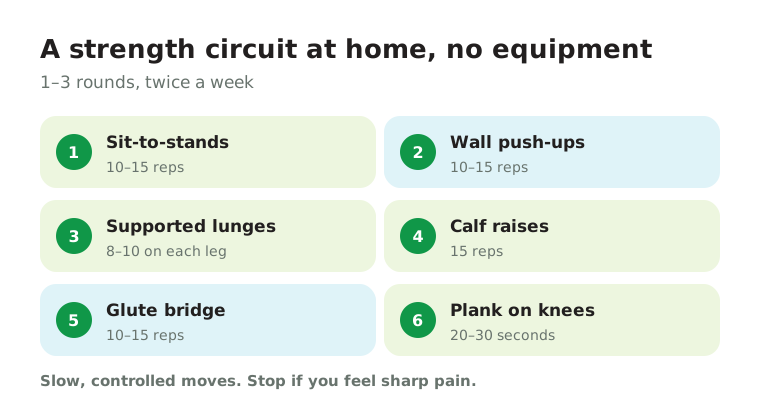
1. Sit-to-stands
Sit on the edge of a sturdy chair with your feet hip-width apart. Stand up without using your hands, then sit back down slowly. This works your thighs and glutes, the same muscles you use to climb stairs.
2. Wall push-ups
Stand facing a wall, one step away, with your palms on the wall at shoulder height. Bend your elbows to bring your chest towards the wall, then push back. This works your chest, shoulders and arms. When it gets easy, move on to push-ups against a table.
3. Supported lunges
Hold the back of a chair. Take a big step forward and slowly lower your back knee towards the floor, then come back up. Do one leg, then the other.
4. Calf raises
With one hand on a wall or chair, rise up onto your toes and lower slowly. This works your calves and helps your balance.
5. Glute bridge
Lie on your back with your knees bent and feet flat on the floor. Lift your hips until your body forms a line from shoulders to knees, then lower slowly. This works your glutes and lower back.
6. Plank on knees
Resting on your forearms and knees, hold your body straight from head to knees with your stomach tight for 20 to 30 seconds. When it gets easy, move on to a full plank on your toes.
How many reps, and how often?
| Stage | Rounds | How often |
|---|---|---|
| Weeks 1–2 | 1 round, 8–10 reps per exercise | 2 days a week |
| Weeks 3–4 | 2 rounds, 10–12 reps | 2 days a week |
| From month two | 2–3 rounds, 12–15 reps | 2–3 days a week |
Leave at least one rest day between two strength sessions for the same muscles. The last 2 or 3 reps of each exercise should feel a bit hard. If they're easy, add reps or move on to the harder version.
So you don't forget, your free MentorSano account puts movement on your daily to-do list, and the journal shows what you've done each week.
How do you make it harder without equipment?
- More reps or more rounds.
- Slower: take 3 seconds to go down and 1 to come up. The same exercise gets harder.
- A harder version: from wall push-ups to table push-ups, then knee push-ups; from sit-to-stands to squats without a chair.
- Weight in your hands: two water bottles, a backpack with books in it or a resistance band.
How do you exercise safely?
- Warm up for 3 to 5 minutes: march on the spot, roll your shoulders and ankles.
- Keep breathing during each move; don't hold your breath.
- Move slowly and with control, not with jerks.
- Stop if you feel sharp pain or dizziness. Mild muscle soreness over the next few days is normal at first.
- Use a sturdy chair that won't slide, and shoes or bare feet on a non-slip surface.
How do you fit strength exercises into your week?
The exercises themselves are easy. The hard part is doing them twice a week, month after month. A few things help:
- Set days. For example Mondays and Thursdays, when you get home or before dinner.
- A ready-made spot. A corner with the chair and a towel, so you don't waste time setting up.
- Pair it with something you already do. Sit-to-stands while the kettle boils, wall push-ups after you brush your teeth.
- One round beats none. On busy days, do a single 5-minute round and tick it off.
Daily walking and strength work twice a week go well together: one keeps your heart fit, the other your muscles and bones.
When to see a doctor
- You have heart disease, untreated high blood pressure or have recently had surgery.
- You have back, knee or shoulder pain that gets worse when you move.
- You have osteoporosis or have had fractures and want to start strength exercises.
- You feel dizzy, have chest pain or get very breathless during exercise.
- You are pregnant and haven't done strength exercises before.
Frequently asked questions
Can I do strength exercises every day?
Not for the same muscles. Muscles recover and grow on rest days. Two or three sessions a week, with a day off in between, is plenty to start with.
Are strength exercises good after 60?
Yes, they matter even more, because they help with balance and stairs. Start with the easiest version and, if you have a long-term condition, check with your doctor first.
Do strength exercises help with weight loss?
Indirectly: muscle uses energy and helps you stay active. On their own they won't make you lose weight, but together with diet and walking they make a difference.
How long until I see results?
Many people notice a difference in daily life, such as climbing stairs, after 4 to 8 weeks of regular training.
Do I need dumbbells?
Not at first. Your own body weight is enough for the first few months. When the exercises get easy, try water bottles, a backpack with books or a resistance band before buying dumbbells.
What if my muscles are sore the next day?
That's normal at the start, especially after the first few sessions. It usually goes away in 2 to 3 days. Gentle walking and light movement help. Next time, do fewer reps and build up more slowly.
Start from where you are today
MentorSano brings together your blood tests, sleep, meals, movement and habits, and Adrian Ienin checks your plan before it reaches you.
- 15-minute questionnaire
- Blood tests, explained
- Daily journal
- Lesson of the day
- An expert by your side
Adrian Ienin
Naturopathic pharmacist, nutrition and holistic health consultant, co-founder of MentorSano. He checks the articles here and the plans in the platform before they reach people.