How to read food labels in 30 seconds
 Checked by Adrian Ienin, pharmacist · updated
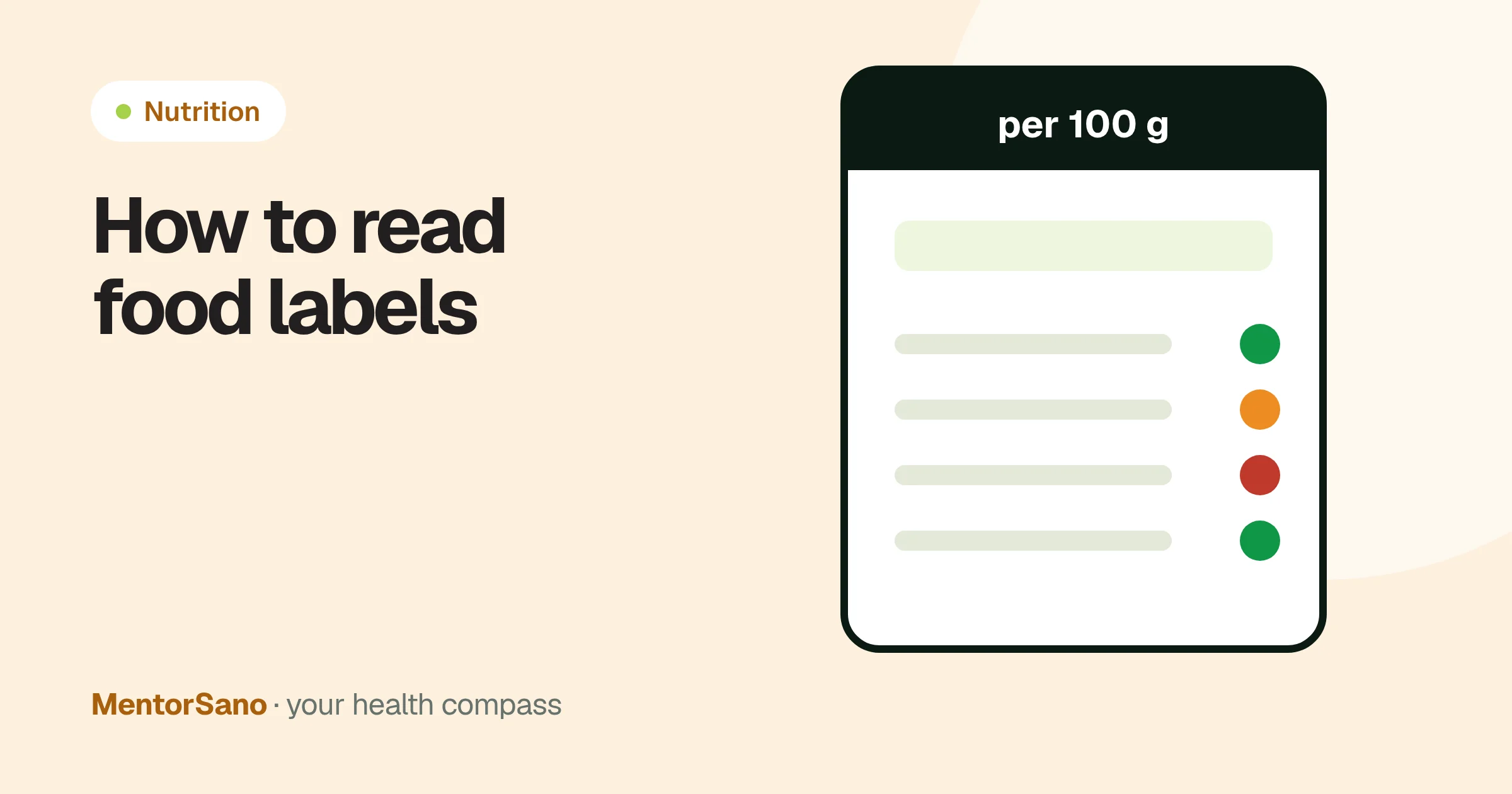
To know how to read food labels, look first at the “per 100 g” column, not at the portion. The UK's National Health Service (NHS) gives simple thresholds: more than 22.5 g of sugars, 17.5 g of fat, 5 g of saturated fat or 1.5 g of salt per 100 g is high. Then read the ingredients list: ingredients are listed by quantity, so the first three matter most.
Want to see what this means for you? Start for free →
What does a food label actually show?
In Europe and the UK, almost every packaged food has two helpful things on the back: the nutrition table and the ingredients list. The table shows how much energy, fat, sugars, protein and salt the product has. The list shows what it is made of.
The front of the pack is where the marketing lives: “natural”, “fitness”, “with whole grains”, “no added sugar”. Some of it is useful, some just sounds good. The real answer is on the back.
Why look at “per 100 g” rather than the portion?
The portion is chosen by the manufacturer. It might be 30 g of cereal, even though you pour 60 g into your bowl. The “per 100 g” column is the same on every product, so it lets you compare two yoghurts or two loaves of bread, even if their portions differ.
Once you have compared, check the portion too, to know how much you actually eat. If you eat twice the portion, you double the numbers.
How can you tell a food is high in sugar, salt or fat?
The NHS puts the thresholds in a simple table for foods (drinks have lower thresholds). Below the lower threshold is low, above the upper one is high, and in between is medium.
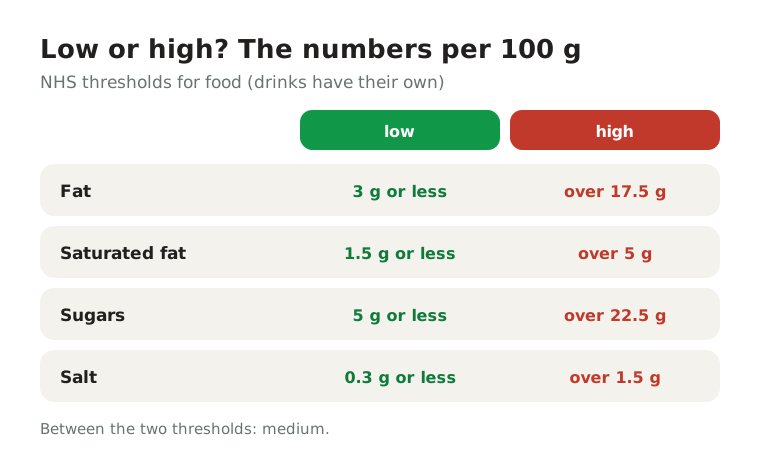
A few practical examples: plain yoghurt usually has around 4–5 g of sugars per 100 g, while a fruit yoghurt can have three times as much. Bread can have more than 1.5 g of salt per 100 g without tasting salty. Breakfast cereals range from under 5 g to over 25 g of sugar.
What does the ingredients list tell you?
Ingredients are listed in order of quantity, from most to least. That tells you quickly what you are buying:
- The first three ingredients make up most of the product. If sugar or oil is among them, the product is mostly sugar or fat.
- Sugar has many names: glucose syrup, glucose-fructose syrup, dextrose, maltodextrin, corn syrup, honey, agave syrup, concentrated fruit juice. If several appear, they add up.
- “Wholegrain” only counts if it comes first. A loaf “with whole grains” may have white flour first and a little wholemeal flour further down.
- A short list of ingredients you recognise is usually a good sign.
If you want to see how you really eat, not just what the pack says, create your free MentorSano account. You log your meals in the journal and see, week by week, what you change.
What do the claims on the front of the pack mean?
| Claim | What it usually means |
|---|---|
| “No added sugar” | no sugar was added, but the product may still have a lot of natural sugar, for example from fruit or milk |
| “Light” or “reduced fat” | it has less than the regular version, not necessarily little; sometimes fat is replaced with sugar |
| “Source of fibre” | it has at least a set amount of fibre per 100 g, under EU rules |
| “Natural” | has no strict definition for the whole product; read the ingredients list |
| “High protein”, “fitness” | can be useful, but check the sugar and fat too |
How do you compare two products on the shelf in 30 seconds?
- Turn the packs over and find the “per 100 g” column.
- Compare sugars and salt; for fatty foods, saturated fat too.
- Look at the first three ingredients.
- Choose the one with less sugar and salt and simpler ingredients.
You do not need to do this on every shop. Do it once for the products you buy often: bread, yoghurt, cereal, sauces. After that you already have your good choices and pick them out of habit.
What does a label not tell you?
A label is useful, but it does not tell you everything. It does not say how filling a food is, how processed it is or how it fits into the rest of your day. A handful of nuts has a lot of fat and calories, but they are healthy fats and they fill you up. A “light” drink may have few calories, but it does not nourish you. That is why a label is a tool for comparing similar products, not a rule for everything you eat.
What does a good ingredients list look like?
Take two strawberry yoghurts from the same shelf. The first says: “milk, strawberries 12%, live cultures”. The second: “milk, sugar, glucose-fructose syrup, strawberry purée 5%, modified starch, flavourings, colour”. Both are called “strawberry yoghurt”, but the second has sugar in second place and another sweetener in third.
An even simpler option: buy plain yoghurt and add fresh or frozen fruit yourself. You know exactly what is in the bowl.
When to see a doctor
Reading labels is not a medical matter. Do see a doctor or a dietitian, though, if:
- you have diabetes, high blood pressure or kidney disease and need to watch sugar, salt or protein closely;
- you have a food allergy or coeliac disease and are unsure what to avoid;
- you have lost or gained a lot of weight without understanding why.
Frequently asked questions
How much sugar is too much in a product?
By NHS thresholds, more than 22.5 g of sugars per 100 g is high, and 5 g or less is low. Drinks have lower thresholds.
What is the difference between salt and sodium?
Salt contains sodium. Labels in Europe and the UK usually show salt directly. If you only see sodium, multiply by 2.5 to get the salt.
Are “no added sugar” products healthy?
Not necessarily. They can have a lot of natural sugar or sweeteners. Look at the total sugars in the table and at the ingredients list.
What does “of which sugars” mean on a label?
It is the part of the carbohydrates that is sugar, whether added or natural, like the sugar in milk or fruit. The label does not separate them, which is why the ingredients list matters too.
Start from where you are today
MentorSano brings together your blood tests, sleep, meals, movement and habits, and Adrian Ienin checks your plan before it reaches you.
- 15-minute questionnaire
- Blood tests, explained
- Daily journal
- Lesson of the day
- An expert by your side
Adrian Ienin
Naturopathic pharmacist, nutrition and holistic health consultant, co-founder of MentorSano. He checks the articles here and the plans in the platform before they reach people.