How many hours of sleep do you need, and how do you know you sleep enough?
 Checked by Adrian Ienin, pharmacist · updated
An adult aged 18 to 64 needs 7–9 hours of sleep a night, and 7–8 hours after 65. Teenagers need 8–10 hours, school-age children 9–11. How many hours of sleep suit you is shown by the next day: if you wake up rested and do not doze off in front of a screen in the afternoon, you probably sleep enough. Under 7 hours, night after night, is too little for most adults.
Want to see what this means for you? Start for free →
How many hours of sleep do experts recommend?
The US National Sleep Foundation set out ranges by age. The American Academy of Sleep Medicine says, separately, that adults need at least 7 hours a night, regularly.
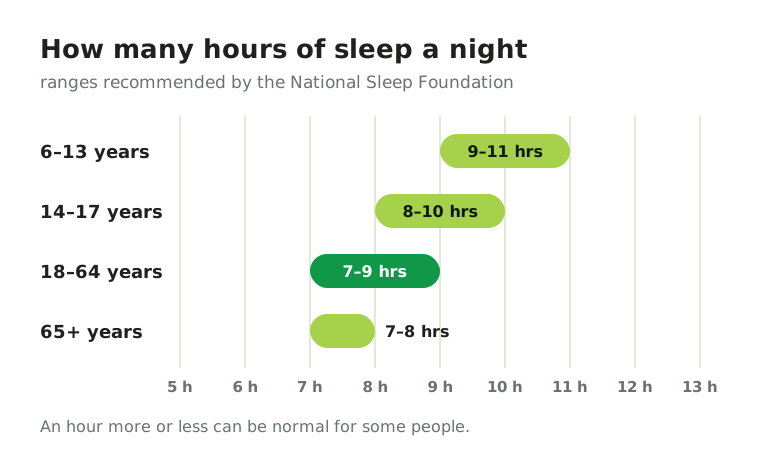
The range is a target, not a rule to the minute. Some people feel fine on 7 hours, others need 9. What matters most is that your hours are steady, night after night, not caught up at the weekend.
How do you know whether you sleep enough?
The clock on your bedside table tells only part of it. The next day tells the rest. You probably sleep too little if:
- you need an alarm and a few snoozes to get up;
- you sleep two hours longer at the weekend than during the week;
- you nod off quickly in front of the TV or on the train in the afternoon;
- you are irritable, forgetful or crave sweets;
- you need coffee to function after lunch.
The simplest test is a one-week journal. In the evening, note when you go to bed; in the morning, when you wake up and how you feel, from 1 to 5. After 7 days you see the link for yourself.
That is exactly what the daily journal in your free MentorSano account does: you log your sleep in a few seconds, and the platform shows how it changes from week to week, next to movement, meals and energy.
What happens when you sleep too little?
You feel one bad night the next day, and it passes. Short sleep for weeks and months matters more. The American Academy of Sleep Medicine links regularly sleeping under 7 hours with:
- weight gain and obesity;
- diabetes and high blood pressure;
- heart disease;
- lower mood and depression;
- weaker immunity, more mistakes and more accidents.
Poor sleep also spoils the next day's choices. When you are tired, you eat more, pick sweets more often and move less. That is the vicious circle: tired, more coffee and later in the day, worse sleep.
What helps you sleep better?
The UK's National Health Service (NHS) gives a few simple rules. Try them one at a time, one per week.
| What you do | Why it helps |
|---|---|
| Go to bed and wake up at the same time, weekends too | Your body clock sets itself by regularity. |
| Last coffee before 2 pm | Caffeine stays in the body for many hours. |
| Screens away an hour before bed | Light and what you read keep you awake. |
| A dark, quiet and cool bedroom | The body falls asleep more easily as temperature drops. |
| Daylight in the morning, 10–15 minutes | It tells the body when it is day, and so when it is night. |
| Little alcohol, not late in the evening | It helps you fall asleep but spoils the second half of the night. |
| Movement during the day | Active people usually fall asleep more easily. |
Does a sleep-tracking ring or watch help?
It can help you see the trend. Watches and rings estimate how long you sleep from movement and heart rate. They are fairly good at sleep duration and bedtime. They get sleep stages (deep, REM) wrong more often, so do not worry about one night with “little deep sleep”.
Use the numbers for trends over weeks, not for a single night. And put them next to how you feel: waking up rested matters more than a score.
What should you eat and drink in the evening to sleep better?
- Your last big meal 2–3 hours before bed. A heavy meal right before sleep can cause heartburn and restless sleep.
- No coffee, black or green tea or energy drinks in the afternoon. Caffeine is also in dark chocolate and some soft drinks.
- Little alcohol, and not late at night. It helps you fall asleep, but waking up in the second half of the night becomes more frequent.
- Fewer drinks in the last hour. That way you do not wake up to go to the bathroom.
- If you are hungry in the evening, a small snack helps more than going to bed hungry: a yoghurt, a banana, a few nuts.
Do afternoon naps help?
A short nap of 10–20 minutes in the early afternoon can restore energy without spoiling your night's sleep. Long naps or naps late in the day can make it harder to fall asleep at your usual time. If you need to sleep during the day every day, it is worth looking at how much and how well you sleep at night.
When to see a doctor
- You snore loudly and someone has noticed you stop breathing in your sleep.
- You fall asleep without wanting to during the day, for example while driving or in meetings.
- You cannot fall asleep or you wake up at night at least 3 times a week, for over 3 months.
- You have unpleasant feelings in your legs in the evening that make you move them.
- Poor sleep comes with sadness, anxiety or thoughts you cannot switch off.
Frequently asked questions
Is 6 hours of sleep enough?
For most adults, no. The American Academy of Sleep Medicine recommends at least 7 hours a night. Few people do well on less, and most who think they do have simply got used to being tired.
Can I catch up on sleep at the weekend?
Partly. Sleeping longer on Saturday helps after a hard week, but it does not erase the effects of short sleep every day. And it pushes back your Sunday bedtime.
Is sleeping too much bad?
If you regularly sleep over 9–10 hours and still feel tired, it is worth talking to your doctor. It can be a sign of poor-quality sleep or another problem.
What time should I go to bed?
There is no right time for everyone. Pick the wake-up time you need and count back 7–9 hours. Then keep it as steady as you can.
Does melatonin help me sleep better?
It can help in some situations, such as jet lag, but it is not the answer to everyday poor sleep. Before taking it regularly, talk to your doctor or pharmacist, especially if you take other medicines.
Start from where you are today
MentorSano brings together your blood tests, sleep, meals, movement and habits, and Adrian Ienin checks your plan before it reaches you.
- 15-minute questionnaire
- Blood tests, explained
- Daily journal
- Lesson of the day
- An expert by your side
Adrian Ienin
Naturopathic pharmacist, nutrition and holistic health consultant, co-founder of MentorSano. He checks the articles here and the plans in the platform before they reach people.