How to fall asleep faster: what actually works, according to research
 Checked by Adrian Ienin, pharmacist · updated
If you want to know how to fall asleep faster, start with two things: get up at the same time every day, and only go to bed when you feel sleepy. If you are still awake after about 20 minutes, get up, do something quiet in dim light and go back when sleep comes. These rules are part of cognitive behavioural therapy for insomnia, which US sleep doctors recommend as the first choice.
Want to see what this means for you? Start for free →
Why can't I fall asleep even when I'm tired?
Being tired and being sleepy are not the same thing. After a hard day you can be worn out while your brain is still running: going over tomorrow's to-do list, replaying a conversation, checking your phone one more time.
There is another mechanism many people don't know about. If you often lie in bed awake and frustrated, your brain starts to link the bed with being awake and worried. The next evening, just getting into bed wakes you up. Much of the advice below comes from that.
What do sleep doctors recommend for insomnia?
In 2021, the American Academy of Sleep Medicine published a guideline on non-drug treatments for long-term insomnia. Its strongest recommendation was cognitive behavioural therapy for insomnia (CBT-I). It is done with a specialist, usually over a few sessions, but you can try some of its rules on your own.
The guideline also says something that surprises people: general “sleep hygiene” tips on their own are not enough for long-term insomnia. They help, but they work better alongside the rules below.
The bed rule: what to do when you can't sleep
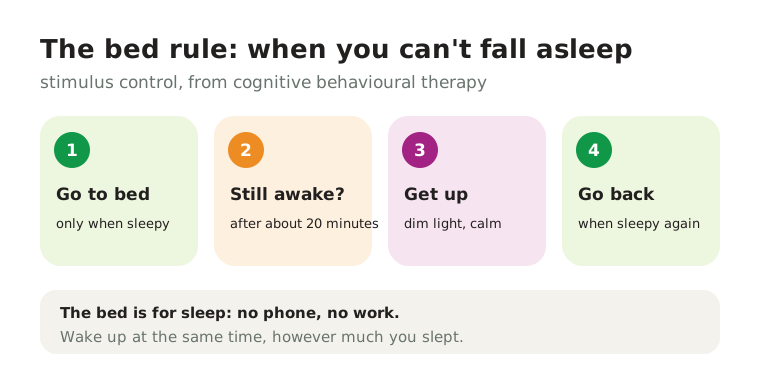
- Go to bed only when you're sleepy, not just because it's time.
- Don't watch the clock. If it feels like a long while, around 20 minutes, has gone by without sleep, stop trying.
- Get up and go to another room. Keep the light low and do something quiet: read a paper book, listen to something calm. No phone, no work.
- Go back to bed when you feel sleepy. If you still can't sleep, repeat.
- Get up at the same time in the morning, however little you slept, and don't linger in bed.
The first few nights can be hard, because you sleep less. After a week or two, most people fall asleep faster, because the bed becomes a place for sleep again.
Why does a fixed wake-up time matter?
Your body clock sets itself by the time you wake up and see daylight, more than by the time you go to bed. If you get up at 7 on weekdays and at 11 at the weekend, your body goes through a small dose of jet lag every Monday.
Pick a wake-up time you can keep at the weekend too, give or take an hour. Get some daylight in the morning, 10 to 15 minutes. Within a few days, the time you start feeling sleepy in the evening tends to settle on its own.
To see whether anything changes, the daily journal in your free MentorSano account keeps track of your bedtime, wake-up time and how you feel, and after a week you can see the pattern.
What does a good evening routine look like?
| When | What you do |
|---|---|
| afternoon | last coffee or caffeinated tea before 2 pm |
| 2–3 hours before | last big meal; little or no alcohol |
| 1 hour before | dimmer lights, screens away, tomorrow's tasks written on paper |
| 30 minutes before | something calming: a warm shower, reading, light stretching, slow breathing |
| at bedtime | a dark, quiet and cool bedroom |
You don't have to get every step right. What helps is doing them in the same order each evening, so your body learns that sleep comes next.
How do you quiet the thoughts that keep you awake?
- Write them down before bed. A list of what you need to do tomorrow, or of what's bothering you, gets things out of your head and onto paper.
- Slow breathing. Breathe in through your nose for a count of 4 and out slowly for 6. A few minutes of this slows your pulse.
- Relax your muscles one by one. Gently tense the muscles in one part of your body for a few seconds, then let them go, working from your feet up to your face.
- Don't fight it. The harder you try to fall asleep, the harder it gets. Tell yourself it's fine to just lie there and rest.
What should you avoid?
- long or late afternoon naps, if you struggle to fall asleep at night;
- your phone in bed, even “just to check something”;
- staying in bed late in the morning to catch up;
- alcohol as a sleep aid: it knocks you out, but it disrupts the second half of the night;
- sleeping pills taken without your doctor's advice.
When to see a doctor
- You struggle to fall asleep or wake up at night at least 3 times a week, for more than 3 months, and feel bad during the day.
- You snore loudly or someone has noticed you stop breathing in your sleep.
- You get unpleasant feelings in your legs in the evening that make you move them.
- Your insomnia comes with low mood, anxiety or thoughts you can't switch off.
- You already take sleeping pills and want to come off them.
Frequently asked questions
How long should it take to fall asleep?
Most people fall asleep in 10 to 20 minutes. If you drop off within seconds every night, it may be a sign you're not getting enough sleep. If it regularly takes you more than half an hour, the rules in this article may help.
Does counting sheep work?
For some people, any dull mental task helps. Others do better with slow breathing or picturing a calm place in detail. Try a few and keep what works for you.
Is it OK to read on my phone before bed?
Better not. The screen light and what you read keep you awake, and the phone tempts you to check one more thing. A paper book in dim light is a better choice.
What if I wake up at 3 am and can't get back to sleep?
The same rule applies: if about 20 minutes pass and you're still awake, get up, do something quiet and go back when sleep comes. Don't look at the clock or start working out how much sleep you have left.
Do evening herbal teas or warm milk help?
A warm caffeine-free drink can be part of a routine that calms you down. Most of the effect comes from the ritual rather than the drink. Just skip black tea, green tea and coffee in the afternoon.
Start from where you are today
MentorSano brings together your blood tests, sleep, meals, movement and habits, and Adrian Ienin checks your plan before it reaches you.
- 15-minute questionnaire
- Blood tests, explained
- Daily journal
- Lesson of the day
- An expert by your side
Adrian Ienin
Naturopathic pharmacist, nutrition and holistic health consultant, co-founder of MentorSano. He checks the articles here and the plans in the platform before they reach people.