High TSH: what it says about your thyroid and which tests come next
 Checked by Adrian Ienin, pharmacist · updated
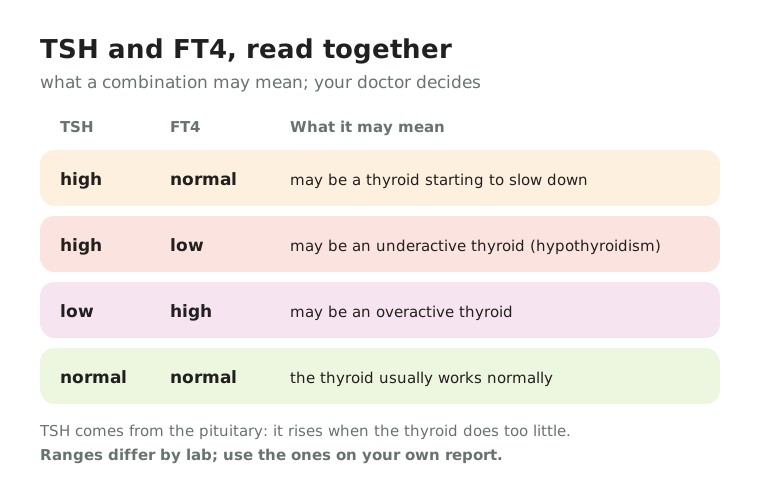
A high TSH usually means your thyroid is making too few hormones, and the pituitary gland is “pushing” it to work harder. It is always read next to FT4: with a normal FT4 it may be a thyroid that is just starting to slow down; with a low FT4 it is a thyroid working too slowly. The most common cause is autoimmune inflammation of the thyroid, which anti-TPO antibodies can show. Your doctor interprets the value.
Want to see what this means for you? Start for free →
What is TSH and why does it rise?
TSH (thyroid-stimulating hormone) does not come from the thyroid. It is made by the pituitary, a small gland at the base of the brain, to tell the thyroid how hard to work.
It works a bit like a thermostat. When there are enough thyroid hormones in the blood, the pituitary makes little TSH. When there are too few, it makes more TSH to speed the thyroid up. That is why a high TSH usually points to a thyroid doing too little, and a low TSH to one doing too much.
The thyroid makes two main hormones, T4 and T3. They set how fast your cells “burn” energy: heart rate, body temperature, weight, digestion, mood.
How is TSH read next to FT4?
TSH alone tells only half the story. Your doctor almost always reads it next to FT4, the free T4, which is the part of the hormone that does the work.
The TSH reference range differs from lab to lab, and values can vary from day to day. That is why doctors often repeat the test after a few weeks before drawing a conclusion, especially when TSH is only slightly above the range.
What does a high TSH with a normal FT4 mean?
When TSH is above the range but FT4 is still normal, doctors talk about a thyroid working a little more slowly than it should, before the hormones have dropped. Many people feel nothing at this stage.
Not every slightly high TSH is a problem that needs treating. It can rise temporarily after an illness, in older age or because of certain medicines. Your doctor looks at how high TSH is, at the antibodies, at your symptoms and, for women, at whether there is a pregnancy or plans for one. Sometimes they simply recommend repeating the test in a few months.
If you already have your report, upload it to your free MentorSano account. You see TSH, FT4 and the antibodies together and how they change from one test to the next, with the explanation checked by a pharmacist.
What symptoms can an underactive thyroid cause?
The UK's National Health Service (NHS) lists the most common signs. They usually come on slowly, over months or years, and look like many other things:
- tiredness and sleepiness;
- feeling cold more often than others;
- weight gain without a change in diet;
- constipation;
- dry skin, dry hair or hair loss;
- aches and muscle cramps;
- low mood, harder concentration;
- heavy or irregular periods.
None of these signs on its own means the thyroid is to blame. Too little sleep, low iron or stress cause the same things. That is why the tests matter, not just the symptoms.
Which tests follow a high TSH?
| Test | Why |
|---|---|
| FT4 (free T4) | shows whether the thyroid hormone has already dropped |
| Anti-TPO (thyroid antibodies) | shows whether it is autoimmune inflammation, the most common cause |
| Repeat TSH | confirms the value after a few weeks |
| Thyroid ultrasound | your doctor asks for it if the thyroid feels enlarged or has nodules |
| FT3 | sometimes, in specific situations; usually not one of the first steps |
High anti-TPO antibodies together with a high TSH are the usual picture of autoimmune thyroiditis (Hashimoto's). The American Thyroid Association calls it the most common cause of an underactive thyroid in countries where dietary iodine is sufficient.
What can affect the test result?
- Biotin (vitamin B7) in high doses, from hair and nail supplements, can give false results on some thyroid tests. Tell the lab if you take it. MedlinePlus advises asking your doctor whether to stop it a few days before.
- Some medicines, such as amiodarone, lithium or steroids, can change the values.
- A recent illness can temporarily push TSH up or down.
- Pregnancy changes the ranges; doctors use different reference values.
- If you already take thyroid hormone, the timing of the test compared with your tablet matters. Ask your doctor.
What can you do, besides treatment?
Treatment, when it is needed, is set by an endocrinologist or your GP. Alongside it, a few things help you feel better and follow what is happening:
- keep all your lab reports, so you see the trend, not just one value;
- note your energy, sleep and weight to show your doctor at check-ups;
- do not take iodine or “thyroid support” supplements on your own: too much iodine can upset thyroid function too;
- eat a varied diet and sleep enough; tiredness often has several causes at once.
When to see a doctor
- Your TSH is above your lab's range, with or without symptoms.
- You are pregnant, planning a pregnancy or have recently given birth and your TSH is outside the range.
- You feel a swelling in your neck, have trouble swallowing or hoarseness that does not go away.
- You already take thyroid treatment and your results come out of range.
- You have severe tiredness, feel cold, have a slow pulse or a puffy face.
Frequently asked questions
What is a normal TSH level?
The one within the range printed on your lab report. Many labs use a range of around 0.4–4 mIU/L, but the limits differ. Different values are used in pregnancy.
Does a high TSH mean I have Hashimoto's?
Not necessarily. Hashimoto's is the most common cause, and anti-TPO antibodies can show it. But TSH can also rise for other reasons, some of them temporary. Your doctor decides based on your other results.
Can I lower my TSH through diet alone?
No diet fixes an underactive thyroid on its own. A varied diet helps your overall health, but treatment, when needed, is set by your doctor.
Do I need to fast for the test?
It is usually not required for TSH, but many labs take the sample in the morning, along with other tests. If you take thyroid hormone or biotin, ask your doctor what to do before the test.
Does TSH change in pregnancy?
Yes. In pregnancy, especially in the first months, normal TSH values are different, and the need for thyroid hormone rises. That is why a woman who is pregnant or planning a pregnancy should discuss her thyroid tests with her doctor, even if they were fine before.
Start from where you are today
MentorSano brings together your blood tests, sleep, meals, movement and habits, and Adrian Ienin checks your plan before it reaches you.
- 15-minute questionnaire
- Blood tests, explained
- Daily journal
- Lesson of the day
- An expert by your side
Adrian Ienin
Naturopathic pharmacist, nutrition and holistic health consultant, co-founder of MentorSano. He checks the articles here and the plans in the platform before they reach people.