Sitting too much: what it does to your body and how to offset it
 Checked by Adrian Ienin, pharmacist · updated
Sitting too much is linked with a higher risk of heart disease, diabetes and early death, especially in people who move little. An analysis of over a million adults, published in The Lancet, found, however, that 60 to 75 minutes a day of moderate activity, such as brisk walking, almost wipes out the risk linked to sitting. Breaks help too: stand up at least once an hour.
Want to see what this means for you? Start for free →
Why is sitting for long periods a problem?
When you sit for a long time, the big muscles in your legs and back barely work. Your body uses less energy, and glucose and fats in the blood are used more slowly. Over the long term, that's linked with weight gain, type 2 diabetes and heart disease.
The UK's National Health Service (NHS) also lists back and neck pain, especially when you stay in the same position for a long time, and a gradual loss of muscle strength.
Many adults with desk jobs sit for 8 to 10 hours a day, once you add the commute, meals and evenings in front of the TV.
Can movement make up for sitting too much?
In 2016, The Lancet published an analysis of 16 studies with over a million adults followed for years. The researchers compared people by how much they sat and how much they moved.
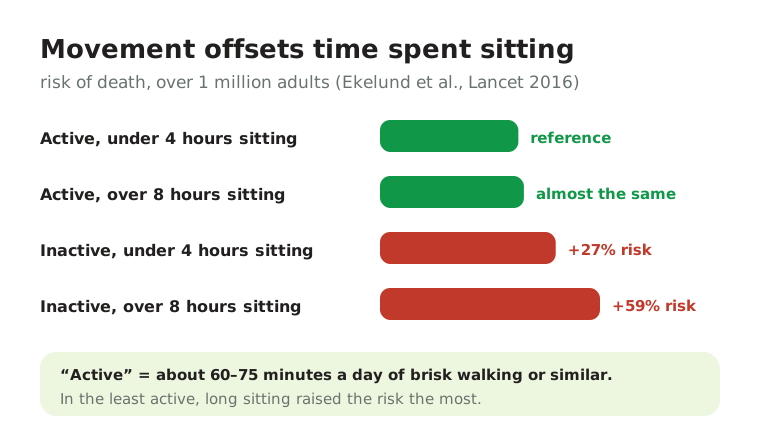
What they found:
- in very active people, with around 60–75 minutes of moderate activity a day, sitting for more than 8 hours barely raised the risk of death;
- in those who moved very little, the risk was higher even when they sat for short periods;
- the riskiest combination was long hours of sitting and very little movement: 59% higher than in active people;
- watching TV for 3 hours or more a day raised the risk in almost everyone, except the very active.
It's an observational study, so it shows a link and doesn't prove the cause on its own. Its practical message is clear, though: if you sit a lot because of your job, the movement in the rest of your day matters enormously.
How much movement do you need?
The World Health Organization recommends 150 to 300 minutes a week of moderate activity for adults and, where possible, less time spent sitting. For people who sit a great deal, the WHO says it's good to aim for the top end of that range.
60 minutes a day can sound like a lot. It doesn't have to be done in one go. It could be a 20-minute walk in the morning, 15 minutes after lunch, the stairs, walking to the shop and a stroll in the evening.
To see how much you sit and how much you actually move, your free MentorSano account puts small movement steps on your daily to-do list, and the journal shows your steps next to your sleep and energy.
What can you do at your desk?
| Habit | How to do it |
|---|---|
| A break every hour | stand up for 2–3 minutes: a glass of water, a walk to the window, a few stretches |
| Phone calls on your feet | talk on the phone while walking around the office or down the corridor |
| Short meetings, standing or walking | a chat between two colleagues can happen on the move |
| The printer and water further away | every trip adds a few steps |
| A walk after lunch | 10–15 minutes; it also helps blood sugar after a meal |
| A sit-stand desk | switch between the two; standing for hours on end isn't ideal either |
A reminder on your phone or watch every hour helps at first, until the break becomes a habit.
And at home, in the evening?
Evenings tend to add up to many hours in front of screens. A few ideas:
- stand up during every break between episodes;
- do a few simple exercises while you watch: getting up from the sofa, calf raises;
- a short walk after dinner, instead of the first episode;
- housework counts too: cooking, cleaning, gardening.
How can you tell how long you really sit?
Many watches and phones show the hours when you didn't walk at all, or nudge you when you've sat too long. You can also try a simple exercise: on a typical day, note the hours spent sitting at work, in the car, at meals and in the evening. Many people find they go past 10 hours.
When to see a doctor
- You have back or neck pain that doesn't ease with breaks and movement.
- You have swelling, pain or redness in one leg after sitting for a long time, for example after a long journey: it could be a clot and needs to be seen quickly.
- You have heart disease or painful joints and want to start moving a lot more.
- You feel dizzy when you stand up from a chair.
Frequently asked questions
How long is it healthy to sit each day?
There's no exact number. Studies show the risk rises mostly when you sit a lot and move little. Try to stand up at least once an hour and get about an hour of movement a day.
Does going to the gym after a day at the office help?
Yes. The Lancet analysis showed that plenty of activity largely offsets the time spent sitting. Short breaks during the day help too, especially for your back and blood sugar.
Is a standing desk healthier?
It can help if you switch between sitting and standing. Standing for hours on end can cause leg and back pain too. It's best to change position often and keep moving.
Does time in front of the TV count?
Yes. In the same analysis, watching TV for 3 hours or more a day was linked with a higher risk even in fairly active people.
How many hours of sitting are too many?
In the Lancet analysis, the risk rose mainly with more than 8 hours a day combined with little movement. It's not a strict limit, but if you often go past 8 hours, make sure you take breaks and move more in the rest of the day.
Start from where you are today
MentorSano brings together your blood tests, sleep, meals, movement and habits, and Adrian Ienin checks your plan before it reaches you.
- 15-minute questionnaire
- Blood tests, explained
- Daily journal
- Lesson of the day
- An expert by your side
Adrian Ienin
Naturopathic pharmacist, nutrition and holistic health consultant, co-founder of MentorSano. He checks the articles here and the plans in the platform before they reach people.