How accurate is your sleep tracker, and how should you use the numbers?
 Checked by Adrian Ienin, pharmacist · updated
A sleep tracker, whether a watch or a smart ring, is fairly good at telling when you're asleep and how long you slept. A 2021 study that compared seven such devices with measurements from a sleep lab found, however, that they struggle to spot the times you're awake at night and that their sleep stage estimates (deep, REM) are unreliable. Use the numbers for trends over weeks and set them alongside how you feel.
Want to see what this means for you? Start for free →
How does a sleep tracker know you're asleep?
A watch or ring doesn't “see” your brain. It looks at movement, using an accelerometer, and at your pulse, using a light that shines through the skin. Some also measure skin temperature or blood oxygen. From all of this, software estimates whether you're asleep and which stage of sleep you're in.
In a sleep lab, the full test is called polysomnography. It measures brain activity, eye movements and muscle tone directly. Sleep stages are defined from those signals, which is why a device on your wrist can only approximate them.
What does research say about accuracy?
In 2021, the journal Sleep published a study in which 34 young adults spent three nights in a lab wearing several devices at once: bands, watches and bedside sensors. The results were compared with polysomnography.
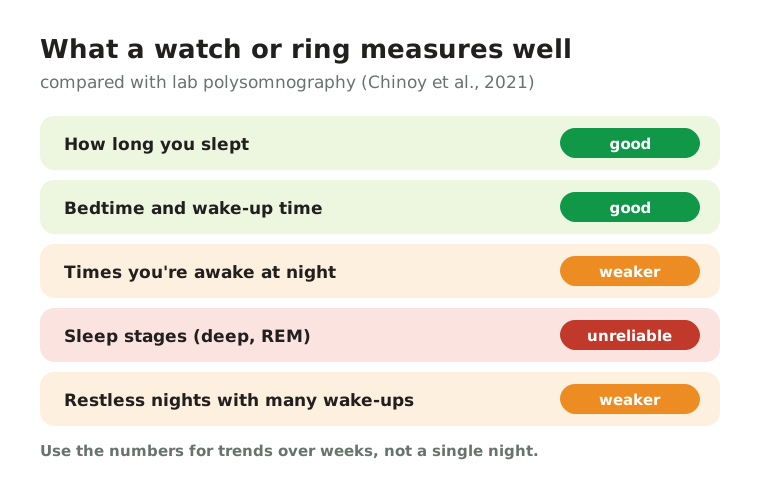
- They recognised sleep very well. When someone was asleep, the devices almost always said so.
- They found it harder to catch time awake. When someone was awake but lying still, many devices thought they were asleep.
- Sleep stages came out inconsistently, differently from one device to another.
- On restless nights, with many wake-ups, they all did worse.
The authors concluded that many newer devices look promising for tracking sleep and wake, but that they need testing in other groups too, not just young, healthy adults.
What does this mean for you?
Your tracker tells you fairly well when you fell asleep, when you woke up and roughly how long you slept. It's less precise about how long you lay awake at 3 am, and you can hardly rely on it for how many minutes of deep sleep you had.
So there's no point worrying about one night with “little deep sleep” or a low score. Sometimes worrying about the numbers spoils sleep in itself. Researchers have even given a name to people sleeping worse because they're preoccupied with their sleep data: orthosomnia.
To put the numbers in context, the daily journal in your free MentorSano account also asks how you feel in the morning, and after a few weeks you can see whether what your tracker shows matches your energy.
How do you use the numbers so they help?
| Number | How far you can trust it | How to use it |
|---|---|---|
| Bedtime and wake-up time | fairly well | see whether you keep a regular schedule, weekends included |
| Total sleep time | fairly well, especially as an average | follow the 7-day average, not one night |
| Resting heart rate overnight | usually well | notice if it rises several days in a row, for example after alcohol, illness or stress |
| Wake-ups during the night | less so | look at the trend, not the number |
| Deep and REM sleep | unreliable | don't make decisions based on them |
| Sleep score | varies by device | compare yourself only with yourself, on the same device |
What can you learn from trends?
The real value of a sleep tracker shows up after a few weeks. That's when you can see things you'd otherwise miss:
- that you sleep an hour less on weekdays than you think;
- that on evenings with alcohol your night-time heart rate is higher and your sleep shorter;
- that on days you move more, you fall asleep faster;
- that your bedtime drifts later and later towards the end of the week.
You see all of this from trends, not from a single night.
When isn't a tracker enough?
Consumer devices don't diagnose anything. They can't tell you on their own whether you have sleep apnoea or insomnia. If you snore loudly, wake up gasping or are very sleepy during the day, you need a consultation and sometimes a sleep recording arranged by a doctor. Some watches give oxygen or breathing alerts, but an alert is just a reason to see a doctor.
When to see a doctor
- You snore loudly, wake up feeling like you're choking, or someone has noticed you stop breathing in your sleep.
- You're very sleepy during the day, even though your tracker says you slept enough.
- Your watch often alerts you to low oxygen or an irregular pulse.
- You've struggled to fall asleep or kept waking up for more than three months.
- Worrying about your sleep numbers keeps you awake at night.
Frequently asked questions
How accurate is a smart ring for sleep?
Newer rings and watches recognise well when you're asleep and how long you slept. They're less precise about time awake during the night and about sleep stages. Use them for trends, not single nights.
How much deep sleep is normal?
In adults, deep sleep usually takes up a small part of the night and decreases with age. Because trackers estimate it unreliably, don't worry if your device shows low values. Waking up rested matters more.
Why does my tracker say I was asleep when I was awake?
Because you were lying still. Trackers rely heavily on movement and pulse, and when you lie quietly in bed they often think you're asleep. Studies have found exactly this weakness.
Is it worth buying a sleep tracker?
It can be useful if it helps you keep a regular schedule and see trends. If it makes you worry about every night, you're better off with a simple journal and how you feel.
What if my tracker says I slept badly but I feel fine?
Trust how you feel more. The tracker is estimating, and a night with poor numbers doesn't necessarily mean you rested badly. If you feel fine several days in a row, your sleep is probably OK.
Do I need to wear it every night?
Not necessarily. To see trends, wearing it most nights is enough. If it bothers you while you sleep, you can take breaks, for example one week a month.
Start from where you are today
MentorSano brings together your blood tests, sleep, meals, movement and habits, and Adrian Ienin checks your plan before it reaches you.
- 15-minute questionnaire
- Blood tests, explained
- Daily journal
- Lesson of the day
- An expert by your side
Adrian Ienin
Naturopathic pharmacist, nutrition and holistic health consultant, co-founder of MentorSano. He checks the articles here and the plans in the platform before they reach people.