Tiredness and coffee: how they link to poor sleep and how to break the loop
 Checked by Adrian Ienin, pharmacist · updated
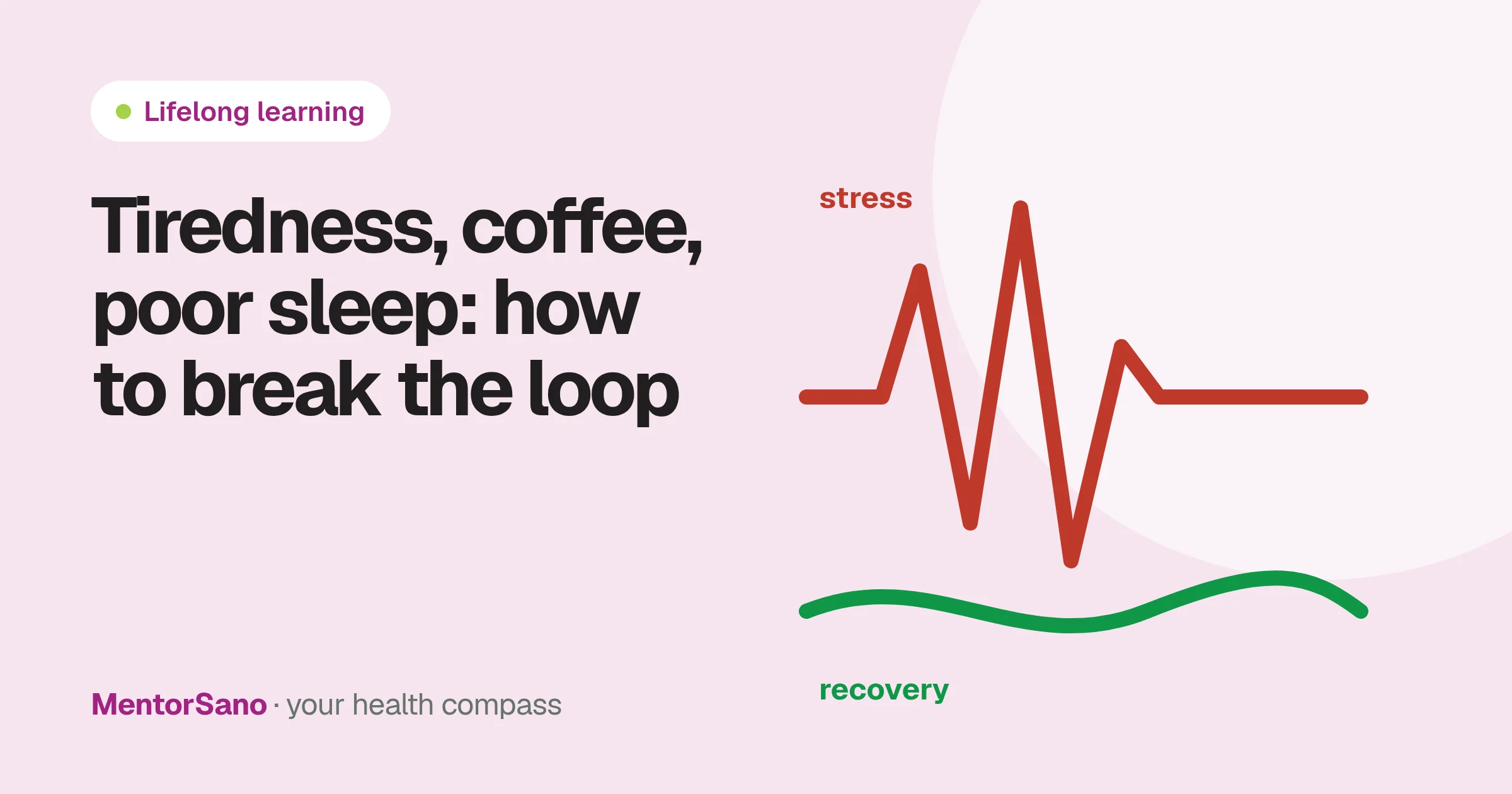
Tiredness and coffee, then poor sleep, then even more tiredness: it's one of the most common loops that keep themselves going. Coffee itself isn't the problem. EFSA considers up to 400 mg of caffeine a day safe for healthy adults, about 3–4 cups of coffee. The problem is timing: caffeine taken even 6 hours before bed reduces sleep. The easiest link to break is usually the last coffee of the day.
Want to see what this means for you? Start for free →
How does the loop between tiredness and coffee work?
It goes roughly like this:
- You sleep badly or too little.
- The next day you're tired and drink more coffee, including in the afternoon.
- The caffeine stays in your body until evening and makes your sleep shorter and lighter.
- The next day you're even more tired and drink even more coffee.
Each step seems logical. Together, they make a loop that keeps tightening. And often you don't notice, because you fall asleep easily enough; it's just that the sleep is poorer.
What does caffeine do in the body?
Through the day, a substance called adenosine builds up in the brain and makes you feel the need to sleep. Caffeine blocks the places where adenosine should act. That's why you feel more alert, even though the tiredness is still there, only covered up.
Caffeine stays in the body for many hours. A study published in 2013 gave people a large dose of caffeine (400 mg) at bedtime, 3 hours before or 6 hours before. In all three cases, sleep was worse than without caffeine. The authors advised against large amounts of coffee in the 6 hours before bed.
How much coffee is fine?
The European Food Safety Authority (EFSA) considers that, for healthy adults, up to 400 mg of caffeine a day and up to 200 mg at a time raise no concerns. For women who are pregnant or breastfeeding, the limit is 200 mg a day.
| Drink | Caffeine, roughly |
|---|---|
| A mug of filter coffee (200 ml) | 90 mg |
| An espresso | 80 mg |
| A cup of black tea | 50 mg |
| A can of energy drink (250 ml) | 80 mg |
| A can of cola (330 ml) | 40 mg |
Values vary a lot with the coffee and how it's made, so the table is only a guide. For most people, 3–4 cups a day are fine, as long as they're drunk in the morning and at lunchtime.
Which link do you break first?
You don't have to give up coffee. Moving the last cup is enough:
- Last coffee before 1–2 pm, if you go to bed around 11 pm.
- In the afternoon, decaf or a herbal tea, if you like the ritual.
- When the after-lunch dip hits, try 10 minutes of walking or a glass of water first.
- In the morning, have your coffee after breakfast rather than the moment you wake up, if you like; some people then feel less need for another.
After a week or two, many people notice they fall asleep more easily, wake up more rested and need less coffee the next day. The loop comes apart on its own.
How do you cut down on coffee without headaches?
If you've drunk a lot of coffee for a long time, stopping suddenly can bring a few days of headaches, tiredness and irritability. It isn't dangerous, but it's unpleasant, and many people go back to coffee just to get rid of it. It's easier step by step:
- Week 1: move your last coffee before 2 pm, without changing how many you have.
- Week 2: swap one of your coffees for a decaf or a tea.
- Week 3: drop one more, if you feel you need less.
Drink water during these days. Sometimes part of the afternoon tiredness is actually thirst. And don't judge yourself if you have an extra coffee on a hard day. What counts is what you do on most days.
What do you learn from this loop?
That health problems rarely come alone. Tiredness, coffee, sleep, sugar cravings and lack of movement are all linked. That's why one small step, in the right place, can change more than ten rules brought in at once. Learning how things connect for you is the most useful part.
How does MentorSano help you break the loop?
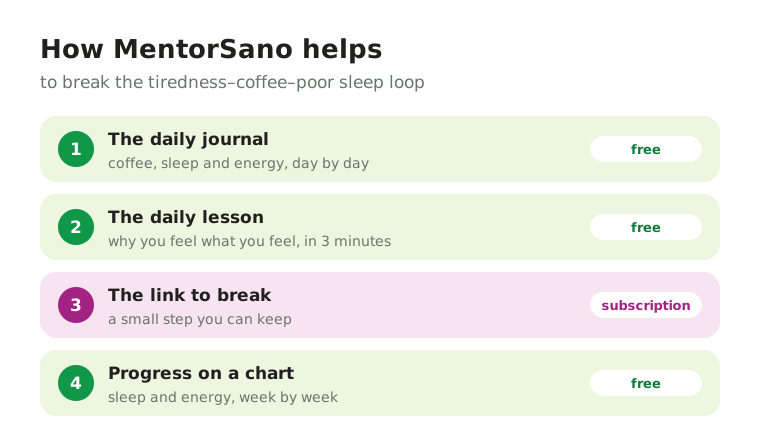
- The daily journal keeps your coffee, sleep and energy, day by day, in a minute or two.
- The daily lesson explains in a few minutes why you feel what you feel, linked to what you're working on.
- Progress on a chart: sleep and energy have scores calculated from your journal, so you see for yourself whether moving your coffee changed anything.
- With the subscription, the plan checked by an expert finds the link to break for you: a small step you can keep, linked to all your other data.
The journal and the lessons are free. Create your free MentorSano account and for two weeks note the time of your last coffee next to how you slept.
When to see a doctor
- You get palpitations, tremor or anxiety after coffee.
- You're pregnant or breastfeeding and don't know how much coffee you can have.
- You have high blood pressure, an irregular heartbeat or reflux and drink a lot of coffee.
- The tiredness doesn't go away after a few weeks, even if you sleep better.
- You need coffee to get through the day, even though you sleep enough.
Frequently asked questions
How many coffees a day are healthy?
EFSA considers up to 400 mg of caffeine a day safe for healthy adults, about 3–4 cups of coffee, depending on how strong it is. In pregnancy and while breastfeeding, the limit is 200 mg.
Until what time can I drink coffee?
A study showed that a large dose of caffeine spoils sleep even 6 hours later. If you go to bed around 11 pm, it's best to have your last coffee before 1–2 pm.
Does decaf affect sleep?
Very little, because it contains little caffeine. It's a good choice if you like the taste or the afternoon ritual.
Why don't I feel the effect of coffee any more?
Your body gets used to caffeine if you drink a lot, often. Then you need more and more for the same effect. Cutting down gradually helps.
Can I give up coffee suddenly?
You can, but many people get a few days of headaches and tiredness. Cutting down gradually, one cup fewer every few days, is easier.
Does green tea contain caffeine?
Yes, but less than coffee, usually 30–50 mg a cup. In the evening a caffeine-free herbal tea is a better choice.
Start from where you are today
MentorSano brings together your blood tests, sleep, meals, movement and habits, and Adrian Ienin checks your plan before it reaches you.
- 15-minute questionnaire
- Blood tests, explained
- Daily journal
- Lesson of the day
- An expert by your side
Adrian Ienin
Naturopathic pharmacist, nutrition and holistic health consultant, co-founder of MentorSano. He checks the articles here and the plans in the platform before they reach people.