No time to exercise? What still works on a busy day
 Checked by Adrian Ienin, pharmacist · updated
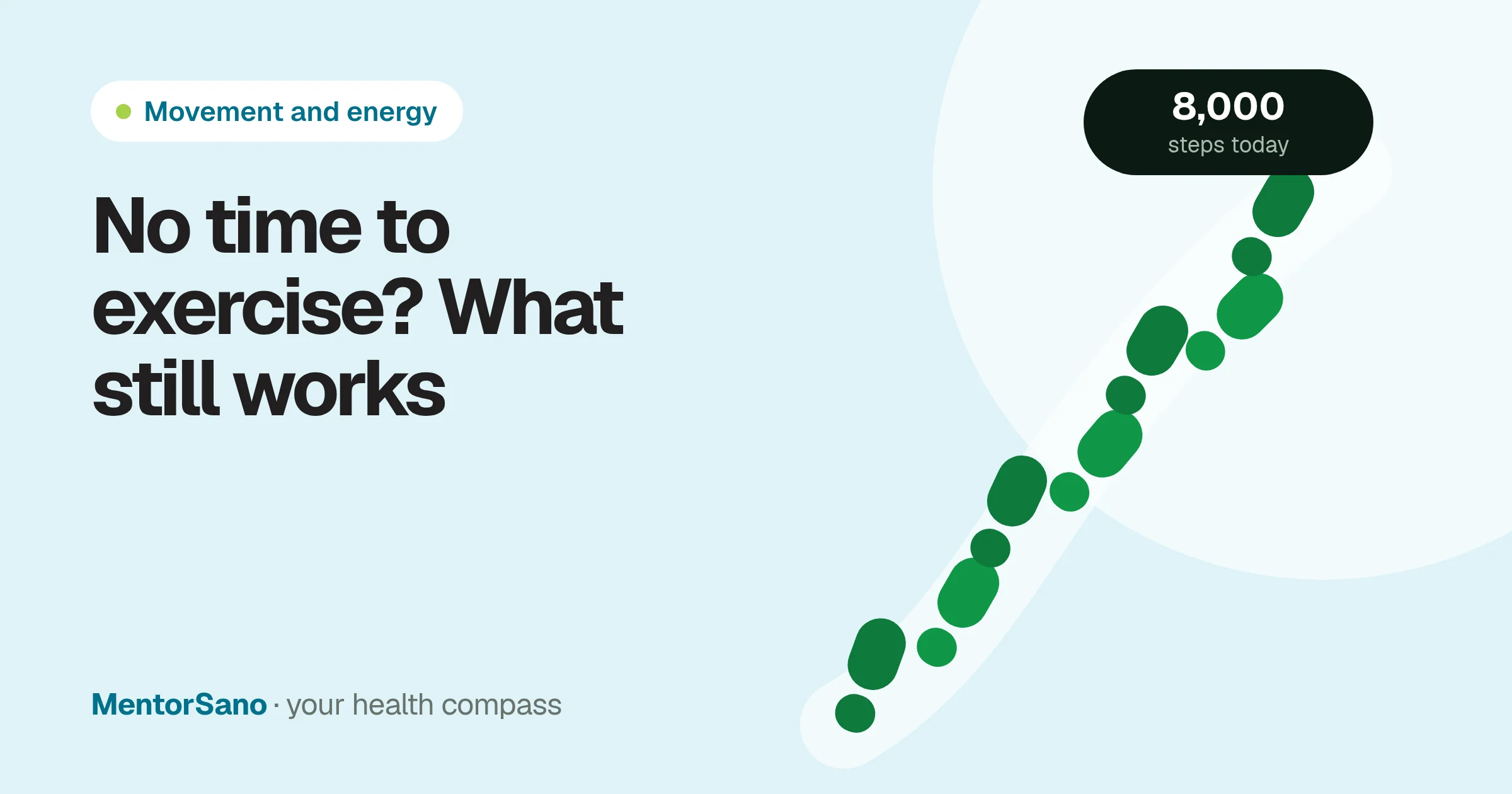
"I have no time to exercise" is the reason heard most often, and for many people it's true. You don't need an hour at the gym. The World Health Organization says every bit of movement counts, and 150 minutes of moderate activity a week can be built from 10-minute pieces: a walk after lunch, the stairs, walking to the shop. The first step is to find two small pieces in the day you already have.
Want to see what this means for you? Start for free →
Why is there no time to exercise, really?
For many people the day really is full: work, commuting, children, the house, parents. Exercise ends up last because it feels like a big project: kit, getting to the gym, a free hour, a shower. When you don't have an hour, you give up altogether.
That's the trap. Movement doesn't have to be a big project to count. In its 2020 guidelines, the World Health Organization dropped the requirement for activity to come in bouts of at least 10 minutes and says plainly that any movement is better than none.
How much movement do you need?
The WHO recommends 150–300 minutes a week of moderate activity for adults, such as brisk walking, plus strength exercises twice a week. It sounds like a lot, but it comes to about 20–40 minutes a day in total.
Steps count too. An analysis published in The Lancet Public Health in 2022, covering more than 47,000 adults, found the biggest gain in people who went from few steps to a few more: from 3,500 to nearly 6,000 steps a day.
Where do you find 10 minutes in a full day?
| When | What you do | Minutes |
|---|---|---|
| After lunch | a walk around the building | 10 |
| The commute | get off a stop early or park further away | 5–10 |
| Work calls | take them standing up, walking | 5–15 |
| With the children | the park, cycling, a walk after school | 15–30 |
| At home, in the evening | a short strength circuit while the kettle boils | 5–10 |
| At the weekend | a longer walk with the family | 30–60 |
Don't do all of them. Pick two you can repeat almost every day and keep them for two weeks.
What do you do in very busy weeks?
- Lower the bar, don't give up. Instead of 30 minutes, do 10. The habit stays alive.
- Tie movement to something fixed. "After lunch, 10 minutes outside" is easier to keep than "I'll exercise when I have time".
- Move with someone. A walk with a friend or your partner is easier to keep up.
- Put it in your calendar like a meeting.
What does a full day with movement in it look like?
An example, for someone who works eight hours in an office and has children at home:
| When | Movement | Minutes |
|---|---|---|
| Morning | walk to the stop, or to the next one | 10 |
| At the office | stairs instead of the lift, calls standing up | 5 |
| After lunch | a short walk | 10 |
| Evening | playing outside with the children or a walk after dinner | 15 |
In total, about 40 minutes, with no gym and no separate time. Five days a week makes 200 minutes, above the WHO minimum of 150.
Not every day will look like this, and it doesn't have to. If you manage two of the four moments, you've still done more than on the day you waited for "a free hour".
What if you work shifts or from home?
On shifts, tie movement to the start or end of your shift rather than to a time of day: ten minutes of walking before you go in or after you come out. At home, set an alarm every hour and get up for a few minutes: a lap around the flat, a few squats, a stretch. And go out at least once a day, even if it's just to the shop.
How does MentorSano help when you have no time to exercise?
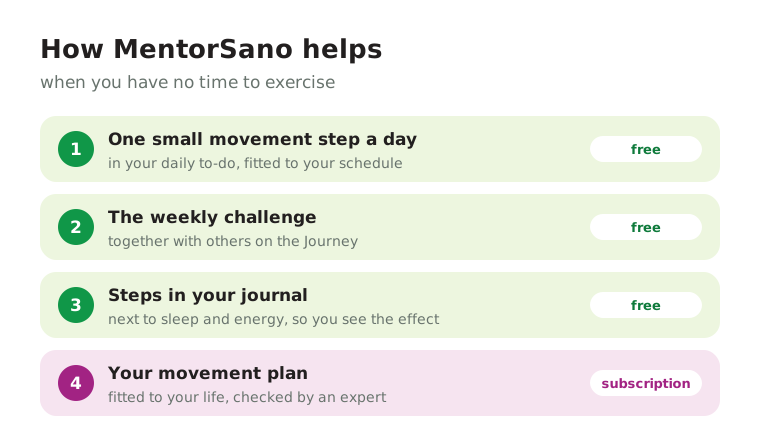
- Your daily to-do gives you one small movement step, matched to what you said about your schedule in the questionnaire. You tick it off when it's done.
- The weekly challenge is a small target you do together with others on the Journey.
- Steps in your journal sit next to sleep and energy, so you see for yourself what an extra walk changes.
- With the subscription you get a movement plan that fits your life, checked by an expert and linked to your sleep, meals and tests.
It all starts for free: create your free MentorSano account, fill in the questionnaire and get your first movement step, sized to your day.
Why is even a little worth it?
Movement helps with sleep, stress, blood sugar and blood pressure, and the effects start quickly. Many people sleep better and have more energy after a few weeks of short daily walks. You don't have to become sporty. You just have to move a little more than you do now.
When to see a doctor
- You have heart disease, untreated high blood pressure or diabetes and want to move a lot more.
- You get chest pain, dizziness or are very breathless with little effort.
- You have knee, hip or back pain that gets worse when you move.
- You're pregnant and haven't exercised regularly before.
Frequently asked questions
Do 10 minutes of exercise count?
Yes. The World Health Organization says every bit of movement counts. Several 10-minute pieces add up to the 150 minutes a week it recommends.
What can I do if I have no time for the gym?
Brisk walking, stairs, cycling and a few strength exercises at home are enough to start. You can fit them in small pieces through the day.
Does housework count as exercise?
Yes, especially the kind that keeps you moving: cleaning, gardening, carrying shopping home on foot. It's light or moderate activity, and it counts.
How long until I feel a difference?
Many people feel they sleep better and have more energy after 2–4 weeks of daily movement, even in short pieces.
Can I exercise only at weekends?
That counts too. Studies show benefits in people who do their activity on one or two days a week. But a few minutes every day helps more with sleep and energy.
Which kind of exercise helps most when I'm short of time?
Brisk walking is the easiest to fit into the day. If you have 10 minutes at home, a few bodyweight exercises, such as squats, wall push-ups and lunges, also work your muscles.
Start from where you are today
MentorSano brings together your blood tests, sleep, meals, movement and habits, and Adrian Ienin checks your plan before it reaches you.
- 15-minute questionnaire
- Blood tests, explained
- Daily journal
- Lesson of the day
- An expert by your side
Adrian Ienin
Naturopathic pharmacist, nutrition and holistic health consultant, co-founder of MentorSano. He checks the articles here and the plans in the platform before they reach people.