A healthy shopping list: how to build it from the week's meals
 Checked by Adrian Ienin, pharmacist · updated
A healthy shopping list starts from the week's meals, not from the offers in the shop. You write down 4–5 meals, list the ingredients with quantities, cross off what you already have and split the rest by aisle. You always keep a few things at home that don't spoil: frozen vegetables, tinned pulses, eggs, plain yoghurt, whole grains. Go after a meal, not hungry, and take an offer only if it's on the list.
Want to see what this means for you? Start for free →
Why do you leave the supermarket with something other than what you needed?
You go in without a list, thinking you'll "just get what's needed". You come out with three products on offer, a packet of biscuits and nothing you can make dinner from on Tuesday evening. On Thursday you order a takeaway, and on Friday you throw away a salad that has gone off in the fridge.
It isn't a question of willpower. Shops are laid out so you see the offers and ready-to-eat food first. Without a list, the shelf makes the decision. With a list written at home, from the week's meals, you make it, once, calmly.
A good list has three parts: what you need for the meals you've planned, what you always keep at home and what has run out. Below you'll go through them one by one.
How do you build a healthy shopping list from the week's meals?
The list comes after the menu, not before it. If you don't yet know what you'll cook, start with the article on healthy meal ideas: there you'll find the plate rule and simple meals you can repeat. Then:
- Write down 4–5 main meals for the coming week, plus what you'll have for breakfast and lunch.
- Take each meal and write down the ingredients, with the amount for however many people you cook for.
- Open the fridge, cupboard and freezer and cross off what you already have.
- Add what has run out from your fixed list (see below).
- Rewrite the list by aisle, in the order you walk through the shop.
Your first list will take about 20 minutes. Once you have a few weeks written down, you can reuse them: many meals repeat, so the lists do too.
How do you split the list by aisle?
A list arranged by aisle keeps you on your route through the shop and helps you not forget anything. The World Health Organization recommends at least 400 g of fruit and vegetables a day, which is about five portions of 80 g. For one person, over a week, that comes to around 2.8 kg. It's a good guide for the first aisle.
| Aisle | What goes on the list | What to look for |
|---|---|---|
| Fruit and vegetables | vegetables for the meals you've written down, fruit for snacks, fresh herbs | what's in season; anything that spoils quickly is for the first few days |
| Meat, fish, eggs | exactly the amount the meals need | fish at least twice a week; processed meat less often |
| Dairy | plain yoghurt, cheese, milk | yoghurt with no added sugar, which you sweeten yourself with fruit |
| Grains and bread | oats, brown rice, buckwheat, wholewheat pasta, wholemeal bread | "wholegrain" near the top of the ingredients list |
| Tins and cupboard | chickpeas, beans, lentils, tomatoes, tinned fish | in water or natural juice, with no added salt or sugar |
| Frozen | vegetables, berries, fish | without sauces or breadcrumbs |
Leave an "Other" line at the end for washing-up liquid, kitchen roll and anything else for the house. That way you don't walk past the sweets aisle looking for soap.
What should you always keep at home so you're never without dinner?
The fixed list is short and rarely changes. It saves you on the evening the plan falls apart. A few things that keep for a long time and that you can turn into a meal in 15 minutes:
- frozen vegetables: the NHS says frozen and tinned vegetables count towards your 5 A Day just like fresh ones;
- tinned pulses: chickpeas, beans, lentils, already cooked;
- eggs, for an omelette with frozen vegetables;
- plain yoghurt, for breakfast or a quick sauce;
- whole grains: oats, brown rice, wholewheat pasta.
The rule that keeps the fixed list stocked: when you open the last packet, write it on the list straight away, on your phone or on a sheet stuck to the fridge. More cupboard basics are in the table in healthy meal ideas.
How do you read the label quickly at the shelf?
You don't have time to read the whole packet for every product. For the things you buy often, look once at three things, then remember what you chose:
- the "per 100 g" column, not the portion set by the manufacturer, so you can compare two products with each other;
- the first ingredients on the list: they're in order of quantity, so the first one is the largest;
- sugar and salt, especially in yoghurts, breakfast cereals, sauces and bread.
The thresholds and the claims on the front of the pack are in the article on how to read food labels. Once you've found the right yoghurt, bread and tins, you don't need to read every time.
Why shouldn't you go shopping hungry?
When you're hungry, ready-to-eat food looks better than your list. Something "for the way home" goes into the basket, then something else. Go after a meal, or eat something small first: a yoghurt, an apple, a handful of nuts.
The time of day helps too. For the big shop, pick a moment when you're not in a hurry and the shop isn't packed. In a rush after work, you grab whatever is closest.
How do you stick to a budget without eating worse?
Healthy food doesn't mean expensive products. You save the most on what you don't throw away and what you don't buy on impulse.
| What you do | Why it helps |
|---|---|
| Buy only from the list | you don't pick up things that don't fit any meal |
| Take an offer only if it's on the list | a cheap product you throw away isn't cheap |
| Compare the price per kilo | the big pack isn't always cheaper |
| Use pulses and eggs as protein | they cost less than meat and keep well |
| Buy seasonal and frozen vegetables | they're cheaper and don't spoil |
| Cook double and freeze some | a ready portion means one takeaway fewer |
If you still end up ordering on busy evenings, the better choices on a restaurant menu are in the article on healthy takeaway.
How does MentorSano help with your healthy shopping list?
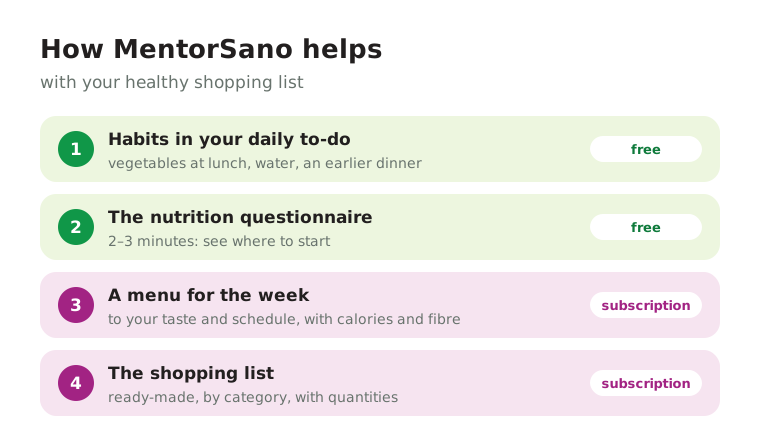
- For free, in your daily to-do you tick off small habits that change what goes into your basket: vegetables at lunch, water in the morning, an earlier dinner.
- For free, the short nutrition questionnaire shows you in two or three minutes where to start.
- With the subscription you get a menu for the week, built around your tastes, preferences and schedule, with calories, protein, fat, carbohydrates and fibre for every meal. It's normal food that's easy to make.
- The shopping list comes ready-made with the menu, split into categories and with quantities. You tick off what you've bought, you can download it, and you can order some of the products in one click.
Start with the free part: create your free MentorSano account, fill in the questionnaire and see which habits suit you. The menu and the list come only if you want them, with the subscription.
What do you do this week, for your first list?
- Pick a fixed day for the big shop and write down the meals the day before.
- Make the list by aisle, with quantities, and check the fridge before you leave.
- Put the fixed list on it: frozen vegetables, tinned pulses, eggs, yoghurt, whole grains.
- Eat something before you go into the shop.
- At the checkout, look in your basket: anything that isn't on the list needs a reason.
- The following Sunday, write down what you threw away. That's where you bought too much. Next time, write less.
After three or four weeks, the list almost writes itself. Keep the good lists and reuse them.
When to see a doctor
Everyday shopping isn't a medical matter. Still, see your GP or a dietitian if:
- you have diabetes, kidney or heart disease and need strict rules about food, for example about salt or sugar;
- you have food allergies or coeliac disease and aren't sure which products are safe for you;
- you've lost or gained a lot of weight without knowing why;
- food, shopping or calories take up much of your day or make you feel guilty.
Frequently asked questions
What goes on a healthy shopping list?
The ingredients for the meals you've planned, with quantities, plus your fixed list: frozen vegetables, tinned pulses, eggs, plain yoghurt and whole grains. The rest comes from what has run out at home.
How much fruit and veg should I buy for a week?
The World Health Organization recommends at least 400 g of fruit and vegetables a day. For one person, that's around 2.8 kg a week, fresh, frozen or tinned.
Are frozen and tinned vegetables just as good?
Yes, they count towards your 5 A Day just like fresh vegetables, the NHS says. For tins, choose ones in water or natural juice, with no added salt or sugar.
How often should I go shopping?
For most people, one big shop a week works, plus a short trip midweek for fresh fruit and vegetables. Cook the things that spoil quickly in the first few days.
How can I save money on shopping without eating worse?
Buy only from the list, compare the price per kilo, use pulses and eggs as protein and buy seasonal or frozen vegetables. You save the most on the food you no longer throw away.
Do I have to read the label on every product?
No. Read it once for the products you buy often: the values per 100 g, the first ingredients, sugar and salt. Once you've chosen, you remember and don't need to read it every time.
Start from where you are today
MentorSano brings together your blood tests, sleep, meals, movement and habits, and Adrian Ienin checks your plan before it reaches you.
- 15-minute questionnaire
- Blood tests, explained
- Daily journal
- Lesson of the day
- An expert by your side
Adrian Ienin
Naturopathic pharmacist, nutrition and holistic health consultant, co-founder of MentorSano. He checks the articles here and the plans in the platform before they reach people.