Waking up tired even though you sleep enough: where to start
 Checked by Adrian Ienin, pharmacist · updated
Waking up tired even though you sleep enough is a very common complaint. If you sleep 7–8 hours and still feel tired in the morning, the problem is usually the quality or regularity of your sleep, not just the length. Common causes: bedtimes that change from day to day, coffee or alcohol in the evening, your phone in bed, stress, a room that's too warm or too bright. Less often, snoring with pauses in breathing. A two-week journal shows you what repeats on the hard mornings.
Want to see what this means for you? Start for free →
Why do I wake up tired when I sleep enough?
The clock says 8 hours, but in the morning you feel as if you'd slept 4. It's a very common complaint, and it usually has ordinary explanations rather than a hidden illness.
Sleep isn't just an amount. It also matters how deep it is, how often it's broken and whether it matches your body clock. Eight hours with frequent wake-ups, or at different times each day, can rest you less than seven quiet hours at the same time.
What are the most common causes?
- An irregular schedule. If you go to bed at 11 pm on weekdays and at 2 am at weekends, your body goes through a small "jet lag" every Monday.
- Afternoon coffee. A 2013 study showed that a large dose of caffeine taken even 6 hours before bed reduces sleep.
- Alcohol in the evening. It helps you fall asleep, but it spoils the second half of the night.
- Screens in bed. The light, and what you read, keep your brain awake longer.
- Stress. Worries make sleep lighter, even if you don't notice waking up.
- The bedroom. Too warm, too bright or too noisy.
- A late, heavy dinner. Digestion carries on through the night.
- Snoring with pauses in breathing (sleep apnoea), less common but important to recognise.
What can you change yourself in two weeks?
| The change | Why it helps |
|---|---|
| The same wake-up time every day, weekends included | your body clock sets itself by your wake-up time |
| Last coffee before 1–2 pm | caffeine stays in the body for many hours |
| No alcohol on weekday evenings | the second half of the night becomes calmer |
| Phone in another room overnight | no more temptation to check something |
| A cool, dark bedroom | the body falls asleep and stays asleep more easily when it's cool |
| Daylight in the morning, 10–15 minutes | it tells your body it's daytime |
Pick two changes and keep them for two weeks. Sleep needs a few days to settle, so don't judge by the first night.
How do you find out what's really tiring you?
The simplest way is a short journal, filled in every morning for two weeks:
- what time you went to bed and what time you woke up;
- how you feel, from 1 to 5;
- whether you had coffee in the afternoon or alcohol in the evening;
- whether you were on your phone in bed;
- whether it was a stressful day.
After two weeks, look at the mornings you rated 1 or 2. What do they have in common? Most of the time the link is obvious.
What do you do in the first 30 minutes after waking up?
The first minutes of the morning can make the difference between an hour of grogginess and an easier start. A few things help most people:
- Light, as soon as possible. Open the curtains or step outside for a few minutes. Morning light tells your body the day has started.
- A glass of water, before coffee.
- No snooze button. The extra 10 minutes don't rest you; they pull you out of sleep all over again.
- A little movement: a few stretches or a short walk around the house.
- Coffee after breakfast, not on an empty stomach, if that suits you better.
Grogginess in the first 15–30 minutes is normal for many people and is called sleep inertia. But if the tiredness lasts all morning, day after day, the cause is more likely in the night than in the morning.
How does MentorSano help when you're waking up tired?
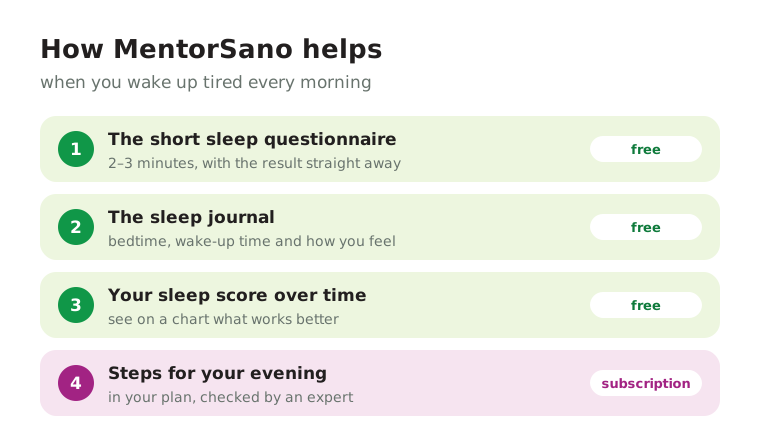
- The short sleep questionnaire takes 2–3 minutes and gives you the result straight away, so you know where to start.
- The daily journal keeps your bedtime, wake-up time and how you feel, plus coffee, movement and your day, in a minute or two.
- Your sleep score is calculated from the journal, and the chart shows you, week by week, whether things are getting better.
- With the subscription you get simple steps for your evenings, in a personal plan checked by an expert and linked to your tests, meals and stress.
The sleep journal is free. Create your free MentorSano account and after two weeks see what repeats on your hard mornings.
When is it more than just habits?
If you've changed your habits for a few weeks and still wake up tired, it's worth talking to your doctor. Morning tiredness can also have medical causes: anaemia, the thyroid, sleep apnoea, depression or some medicines. Your doctor decides which tests or investigations are useful.
When to see a doctor
- You snore loudly and someone has noticed you stop breathing in your sleep.
- You wake up with a headache or a very dry mouth almost every morning.
- You fall asleep during the day without meaning to, for example while driving.
- The tiredness doesn't go away after a few weeks of regular sleep.
- You've felt low or lost interest in things for several weeks.
Frequently asked questions
Why do I wake up tired even after 8 hours of sleep?
Usually because of the quality or regularity of your sleep: changing bedtimes, coffee or alcohol in the evening, screens in bed, stress. Less often, sleep apnoea.
Does sleeping in at weekends help?
A little, but it upsets your rhythm. If you go to bed and get up much later at weekends, Monday is even harder. It's better to keep the same wake-up time.
How long until I wake up more rested?
Many people notice a difference after 1–2 weeks of a regular schedule and no late coffee. Sleep settles gradually.
What is sleep inertia?
It's the groggy feeling in the first minutes after waking. It's normal and usually passes within 15–30 minutes. If it lasts for hours, it's a sign your sleep isn't resting you.
Why am I more tired after sleeping in at the weekend?
Because you shift your wake-up time, and your body feels it as a small jet lag. It helps to get up at the same time at weekends too, at most an hour later.
Start from where you are today
MentorSano brings together your blood tests, sleep, meals, movement and habits, and Adrian Ienin checks your plan before it reaches you.
- 15-minute questionnaire
- Blood tests, explained
- Daily journal
- Lesson of the day
- An expert by your side
Adrian Ienin
Naturopathic pharmacist, nutrition and holistic health consultant, co-founder of MentorSano. He checks the articles here and the plans in the platform before they reach people.