Health lessons in 3 minutes a day: learning about your body without getting lost
 Checked by Adrian Ienin, pharmacist · updated
Short health lessons, a few minutes a day, work better than reading a lot once a month. A review of 317 memory experiments found that learning spread out over time, with breaks and coming back to the same ideas, is remembered better. It also helps if the lesson is linked to what you're living through: your sleep, your meals, your blood tests. That makes it easier to go from "I read it" to "I tried it".
Want to see what this means for you? Start for free →
Why is it hard to learn about health?
There's plenty of information. The problem is something else: too much of it, unsorted and, most of the time, unrelated to your life. You read a long article about sleep, you like it, and a week later you remember nothing. Or you watch dozens of videos and end up more confused than before.
The World Health Organization calls the ability to find, understand and use health information "health literacy". And it says it can be learned, like any other skill.
Why do short health lessons work better?
In 2006, a team of psychologists reviewed 317 experiments on memory. Their conclusion: if you split learning into several sessions, with breaks between them, you remember more and for longer than if you learn everything at once.
For health, this means:
- one idea a day sticks better than ten in one evening;
- coming back to the same idea a few days later fixes it in memory;
- a few minutes a day is something you can keep up, while "an hour of reading" always stays for tomorrow.
Why does it matter that the lesson is about you?
We remember more easily what concerns us directly. A lesson about caffeine and sleep, read in the very week you're trying to move your last coffee, connects with how you feel in the morning. Next time you want a coffee at 5 pm, you remember it.
And when you try something and see that it works, you've learned it better than from any book.
How do you build a learning habit?
| What you do | Why |
|---|---|
| 3–5 minutes a day, at the same time | for example with your morning coffee; a fixed moment helps the habit |
| One idea a day | easier to remember and to apply |
| Linked to what you're working on now | if you're changing your sleep, read about sleep |
| Write one sentence afterwards | what you remembered and what you'll try today |
| Come back a few days later | repetition fixes the idea |
| Trustworthy sources | health institutions, named professionals, sources with links |
Which topics are worth learning first?
A few basics change how you make decisions every day:
- how sleep works and what spoils it;
- what sugar does in the blood and why fibre matters;
- why movement helps with sleep, stress and blood sugar;
- how to read basic blood tests and what a reference range means;
- how a habit forms and how it changes;
- how to tell whether health information can be trusted.
How do you go from reading to trying?
The best lesson is the one you try the same day. After you read something, ask yourself: what small thing can I do today with what I've learned?
| You read about | You try today |
|---|---|
| morning light and sleep | 10 minutes outside before 10 am |
| fibre and blood sugar | vegetables at the start of lunch |
| caffeine | last coffee before 2 pm |
| moving after meals | a 10-minute walk after dinner |
| stress and breathing | five slow breaths before a meeting |
Then note in the evening whether you did it and what you noticed. A few days later, when you come back to the same idea, it's no longer just something you read. It's something you've tried on yourself.
How does MentorSano help you learn day by day?
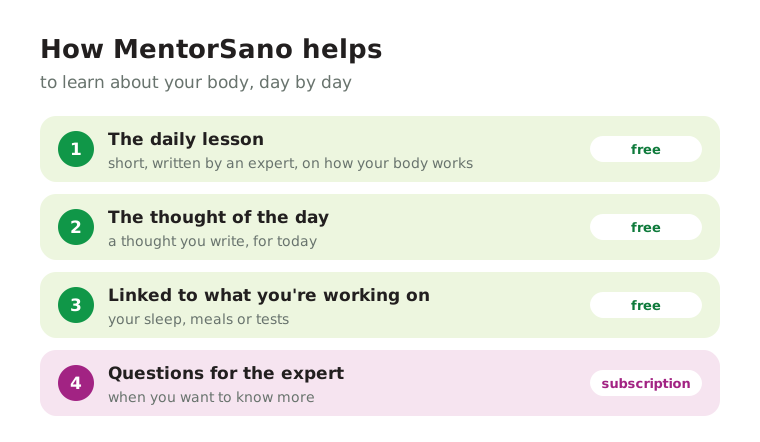
- The daily lesson, from the "Discover your body" series, is short and written by our expert, about how your body works. It takes a few minutes.
- The thought of the day is a new thought, written by you, for today.
- Lessons are linked to what you're working on: if you're changing your sleep or your meals right now, you read about sleep or meals, not about the latest trend.
- With the subscription, when you want to know more, you can write directly to the expert, and the answers stay in your account.
The daily lesson is free. Create your free MentorSano account and get your first lesson today.
How can you tell you've learned something?
Not when you can repeat the lesson, but when it changes a choice. When you pick water instead of juice without thinking about it, or leave your phone in another room at night because you know why. That's when information has become knowledge.
When to see a doctor
Health lessons don't replace a medical appointment. See a doctor:
- before changing a treatment because of something you've read;
- if you have new symptoms or ones that don't go away;
- before starting supplements, if you take medicines or have a long-term condition;
- if health information makes you more anxious rather than reassured.
Frequently asked questions
How do I learn about health if I have no time?
A few minutes a day, at the same time, with one idea linked to what you're trying to change. Memory studies show that learning spread out over time is remembered better.
Where can I learn trustworthy things about health?
From health institutions such as MedlinePlus, the NHS or the WHO, from named professionals with proper training, and from sources that say what they're based on.
Does it help to read a lot about health?
It helps if you apply what you read. Reading a lot without trying anything can bring confusion or worry. Better a little, often, and put into practice.
What is the thought of the day in MentorSano?
It's a short thought, written by you, for today. It helps you remember what you want to do and why.
How long is a lesson in MentorSano?
A few minutes. The daily lesson is short on purpose, so it fits into any day, even a full one.
What if new information contradicts what I knew?
Look at the source and the date. Science changes slowly, through many studies, not through a single one. If it affects you directly, ask your doctor or pharmacist before you change anything.
Start from where you are today
MentorSano brings together your blood tests, sleep, meals, movement and habits, and Adrian Ienin checks your plan before it reaches you.
- 15-minute questionnaire
- Blood tests, explained
- Daily journal
- Lesson of the day
- An expert by your side
Adrian Ienin
Naturopathic pharmacist, nutrition and holistic health consultant, co-founder of MentorSano. He checks the articles here and the plans in the platform before they reach people.