Motivation to exercise: why you quit after two weeks and what keeps you going
 Checked by Adrian Ienin, pharmacist · updated
Motivation to exercise is high at the start, and for almost everyone it fades after a few weeks. What keeps you going is habit: the same movement, at the same point in the day, small enough to do even on bad days. It helps a lot to see your progress written down, to have someone alongside you and to be rewarded for what you do, not only for results. A missed day changes nothing, as long as you come back the next day.
Want to see what this means for you? Start for free →
Why do you quit after two weeks?
The story is familiar: a new gym membership, the first days full of enthusiasm, then a busy week, a cold, a tired evening. The break becomes a week, the week becomes a month. And the conclusion seems to be "I have no willpower".
Willpower usually isn't the problem. A few mistakes keep repeating:
- You started too hard. Five workouts a week after months of no movement can't be kept up.
- You don't have a fixed time. "When I have time" usually means never.
- You expect quick results. Weight and shape change slowly, and seeing no result is discouraging.
- You let one missed day become the end. The thought "I've ruined it" stops you more than the day itself.
- You're doing something you don't enjoy. Running isn't for everyone.
What keeps you going when your motivation to exercise fades?
Researchers who study health habits say a habit forms through repetition in the same situation, until you do it almost without thinking. In a study at University College London this took 66 days on average, and one missed day didn't spoil the process.
Another analysis, of 138 studies, found that people who track their progress reach their goals more often, especially when they write it down or tell someone.
So what keeps you going is:
- a small movement you can do even on bad days;
- a fixed point in the day, tied to something you already do;
- progress written down, so you can see you've done something;
- someone alongside you, who waits for you or does the same.
How do you build movement into a habit?
| Step | Example |
|---|---|
| Choose something you enjoy | walking, dancing, cycling, swimming, exercises at home |
| Keep it small | 15 minutes, not an hour |
| Tie it to a moment | "when I get home, I go out for 15 minutes" |
| Note every day | a tick in a calendar or in an app |
| Tell someone | a friend, your partner, a group |
| Build up gradually | after 2–3 weeks, add 5 more minutes |
What do you do after a missed week?
Come back with a smaller version. Don't try to catch up or double your workouts. The next day, take a 10-minute walk and tick it off. The streak starts again from there.
What do you do on days when you don't feel like it?
There will be plenty. Tiredness, the weather, a hard day at work. On those days don't try to find your motivation. Do the smallest version of your habit:
- instead of a 30-minute walk, go out for 5 minutes to the corner and back;
- instead of a whole workout, do just the warm-up;
- instead of the gym, a few squats next to the bed.
It seems too little to matter. It matters for the streak: you did something, you ticked it off, and the habit stayed whole. Often, once you're out of the door, you do more than you planned. And if you don't, that's fine too.
A simple trick: lay out your workout clothes or put your trainers by the door the night before. The less there is to do before the first step, the easier it is to take.
How does MentorSano help you not to quit?
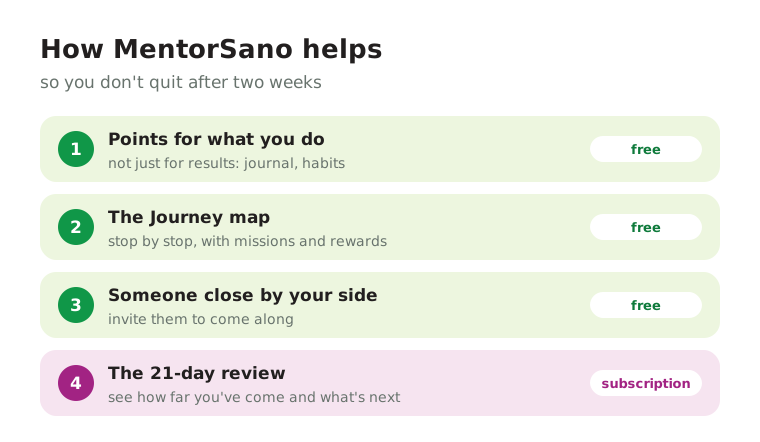
We built the Journey in MentorSano on what the habit studies say:
- Points for what you do, not only for results. You get points for your journal, for the habits you tick off and for the step of the week, even if the scales haven't moved yet.
- The Journey map: you climb stop by stop, with missions and rewards for what you achieve.
- The weekly challenge you do alongside others, and you can invite someone close to come with you.
- With the subscription, you work in 3-week blocks: at the end you have a review, see how far you've come and start the next round with an adjusted plan.
The Journey is free. Create your free MentorSano account and invite someone close to start with you.
How can you tell it has become a habit?
When you no longer negotiate with yourself. You go for a walk because that's what you do after lunch, not because you feel like it. At that point motivation matters much less, and the days when you don't feel like it no longer stop you.
When to see a doctor
- You have heart disease, high blood pressure or diabetes and want to start an intense programme.
- You had pain that made you stop last time and it hasn't gone away.
- You feel dizzy, get chest pain or are very breathless during exercise.
- You've felt low on energy and interest in everything for several weeks.
Frequently asked questions
How do I find the motivation to exercise?
Don't rely on motivation alone; it fades for everyone. Choose a small movement at a fixed time of day, note every day and, where you can, do it with someone.
How long does it take for exercise to become a habit?
In a University College London study, a new habit became automatic after 66 days on average, with big differences between people.
What if I've missed a week?
Come back the next day with a smaller version, such as a 10-minute walk. Don't try to make up for everything at once.
Does it help to exercise with someone?
Yes. Studies on tracking progress show a bigger effect when you tell someone else what you're doing, and a partner waits for you even on days you don't feel like it.
Is it normal for my motivation to drop after a few weeks?
Yes, it happens to almost everyone. The early enthusiasm wears off. That's why a small habit at a fixed time helps more than motivation.
Which sport is best if I don't want to quit?
The one you enjoy and can do close to home. For many people walking is the easiest to keep up, because it needs no kit, membership or fixed schedule.
Start from where you are today
MentorSano brings together your blood tests, sleep, meals, movement and habits, and Adrian Ienin checks your plan before it reaches you.
- 15-minute questionnaire
- Blood tests, explained
- Daily journal
- Lesson of the day
- An expert by your side
Adrian Ienin
Naturopathic pharmacist, nutrition and holistic health consultant, co-founder of MentorSano. He checks the articles here and the plans in the platform before they reach people.