Waking up at night and can't get back to sleep: what helps
 Checked by Adrian Ienin, pharmacist · updated
Waking up at night is one of the most common sleep complaints. Waking briefly is normal: everyone has short wake-ups between sleep cycles, they just don't usually remember them. The problem starts when you wake up fully and can't get back to sleep. The usual causes are stress, alcohol in the evening, late coffee, needing the toilet or a room that's too warm. If you've been awake for more than about 20 minutes, get up, do something quiet and go back to bed when you feel sleepy.
Want to see what this means for you? Start for free →
Is it normal to wake up at night?
Yes, up to a point. Sleep comes in cycles of about an hour and a half, and between them the brain comes close to waking. Everyone has small wake-ups during the night. They usually last a few seconds and you don't remember them.
It becomes a problem when you wake up fully, look at the clock, start thinking and can't fall asleep again. If it happens several times a week for a few months and you feel bad during the day, the NHS calls it insomnia and advises talking to your doctor.
Why do I wake up at the same time every night?
Many people wake up around 3 or 4 am. There's no single explanation, but a few reasons come up again and again:
- Alcohol in the evening. It helps you fall asleep, but a few hours later, as your body clears it, sleep becomes restless.
- Stress. Towards morning sleep becomes lighter, and worries catch you more easily.
- Sleep cycles. If you always go to bed at the same time, the switch between cycles also falls at roughly the same time.
- Your bladder. Lots of fluid in the evening wakes you up to go to the toilet.
- Heat. A warm room or a duvet that's too thick wakes you.
- A big or very late dinner, with heartburn or heavy digestion.
What do you do in the moment you wake up?
- Don't look at the clock. Counting the hours left wakes you up even more.
- Don't pick up your phone. The light and what you see switch your brain on.
- Breathe slowly for a few minutes: in for a count of 4, out for a count of 6.
- If about 20 minutes pass and you still can't sleep, get up, go to another room with dim light and do something calm: a paper book, quiet music.
- Go back to bed when you feel sleepy.
This rule of getting out of bed is part of cognitive behavioural therapy for insomnia, which US sleep doctors recommend as the first choice of treatment.
What do you change during the day to sleep through the night?
| What you do | Why it helps |
|---|---|
| No alcohol in the 3–4 hours before bed | the second half of the night becomes calmer |
| Last coffee before 1–2 pm | caffeine can spoil sleep even 6 hours later |
| Less fluid in the last hour | your bladder no longer wakes you |
| Dinner 2–3 hours before bed | digestion no longer carries on at night |
| Worries written down in the evening | you get them out of your head before bed |
| The same wake-up time, however much you slept | sleep becomes more solid within a few weeks |
What do you note in the morning after a broken night?
Memories of the night fade fast, so write them down right after you get up, in two minutes:
- what time you went to bed and roughly when you fell asleep;
- how many times you woke up and roughly how long you were awake;
- what you did in the evening: coffee, alcohol, late dinner, screens, a tense conversation;
- how you feel now, from 1 to 5.
Don't check the clock during the night to note things exactly. Rough guesses are enough. After two weeks, compare the good nights with the bad ones. Something that repeats often comes to light: the Friday wine, the big dinner, the stressful Monday.
If you take your notes to your doctor, you show them more than "I sleep badly". You show them a pattern, which helps them decide whether further investigations are needed.
How does MentorSano help when you keep waking up at night?
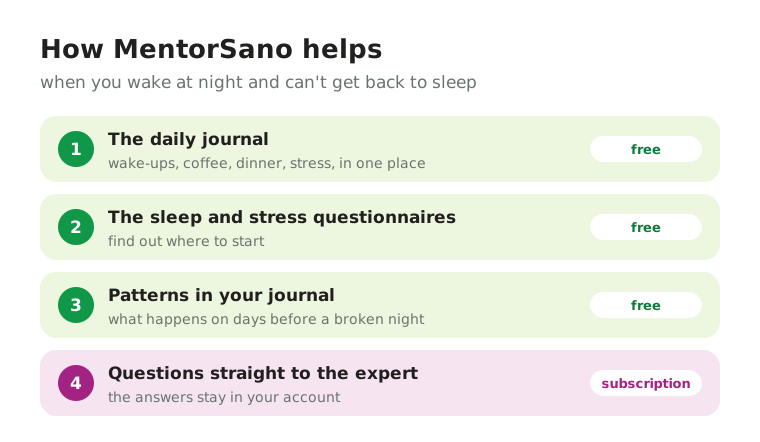
- The daily journal keeps, in a minute or two, how you slept, your coffee, dinner time, movement and your day. Wake-ups and possible causes, all in one place.
- The short sleep and stress questionnaires take 2–3 minutes each and show you where to start.
- Patterns in your journal: after a few weeks you see on a chart what the broken nights have in common.
- With the subscription you can write straight to the expert when you have a question, and the answers stay in your account. You also get a plan with steps for your evenings.
The journal is free. Create your free MentorSano account and note how you sleep for two weeks. The patterns show up sooner than you think.
When is it more than restless sleep?
Sometimes waking at night has a medical cause: sleep apnoea, reflux, needing to pee often, pain, anxiety or depression. In women, perimenopause often brings night waking with sweats. If the wake-ups have lasted for months or come with other signs, your doctor can help you find out why.
When to see a doctor
- You wake up at night at least 3 times a week, for more than 3 months, and feel bad during the day.
- You wake up feeling like you're choking, or someone has noticed you stop breathing in your sleep.
- You often wake up to pee, especially if you're also very thirsty.
- You have night sweats, a fever or have lost weight for no reason.
- The wake-ups come with low mood, anxiety or thoughts you can't switch off.
Frequently asked questions
Why do I wake up at 3 am?
Common reasons: alcohol in the evening, stress, the switch between sleep cycles, a warm room or needing the toilet. A journal helps you see what repeats for you.
What should I do if I can't get back to sleep?
Don't look at the clock or pick up your phone. If about 20 minutes pass, get up, do something calm in dim light and go back to bed when you feel sleepy.
Is it normal to wake up 2–3 times a night?
Short wake-ups after which you fall asleep quickly are normal. They become a problem when you lie awake for a long time or feel tired during the day.
Does melatonin help with waking at night?
Usually not for waking at night. Melatonin helps mainly with falling asleep in certain situations. Talk to your doctor or pharmacist before taking it.
Should I check the clock when I wake up at night?
Better not. When you see the time, you start counting how much sleep you have left, and the worry keeps you awake. Turn the clock to face the wall.
Start from where you are today
MentorSano brings together your blood tests, sleep, meals, movement and habits, and Adrian Ienin checks your plan before it reaches you.
- 15-minute questionnaire
- Blood tests, explained
- Daily journal
- Lesson of the day
- An expert by your side
Adrian Ienin
Naturopathic pharmacist, nutrition and holistic health consultant, co-founder of MentorSano. He checks the articles here and the plans in the platform before they reach people.