Which blood tests to get: how to choose without paying for everything
 Checked by Adrian Ienin, pharmacist · updated
Which blood tests to get depends on your age, your symptoms, your family history and what you want to keep an eye on. A big panel picked at random costs a lot and can produce borderline values that worry you for no reason. It's better to start from a basic set, which your GP can often order for free, and add only what makes sense for you.
Want to see what this means for you? Start for free →
Why isn't it a good idea to get "every test"?
Labs sell panels with dozens of tests. It seems sensible: the more, the safer. In practice, it doesn't quite work that way.
- It costs a lot, and some of the tests tell you nothing useful if you have no reason to do them.
- More tests mean more values out of range by chance. Reference ranges are set so that healthy people sometimes fall slightly outside them. The more tests you do, the more likely you are to see one "in red" that means nothing.
- They can worry you for no reason and send you on to extra tests and appointments.
The US National Library of Medicine (MedlinePlus) advises choosing screening tests by age, sex, history and risk factors, rather than doing every test for everyone.
Which basic tests are usually done?
| Test | What it shows |
|---|---|
| Full blood count | red and white cells and platelets: anaemia, infections |
| Blood glucose (and sometimes HbA1c) | blood sugar, diabetes risk |
| Cholesterol and triglycerides | risk for the heart and blood vessels |
| Creatinine, urea | how your kidneys are working |
| Liver enzymes (ALT, AST) | how your liver is working |
| Urine test | kidneys, urinary infections |
Your doctor may add TSH for the thyroid, ferritin, vitamin D or vitamin B12, especially if you have tiredness, hair loss or other symptoms.
What can you get for free through your GP?
In many health systems, including Romania's, a GP can refer you for some basic tests that are covered by your health insurance. The exact list and how often you can have them change over time, and some labs have a limited number of referrals each month, so it's worth asking early.
For tests that aren't covered, prices vary a lot from one lab to another. When you know in advance what you need, you can compare and avoid paying for a whole panel.
How do you choose the right tests for you?
- Start from how you feel. Tiredness, hair loss, poor sleep, cravings, digestive problems: each points to different tests.
- Think about your family history. Diabetes, heart disease or thyroid problems in your parents change what's worth checking.
- Look at your old results. A value that rises from one year to the next says more than a single one.
- Talk to your doctor about what you want to find out, not just about which panel to buy.
What should you ask your GP?
Appointments go quickly, so it helps to arrive with a few things ready. You can write down:
- what bothers you and since when: tiredness, poor sleep, weight, digestion;
- which illnesses your parents and siblings have had, especially diabetes, heart disease, thyroid problems or cancer;
- which medicines and supplements you take;
- when you last had blood tests and what came back out of range.
Then ask directly: "Which tests would you recommend, given my age and what I've told you?" and "Which of them can be done with a referral?". Most basic tests can be done that way, without paying.
Ask them to explain any results that come back out of range, too. A value that's slightly high or low isn't always a problem, but it's good to know what it means for you and when to repeat it.
How does MentorSano help you know which blood tests to get?
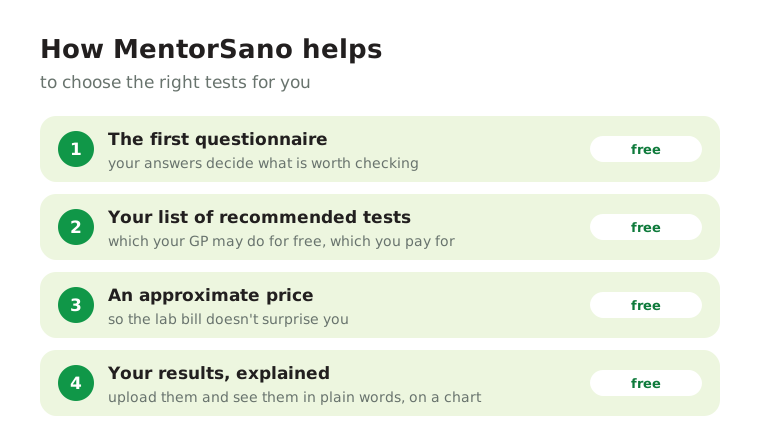
- The first questionnaire, about 15 minutes long, asks about symptoms, sleep, meals, energy and family history.
- Based on it you get a list of tests that would be worth doing, not a generic panel.
- You see which ones your GP may do for free and which you pay for, with an approximate price, so you can decide knowing what to expect.
- Once you've had them, you upload them to your account and see them in plain words, on a chart, next to your older results.
It's all free. Create your free MentorSano account and in 15 minutes you'll know which tests are worth doing for you.
How often should you have blood tests?
For a healthy adult with no symptoms, doctors usually suggest basic tests once a year or every few years, depending on age and risk. If you have a long-term condition or take regular treatment, your doctor sets a different rhythm. A borderline value is usually repeated after a few months, to see which way it's going.
When to see a doctor
- You have new symptoms or ones that don't go away: weeks of tiredness, weight loss for no reason, strong thirst, pain.
- A test you did on your own came back far out of range.
- Illnesses appear early in your family, for example a heart attack or diabetes before 50.
- You're pregnant or planning a pregnancy.
- You take treatment that needs regular check-up tests.
Frequently asked questions
Which blood tests should I get once a year?
Usually a full blood count, blood glucose, cholesterol, kidney and liver tests and a urine test. Your doctor adds others based on your age, symptoms and history.
Can I get blood tests for free?
Often yes, with a referral from your GP, for some basic tests covered by your health insurance. Ask your GP what's covered and how often.
Is a big blood test panel worth it?
Usually not, if you have no reason for it. Big panels cost a lot and can produce meaningless borderline values that worry you for nothing.
Do I need to fast before blood tests?
For glucose and cholesterol, usually yes, for 8–12 hours. For other tests it isn't required. The lab will tell you what applies to your set.
What if a value is slightly out of range?
Don't panic. Values can vary from day to day. Show the result to your doctor, who will tell you whether to repeat the test or do others.
Which tests should I get if I'm always tired?
Talk to your GP. They usually start with a full blood count, glucose, ferritin, TSH and vitamin B12 or D, as needed, chosen according to your symptoms and history.
Start from where you are today
MentorSano brings together your blood tests, sleep, meals, movement and habits, and Adrian Ienin checks your plan before it reaches you.
- 15-minute questionnaire
- Blood tests, explained
- Daily journal
- Lesson of the day
- An expert by your side
Adrian Ienin
Naturopathic pharmacist, nutrition and holistic health consultant, co-founder of MentorSano. He checks the articles here and the plans in the platform before they reach people.