Late-night snacking: why it happens and how to stop without a struggle
 Checked by Adrian Ienin, pharmacist · updated
If late-night snacking keeps you at the fridge until bedtime, it usually isn't a lack of willpower. The most common causes are skipped or small meals during the day, tiredness, built-up stress and a habit tied to the TV. Regular meals help, as do a dinner with protein and vegetables, snacks prepared in advance instead of packets, and a time after which the kitchen closes. Sleep matters too: after a sleepless night, the brain wants more high-calorie food.
Want to see what this means for you? Start for free →
Why does late-night snacking happen when you do well all day?
The day goes well. A coffee in the morning, a small or skipped lunch, nothing sweet. Then you get home, open the fridge "just for a taste" and only stop at bedtime: a slice of cheese, bread, biscuits, a handful of peanuts, then another.
The next day you feel guilty, skip breakfast to make up for it, and the evening repeats itself. It isn't a character flaw. It's a pattern, and a pattern has causes you can change one at a time.
What lies behind evening hunger?
- Skipped meals during the day. If by 6 pm you've only had a coffee and a sandwich, your body asks in the evening for what it missed. Hunger you put off doesn't go away; it builds up.
- Tiredness. In a study published in Nature Communications, after a sleepless night people wanted high-calorie foods more, and the brain areas that weigh up choices worked less well. In the evening, after a long day, you're in a similar position on a smaller scale.
- Stress. Food is a quick way to calm down and to mark the end of the day. Snacking stands in for a break.
- A habit tied to the screen. The sofa, the series and the bag of crisps end up going together. When you switch on the TV, your hand reaches for something to nibble on its own.
- What's within reach. Whatever sits on the table or in plain sight in the cupboard gets eaten first.
Most of the time there are two or three causes at once. It's worth finding out which are yours before you change anything.
How can you tell what drives you to the fridge?
For one week, every evening, write down three things: what you ate during the day and when, how tired you were on a scale of 1 to 10, and what you were doing when you started snacking. Don't judge yourself; just look.
After a few evenings a pattern appears. Some people see that the hard evenings follow days without lunch. Others find they only snack in front of a series, or only after tense days at work. The cause you see most often is the first one to change.
What can you actually do to stop snacking until bedtime?
| Instead of | Try |
|---|---|
| skipping breakfast to "make up for it" | a breakfast with eggs, yoghurt or cheese and wholemeal bread |
| a lunch of coffee and a pretzel | a proper lunch, with half the plate vegetables |
| nothing between 1 pm and 8 pm | a snack around 4–5 pm: a piece of fruit with a handful of nuts, or a yoghurt |
| skipping dinner or just a small salad | a dinner with protein (fish, meat, eggs, beans, lentils) and vegetables |
| the bag of crisps on the sofa | a small bowl you fill yourself: cut vegetables, fruit, yoghurt |
| the kitchen open until bedtime | a set time after which the kitchen closes, for example 9 pm |
The NHS advises not skipping breakfast and eating at least five portions of fruit and vegetables a day, a portion being about 80g. The same guide says wholegrain, higher-fibre options help you feel full for longer. A day built on regular meals leaves less hunger for the evening.
What do you do when you feel like opening the fridge?
Evening cravings often come in waves. A few things that help on the spot:
- drink a glass of water or a cup of tea and wait 10 minutes;
- ask yourself: would I eat a bowl of soup right now? If not, it isn't hunger, it's something else;
- if it is real hunger, eat something simple, sitting at the table, from a plate, not from the packet;
- change place: leave the kitchen, brush your teeth, get your clothes ready for tomorrow.
Brushing your teeth early tells you the eating day is over. After it, there's one more step between you and the next snack.
How do you change a habit tied to the TV?
A habit is linked to a context: the same time, the same place, the same activity. To change it, you have two options. Either you keep the context and change what you do in it: the series stays, but with a cup of tea and a small bowl of cut vegetables. Or you change the context: a short walk after dinner, a shower, a book in another room.
Don't keep packets in sight, and don't buy "for guests" what you know you'll eat yourself in the evening. It's easier not to buy something once than to say no every evening.
How does MentorSano help with evening hunger?
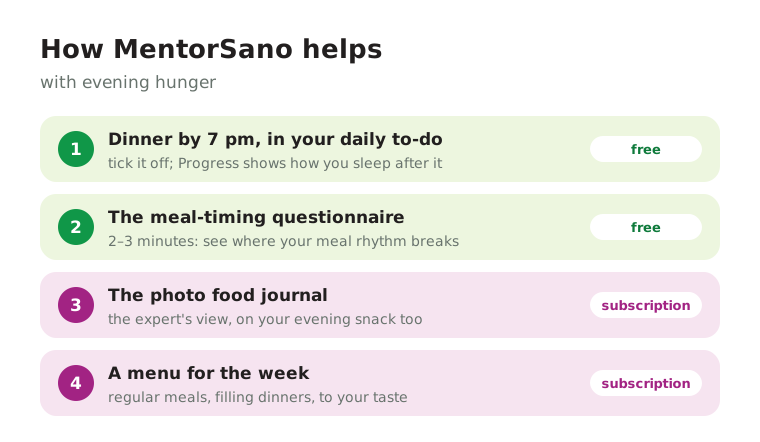
MentorSano doesn't ban anything. It helps you see the pattern and change one thing at a time:
- For free, in your daily to-do you tick off "dinner by 7 pm" and your other habits, and after a few weeks Progress shows how you sleep after evenings with an early dinner compared with the rest.
- For free, the short meal-timing questionnaire shows you in two or three minutes where the rhythm of your meals breaks down.
- With the subscription, in the food journal you take a photo of your plate, including your evening snack, and get the expert's view: what's good and what you could change next time.
- With the subscription, the weekly menu has regular meals and dinners that fill you up, worked out with protein and fibre, to your taste.
Start with the free part: create your free MentorSano account and tick off dinner by 7 pm from the first evening.
What does a day that doesn't end at the fridge look like?
- 8:00, breakfast: eggs with wholemeal bread and tomatoes.
- 13:00, lunch: a bowl of soup, then meat or fish with vegetables.
- 16:30, snack: an apple and a handful of nuts.
- 19:00, dinner: a vegetable omelette, or beans with salad.
- 21:00, the kitchen closes: a cup of tea, then teeth brushed.
Your day doesn't have to look exactly like this. What matters is not leaving a gap of six or seven hours without food and having a dinner that fills you up. If one evening slips, don't skip breakfast the next day. Go back to your usual rhythm from the first meal.
When to see a doctor
- You often eat very large amounts in a short time, can't stop when you're full, and then feel guilty or ashamed.
- You wake up at night and can't get back to sleep until you've eaten.
- You have diabetes or take medicines that lower blood sugar, and in the evening or at night you get very hungry, with shaking or sweating.
- You get heartburn or reflux when you lie down after eating.
- You've lost or gained a lot of weight without changing anything.
Frequently asked questions
Is late-night snacking bad for you?
The problem is usually the amount and the kind of food, not just the time. Evening snacking often comes on top of a full dinner, from packets, in front of a screen. A dinner that fills you up and a set time after which you stop eating help more than a rigid rule.
What time should I stop eating in the evening?
There's no time that suits everyone. Pick one you can keep every day and close the kitchen after it. If you get heartburn, you usually feel better when you don't lie down straight after a meal.
Why am I hungrier in the evening when I'm tired?
Tiredness changes how the brain chooses food. In a study in Nature Communications, after a sleepless night people wanted high-calorie foods more.
What can I eat in the evening if I'm hungry?
Something simple and small, from a plate, at the table: a yoghurt, a piece of fruit, cut vegetables, a boiled egg or a slice of cheese. If you're hungry every evening, look at your daytime meals first.
Does skipping dinner help me lose weight?
Rarely. The hunger moves later and often ends in snacking until bedtime. A dinner with protein and vegetables helps you more than a skipped one.
How do I stop snacking in front of the TV?
Change what's within reach or change the context. Don't keep packets in sight, prepare a small bowl of vegetables or fruit in advance, and try a cup of tea instead of a snack. A short walk after dinner also breaks the link with the sofa.
Start from where you are today
MentorSano brings together your blood tests, sleep, meals, movement and habits, and Adrian Ienin checks your plan before it reaches you.
- 15-minute questionnaire
- Blood tests, explained
- Daily journal
- Lesson of the day
- An expert by your side
Adrian Ienin
Naturopathic pharmacist, nutrition and holistic health consultant, co-founder of MentorSano. He checks the articles here and the plans in the platform before they reach people.