Portion sizes: eating healthily but not losing weight?
 Checked by Adrian Ienin, pharmacist · updated
If you eat healthily and don't lose weight, portion sizes are often the explanation. People eat more when the portion, the bag or the plate is bigger. Your hand is a handy guide: two handfuls of dry pasta, a piece of chicken the size of your hand, cheese the size of two thumbs. Vegetables on half the plate, oil measured with a spoon and eating more slowly help you eat what you need, without counting calories.
Want to see what this means for you? Start for free →
Why aren't you losing weight when you eat healthily?
You've given up fizzy drinks. You cook at home, add vegetables, use olive oil, eat wholegrain bread and nuts. And yet the scales haven't moved for months. You wonder whether you might be eating too much, even though you eat well.
Often that's the explanation. Healthy food still has calories. Brown rice, olive oil, nuts, cheese, granola and dried fruit are good choices, but they're also energy-dense. An extra spoonful of oil on your salad, a big handful of nuts instead of a small one, a plate of pasta filled to the edge all add up, day after day.
You don't need to weigh everything or count every calorie. It helps to have a few reference points for portion sizes and a few habits that make you stop when you're full, not when the plate is empty.
Why do we eat more when the portion is bigger?
Because we look at what's in front of us, not just at how hungry we are. A 2015 Cochrane review brought together 58 studies with more than 6,600 participants. The conclusion: when the portion, the package or the plate is bigger, people eat more. The effect was small to moderate but consistent, and clearer in adults than in children.
The authors also estimated how much this would matter in practice. If portions, packages and tableware were smaller across the whole diet, UK adults and children would eat on average 144–228 fewer kilocalories a day. That's between 8.5% and 13.5% of what they usually eat.
In everyday life, the effect comes from several places:
- plates and bowls at home are large, and a full plate looks like the "normal" portion;
- family-size bags and boxes often get eaten in one go, without being shared out;
- in restaurants and takeaways, portions are designed to look generous;
- food left on the table in the pot or tray makes you help yourself again.
How do you judge portion sizes with your hand?
Scales are the most accurate, but few people use them at every meal. The British Nutrition Foundation suggests hand and spoon measures. The portions are designed for an adult who needs about 2,000 kilocalories a day.
| Food | Portion, by hand | Roughly how much it weighs |
|---|---|---|
| Pasta or rice, weighed dry | about two handfuls | 75 g |
| A baked potato | the size of your fist | 220 g |
| Breakfast cereal | about three handfuls | 40 g |
| Chicken breast | the size of your whole hand | 120 g |
| Hard cheese | a piece the size of two thumbs together | 30 g |
| Peanut butter | one tablespoon | 20 g |
| Soft cheese | three teaspoons | 30 g |
Your hand has one advantage: it's always with you and it grows with you. A bigger person has bigger hands and gets bigger portions. The Foundation also says that if you're tall or very active you may need more, and if you're smaller or trying to lose weight you may need smaller portions.
For fruit and vegetables, the NHS counts a portion as 80 grams, about what fits in the palm of your hand. Examples: an apple, a banana or an orange; a medium tomato or 7 cherry tomatoes; 3 heaped tablespoons of cooked vegetables or chickpeas. Dried fruit has a small portion, around 30 grams, and fruit juice and smoothies together shouldn't go over 150 ml a day.
How do you build your plate?
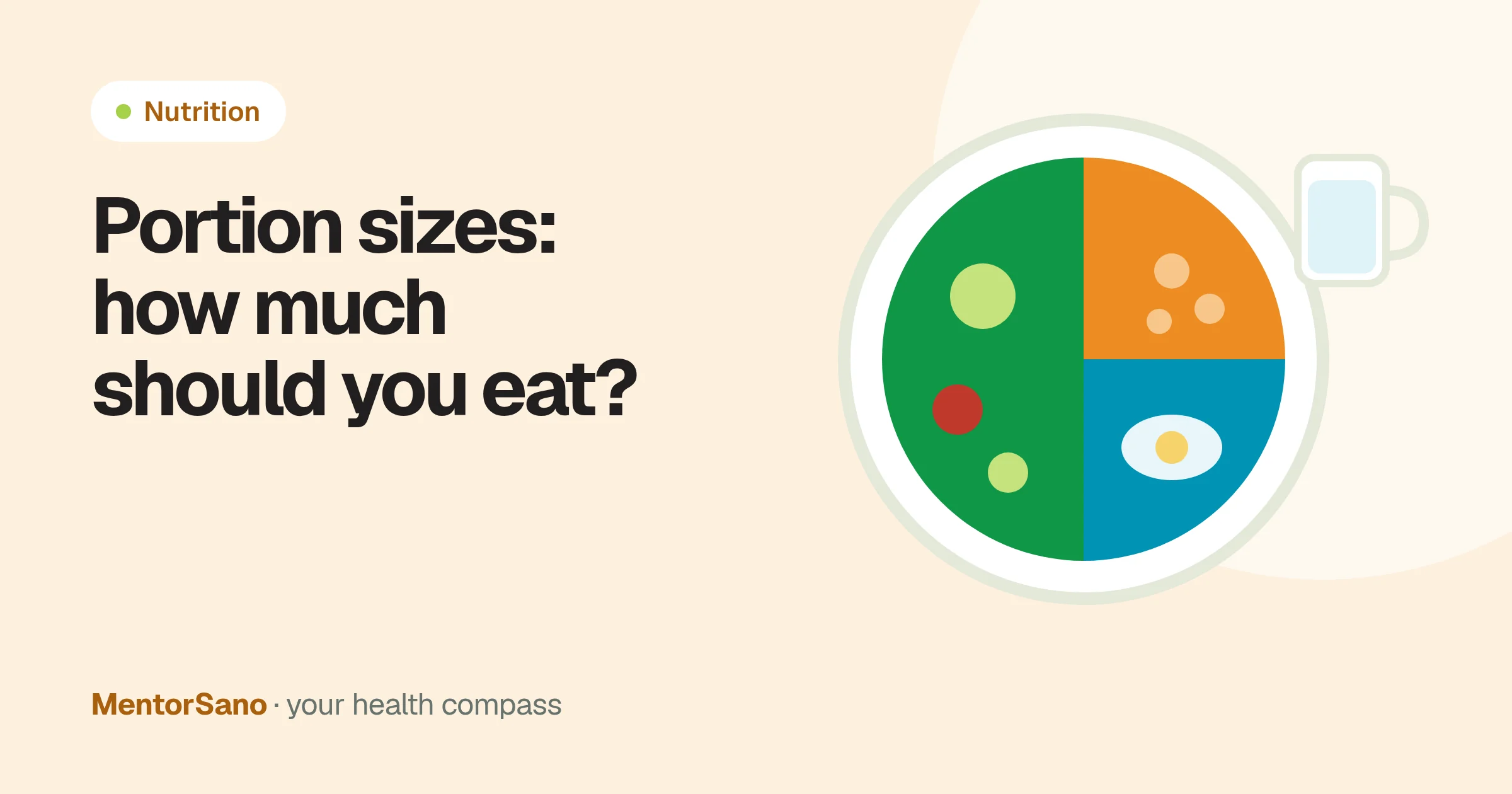
The NHS Eatwell Guide shows the proportions of what you eat over a day, not just at one meal:
- just over a third: fruit and vegetables, at least 5 portions a day;
- just over a third: starchy foods, wholegrain where possible: bread, rice, pasta, potatoes;
- the rest: protein (beans, lentils, fish, eggs, meat) and dairy or alternatives;
- small amounts: oils and spreads.
The British Nutrition Foundation turns this into portions a day: 5 or more of fruit and vegetables, 3–4 of starchy foods, 2–3 of protein and 2–3 of dairy.
At a meal, the simplest way is to put the vegetables on first, then the protein, then the starchy side. If the vegetables take up half the plate first, the rest falls into the right size on its own. Measure oil with a spoon, not straight from the bottle.
For what goes on the plate rather than how much, see the article healthy meal ideas.
Why does how fast you eat matter?
A review published in 2014 in the American Journal of Clinical Nutrition brought together 22 studies in which people were asked to eat quickly or slowly. When they ate more slowly, they ate less. Hunger after the meal was no greater, either at the end of the meal or over the next three and a half hours.
A few simple ways to slow down:
- put your fork down between mouthfuls;
- eat at the table, not in front of a screen or standing up;
- start with soup or salad;
- wait a few minutes before going back for seconds and ask yourself whether you're still hungry.
What can you change at home without counting calories?
| The habit | What you do instead |
|---|---|
| Eating from the bag or the big box | put a portion in a small bowl and put the bag back in the cupboard |
| The pot stays on the table | serve the plates at the hob and leave the pot there |
| A large plate filled to the edge | a smaller plate, or half the plate vegetables |
| Oil poured straight from the bottle | oil measured with a spoon |
| Nuts and dried fruit from the bag | a small handful, set aside |
| Finishing the whole restaurant portion | ask for a box for half of it from the start |
| Eating fast, in 5 minutes | put your fork down between mouthfuls and eat at the table, without a screen |
Don't change them all at once. Pick two and keep them up for three weeks. If you also use the scales, weigh yourself once a week, on the same day and at the same time, not every morning.
One thing to avoid: cutting portions so much that you're hungry all the time. Very strict diets are hard to keep up and often end in big meals. There's more on this in why diets fail.
How does MentorSano help with portions?
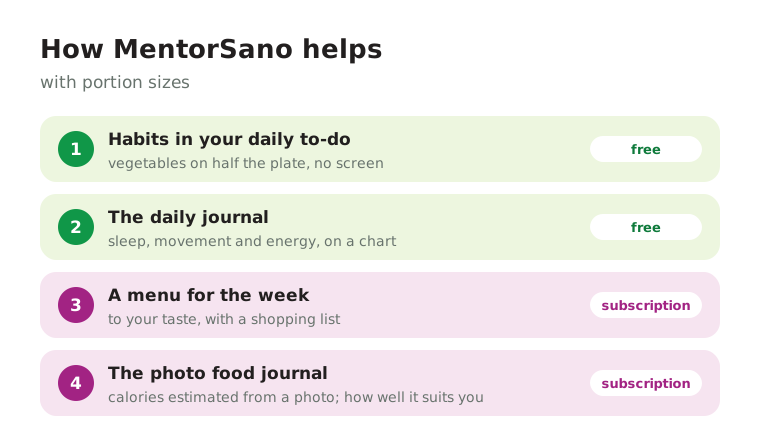
- For free, you tick off small habits in your daily to-do that change your portions: vegetables on half the plate, eating at the table, no screen.
- The daily journal, also free, keeps track of your sleep, movement and energy in a minute or two. Short sleep and tiredness often mean bigger portions the next day.
- With the subscription you get a menu for the week, to your taste and schedule, with a shopping list. You know in advance what you're cooking and how much to buy.
- The photo food journal, with the subscription: you take a photo of your plate and see an estimate of the calories and nutrients, plus how well the meal suits you. The values from photos are approximate.
You can start without paying anything: create your free MentorSano account, fill in the 15-minute questionnaire and add your first habits to your daily to-do.
What does a day of portions that suit you look like?
An example, using the reference points above, for an adult who doesn't do heavy physical work:
| Meal | What goes on the plate |
|---|---|
| Breakfast | three handfuls of oats or cereal, milk or yoghurt, a piece of fruit |
| Lunch | half a plate of vegetables, a piece of chicken the size of your hand, rice cooked from two handfuls of dry rice |
| Snack, if you're hungry | an apple and a piece of cheese the size of two thumbs |
| Dinner | vegetable soup, then fish or lentils with salad and a potato the size of your fist |
If after two or three weeks you're often hungry, add vegetables or a portion of protein, not a bigger starchy side. If your weight still doesn't move, look first at oil, nuts, cheese and what you drink. That's where calories you don't see on the plate add up most easily.
When to see a doctor
Large portions are usually a habit, not an illness. Still, see your GP if:
- you're putting on weight quickly without changing what you eat;
- you're losing weight without trying;
- you're very thirsty, peeing a lot or hungry all the time;
- you've had tiredness, feeling cold, dry skin or constipation for several weeks;
- you often eat very large amounts and feel you can't stop;
- you have diabetes, heart or kidney disease and want to lose weight.
Frequently asked questions
How do I know if my portions are too big?
Compare them with the hand measures: two handfuls of dry pasta or rice, a piece of chicken the size of your hand, cheese the size of two thumbs. If your weight is slowly going up and you feel heavy after meals, your portions are probably bigger than you need.
Does a smaller plate help?
It can. The 2015 Cochrane review found that people eat more when portions, packages or tableware are bigger. A smaller plate stops the right portion from looking empty.
Can I eat as much healthy food as I like?
Not all of it. Vegetables can be eaten freely. Oil, nuts, dried fruit, cheese and granola are healthy, but they have a lot of calories in small portions.
Do I have to count calories to lose weight?
Not necessarily. Hand measures, a plate that's half vegetables and eating more slowly help many people without counting. If you have a condition that needs a specific diet, talk to your GP or a dietitian.
Why should I eat more slowly?
In a 2014 review of 22 studies, people who ate more slowly ate less, without feeling hungrier after the meal.
How much is a portion of fruit or vegetables?
The NHS counts a portion as 80 grams, about what fits in the palm of your hand: an apple, a banana, a medium tomato or 3 heaped tablespoons of cooked vegetables. A portion of dried fruit is around 30 grams.
Start from where you are today
MentorSano brings together your blood tests, sleep, meals, movement and habits, and Adrian Ienin checks your plan before it reaches you.
- 15-minute questionnaire
- Blood tests, explained
- Daily journal
- Lesson of the day
- An expert by your side
Adrian Ienin
Naturopathic pharmacist, nutrition and holistic health consultant, co-founder of MentorSano. He checks the articles here and the plans in the platform before they reach people. About Adrian and how we write our articles →
Sources
- NHS: The Eatwell Guide
- NHS: 5 A Day portion sizes
- British Nutrition Foundation: Portion sizes
- Hollands et al. Portion, package or tableware size for changing selection and consumption of food, alcohol and tobacco. Cochrane Database of Systematic Reviews, 2015
- Robinson et al. A systematic review and meta-analysis examining the effect of eating rate on energy intake and hunger. American Journal of Clinical Nutrition, 2014