Phone before bed: why you fall asleep at 1 am and what to change
 Checked by Adrian Ienin, pharmacist · updated
Using your phone before bed feels like a way to relax, but most of the time it keeps you awake longer than you intend. The effect comes from three things: you put off bedtime, what you read keeps you alert, and the screen's light delays your body clock a little. Studies show real effects, but smaller than is often claimed. What matters most is the time it takes. A fixed switch-off time, your phone charging in another room and a traditional alarm clock help.
Want to see what this means for you? Start for free →
Why do you stay on your phone in bed when you're tired?
You get into bed at 11 pm, meaning to fall asleep quickly. You pick up your phone "just for five minutes", for a message or a news story. When you look at the clock, it's 12:45. You fall asleep around 1 am, and the alarm goes off at 7.
Researchers have a name for this: bedtime procrastination. It's when you don't go to bed at the time you intended, even though nothing outside you is stopping you. In a 2014 study, people who put off bedtime more often were more likely to say they didn't get enough sleep, regardless of age or sex.
The reasons are understandable. The evening is often the only time that feels like yours, after work and housework. And apps are built not to have an end: one more clip, one more post, one more message. A book has a chapter that finishes. The feed on your phone doesn't.
What does your phone before bed actually do?
There's a lot of talk about "blue light". Light matters, but it's only one of three ways your phone shifts your sleep. Most of the time it isn't even the most important one.
| What happens | How it affects your sleep | What studies say |
|---|---|---|
| You put off bedtime | you fall asleep later, and the alarm stays at the same time | consistently linked with too little sleep |
| What you read keeps you awake | messages, news, work emails or games keep you alert | messages and calls after lights out are linked with falling asleep more slowly and sleeping worse |
| The screen's light | delays your body clock and melatonin a little | a clear effect in the laboratory, with several hours of use |
| Notifications overnight | can wake you up or make you check your phone | the NHS suggests putting your phone on silent and face down |
The part about light comes mainly from a 2015 laboratory study. The same people read for several evenings in a row, in the hours before bed, either on a tablet or from a printed book. With the tablet they took longer to fall asleep, had less melatonin in the evening, their body clock shifted later and they were less alert the next morning. But the study compared a tablet with a book, under controlled conditions. It doesn't tell you exactly how much your 20 minutes on your phone matter.
What do studies say about your phone before bed, without the hype?
Newspaper headlines often sound alarming. The large studies are more nuanced.
- In adults: a study of 844 adults in Belgium found that 6 in 10 took their phone into the bedroom. Those who sent or received messages and calls after lights out took longer to fall asleep, slept worse and were more tired during the day. The study measured everything once, so it shows a link, not proof of cause.
- In teenagers: an analysis of 11,884 teenagers in the UK found very small links. An extra hour of screen time a day meant about 9 minutes less sleep on school days and 3 minutes at weekends. Screens used in the last half hour before bed meant about one minute less sleep.
The practical conclusion: your phone doesn't spoil your sleep through some mysterious effect. It spoils it mostly through the time it takes from you, the two hours between 11 pm and 1 am. A blue light filter or night mode changes the colour of the screen, but it doesn't shorten the time you spend on the phone. That's why what you change has to reach the habit, not just the screen.
What does an evening routine without your phone in bed look like?
The NHS suggests not using phones, tablets or computers for an hour before bed and having a calm bedtime routine. In practice, that means deciding in advance, not in bed:
- A switch-off time. Pick a time, for example 10:30 pm, after which your phone goes on charge and doesn't come with you.
- The charger in another room. The kitchen or the hall. If your phone isn't next to the bed, there's nothing to pick up "just for five minutes".
- A traditional alarm clock. A cheap alarm clock takes away your best reason to keep your phone on the bedside table.
- Scheduled "Do not disturb". If your phone has to stay in the bedroom, put it on silent, face down, with exceptions only for a few important numbers.
- Something with an end. A paper book, a few pages of a journal, calm music played on another device. Activities that finish by themselves.
| Instead of… | Try… |
|---|---|
| scrolling in bed "until I get sleepy" | a paper book by the bed |
| your phone as an alarm | a traditional alarm clock |
| checking work emails at 11 pm | writing down on paper what you need to do tomorrow |
| falling asleep to a series on your phone | music or an audiobook on a timer, with the phone away from the bed |
| replying to messages in bed | replying before your switch-off time or in the morning |
What do you do in the first few evenings, when your phone tempts you?
The first 3–4 evenings are the hardest. Your hand reaches for the phone out of habit, and without it you may feel it's harder to fall asleep. That's normal and it passes.
- Change one thing at a time. First move the charger, then add the switch-off time. Not everything on the same evening.
- Don't pick up your phone if you can't sleep. If you've been lying awake for more than about 20 minutes, get up and do something calm in dim light. The bed rule is explained in detail in the article on how to fall asleep faster.
- Keep your wake-up time. Even if you fell asleep late, get up at your usual time. The next evening you'll get sleepy earlier.
- Note it down in the morning: what time you fell asleep and whether your phone stayed in another room. After a week you see the difference in numbers, not from an impression.
How does MentorSano help if you use your phone before bed?
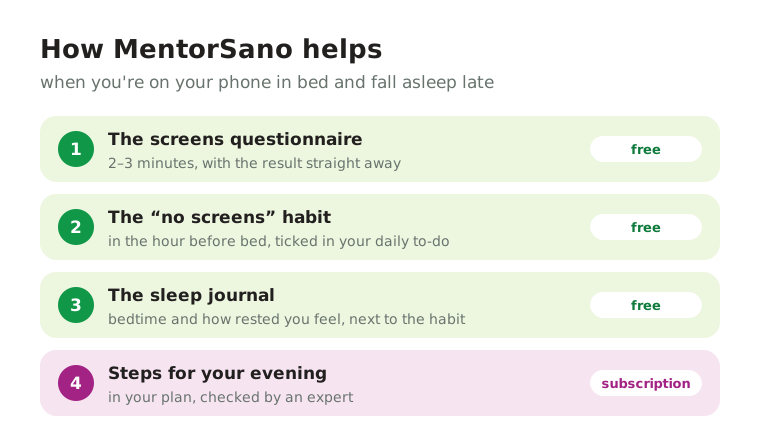
- The short screens questionnaire takes 2–3 minutes and gives you the result straight away: you find out how much of your evening screens take and where to start.
- The habit "no screens in the hour before bed" appears in your daily to-do, and you tick it on the evenings you kept it.
- The sleep journal keeps your bedtime and how rested you feel, and the chart shows you, next to the ticked habit, how you sleep on phone-free evenings.
- With the subscription you get simple steps for your evenings, in a personal plan checked by an expert and linked to your schedule and your stress.
The questionnaire and the journal are free. Create your free MentorSano account and keep your phone in another room for two weeks. The journal shows you whether you fall asleep earlier.
What if your phone isn't really the problem?
Sometimes the phone is just what you do while you can't fall asleep. If you've left your phone in another room for two weeks and still fall asleep at 1 am, the cause may be something else: worries that start when it goes quiet, afternoon coffee, a natural evening rhythm or insomnia that has set in. Then it's worth looking at what happens in the hours before bed, not just at the screen. If the problem has lasted for months and affects your day, talk to your GP.
When to see a doctor
- You can't fall asleep on several nights a week, for more than three months, even without your phone.
- You lie awake at night with worries and feel anxious or low during the day too.
- You fall asleep during the day without meaning to, for example while driving.
- You snore loudly and someone has noticed you stop breathing in your sleep.
- You feel you can't put your phone down and it affects your work, sleep or relationships.
Frequently asked questions
Is using my phone before bed really that bad?
The effect is real, but smaller than is often claimed. What matters most is the time it takes: if you're on your phone from 11 pm to 1 am, you've lost two hours of sleep, whatever the colour of the screen.
Does night mode or a blue light filter help?
It changes the colour of the screen, but it doesn't shorten the time you spend on your phone or make you less alert to what you're reading. It doesn't replace a switch-off time.
How long before bed should I put my phone away?
The NHS suggests an hour without phones, tablets or computers before bed. If an hour feels too much at first, start with half an hour.
Can I use my phone as an alarm if it's on silent?
You can, face down and with "Do not disturb" on. Still, a traditional alarm clock takes away your reason to keep the phone by the bed, and it usually helps more.
What if I can't fall asleep without my phone?
The first few evenings are the hardest. If you can't fall asleep in about 20 minutes, get up and do something calm in dim light, then go back to bed when you feel sleepy. Don't pick up your phone.
Is reading on an e-reader the same as a phone?
It depends on the screen. In the 2015 study, reading on a bright tablet delayed sleep compared with a printed book. If your e-reader has its own light, keep it at the minimum or read on paper in the evening.
Start from where you are today
MentorSano brings together your blood tests, sleep, meals, movement and habits, and Adrian Ienin checks your plan before it reaches you.
- 15-minute questionnaire
- Blood tests, explained
- Daily journal
- Lesson of the day
- An expert by your side
Adrian Ienin
Naturopathic pharmacist, nutrition and holistic health consultant, co-founder of MentorSano. He checks the articles here and the plans in the platform before they reach people.
Sources
- NHS Every Mind Matters: How to fall asleep faster and sleep better
- Chang et al. Evening use of light-emitting eReaders negatively affects sleep, circadian timing, and next-morning alertness, PNAS, 2015
- Exelmans, Van den Bulck. Bedtime mobile phone use and sleep in adults, Soc Sci Med, 2016
- Kroese et al. Bedtime procrastination: introducing a new area of procrastination, Front Psychol, 2014
- Orben, Przybylski. Teenage sleep and technology engagement across the week, PeerJ, 2020