The placebo effect: did it really work, or did it just seem that way?
 Checked by Adrian Ienin, pharmacist · updated
The placebo effect is a beneficial outcome that comes from expecting something to help you. It's real, but usually small and mainly on what you feel, such as pain or nausea. On top of that, your worst days are followed by better days anyway. That's why a few days' impression proves nothing. To know whether a change helps, take notes every day, at the same time, for a few weeks, and change one thing at a time.
Want to see what this means for you? Start for free →
Why do you feel better after trying something new?
You've started going to bed earlier, dropped your afternoon coffee or read about a tea that "helps you sleep". After three days you feel more rested. The natural question: did it really work, or did it just seem that way?
The honest answer is that, from three days, you can't know. Several things happened at once in those days. You expected to feel better. You started the change just when you felt at your worst. Maybe it was also a quieter week at work. All of these can produce the same feeling that "it's working".
That doesn't mean nothing works. It means you need a better way of looking at your own changes. Below you'll find out what the placebo effect is, what regression to the mean is and how to keep notes on your days so you see a trend, not an impression.
What is the placebo effect, really?
A placebo is something that looks like a treatment but doesn't contain the substance or action being tested: a sugar pill, a saline injection, a sham procedure. The US National Center for Complementary and Integrative Health (NCCIH) describes the placebo effect as a beneficial health outcome that comes from expecting something to help you. The way the person giving the treatment interacts with you matters too.
The effect is real, but it has limits. A Cochrane review brought together 234 trials in which some people got a placebo and some got nothing. In general, the authors did not find important clinical effects of placebo. They found small effects, mainly on what people feel and report, such as pain or nausea, and these varied a lot from one trial to another.
For you, this means a placebo can change how strongly you feel a symptom. It rarely changes what's measured, such as a blood test result.
What is the nocebo effect?
Nocebo is the opposite: you expect something to harm you and you really do get symptoms, even though what you were given can't cause them. You read the long list of side effects in the leaflet and the next day you notice every headache.
A well-studied example comes from statins, the cholesterol medicines. In a London study, 60 people who had stopped statins because of side effects took, in turn, in months chosen at random, the statin, an identical placebo tablet or nothing. The symptoms they reported in the placebo months were almost as strong as in the statin months.
That doesn't mean side effects don't exist or that a medicine is "all in your head". It means expectation matters, in both directions. If a treatment gives you symptoms, don't stop it on your own: talk to the doctor who prescribed it.
Why is there a placebo group in trials?
NCCIH says the standard for testing a treatment in people is the randomised, placebo-controlled trial. Volunteers are split at random into two groups. One group gets the treatment, the other a placebo that looks the same. Usually neither the volunteers nor the people assessing them know who got what.
The idea is simple. Both groups have the same expectations, go through the same good and bad days and change on their own in the same way. The difference between the groups is what the treatment did. Without a placebo group, all of the improvement would be credited to the treatment, even if some of it would have come anyway.
At home, you don't have a placebo group. That's why you need another method so the same things don't fool you. For how to read a study mentioned in the news, see health information.
What is regression to the mean, and why does it fool you?
Any repeated measurement varies from day to day. An article in the International Journal of Epidemiology explains the phenomenon: an unusually high or low value tends to be followed by one closer to the average. This is called regression to the mean. The authors say it can make natural variation look like real change.
In everyday life it looks like this. You rarely start something new in a good week. You start after three bad nights, when your back pain is at its worst or when your tiredness won't go away. But the worst days are usually followed by better days anyway. If that's exactly when you started something, the improvement looks like it came from it.
| What you notice | What else could explain it |
|---|---|
| You sleep better three days after a change | you started after your worst nights, and your sleep is returning to your usual |
| A cold goes away after you took something | colds go away on their own within a few days |
| You have more energy in the week of the new habit | it was a quieter week or you slept more |
| Headaches are rare after a change | headaches come and go in waves |
| You feel better as soon as you start | you expect to feel better and you notice the good days |
Why doesn't a few days' impression prove anything?
- Days vary a lot on their own. Sleep, energy and mood go up and down from day to day, for no particular reason.
- Memory is selective. You remember the days that match what you expected and forget the others.
- You change several things at once. When you decide to "look after yourself", you usually go to bed earlier, eat better and move more in the same week. You no longer know what made the difference.
- Some changes take time. A sleep or exercise habit usually shows in weeks, not days.
How do you track your own changes properly?
You don't need a laboratory. You need a few rules that you keep for a few weeks:
- Take notes before you change anything. One or two weeks of journal with no change show you what your usual days are like.
- Write it down every day, at the same time. In the morning, for example, how you slept and how rested you feel, on a scale from 1 to 10.
- Change one thing at a time. If you want to see whether an earlier dinner helps your sleep, don't give up coffee in the same week.
- Keep the change going for a few weeks. Three or four weeks give you enough days for one bad day not to spoil everything.
- Compare the average, not one day. Put the average from before next to the average from after. Look at the trend, not at your best day.
- Also write down what else changed: a cold, a hard time at work, a holiday.
| The usual mistake | What to do instead |
|---|---|
| Judging after 2–3 days | waiting 3–4 weeks |
| Remembering how it was | writing it down every day |
| Changing everything at once | changing one thing |
| Taking notes when you remember | taking notes at the same time |
| Looking at your best day | comparing the average before with the average after |
This method works for habits: sleep, dinner, exercise, coffee, evening screens. Don't use it to stop or change a medicine. That decision is one you make with your doctor.
How does MentorSano help you see the trend, not the impression?
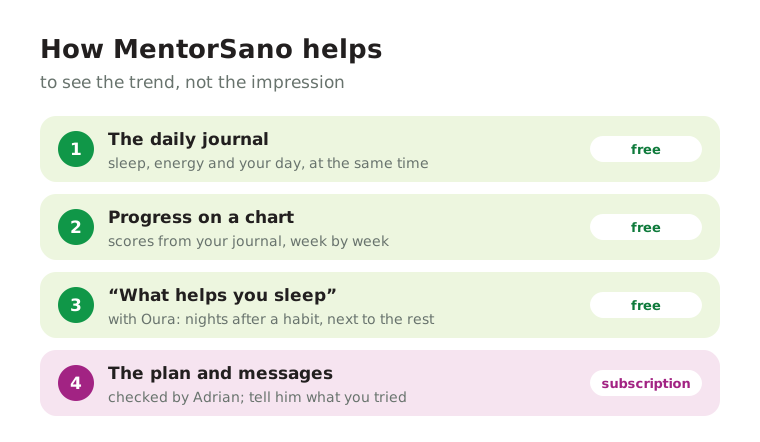
MentorSano doesn't make a diagnosis and doesn't tell you a treatment "works" or "doesn't work". It keeps your days on record so you compare weeks, not impressions:
- For free, the daily journal takes a minute or two: how you slept, how much you moved, how rested you feel and how your day went. You fill it in at the same time every day.
- For free, in Progress, sleep, energy, nutrition, movement and the other areas each have a score worked out from your journal. The charts show how they move over weeks, not just yesterday.
- For free, if you've connected an Oura ring, "What helps you sleep" puts the nights after a habit next to the others, only once you have at least four of each kind.
- With the subscription, the AI reads your journal together with the questionnaire and your blood tests, and Adrian Ienin, a pharmacist, checks the plan. You can write to him about what you tried and how you tracked it, and supplements, if they make sense for you, come with the reason.
To have something to compare against, create your free MentorSano account and start the journal before your next change.
What do you do if you want to try something new from Monday?
- Don't start on Monday. Keep the journal for a week or two first, with no change.
- Pick one thing and write down what you expect to change: sleep, energy, headaches.
- Decide in advance how long you'll keep it up, for example four weeks, and don't draw conclusions earlier.
- Take notes at the same time and write next to each day anything unusual.
- At the end, compare the average of the weeks before with the average of the weeks after.
- If it's a treatment prescribed by your doctor, don't change it or stop it on your own. Take your notes to your doctor: they help them see what happened.
If the difference still shows after four weeks, and not just in the first few days, you have a good reason to keep the habit.
When to see a doctor
- You have new symptoms after starting a medicine or treatment: talk to your GP or pharmacist before you stop it.
- You want to stop a prescribed treatment because you feel it isn't working or is harming you.
- You want to swap a prescribed treatment for something you've tried on your own.
- A health problem lasts several weeks or gets worse, however much you change your habits.
- You have chest pain, difficulty breathing, sudden weakness on one side of the body or confusion: call 999 (or your local emergency number).
Frequently asked questions
What does the placebo effect mean?
It's a beneficial health outcome that comes from expecting a treatment to help you, even if what you were given has no active substance. The way the person giving the treatment interacts with you matters too.
Is the placebo effect real or just imagination?
It's real, but it has limits. A Cochrane review of 234 trials found effects that were generally small, mainly on what people feel and report, such as pain or nausea. It rarely changes what's measured in blood tests.
What is the nocebo effect?
It's the opposite: you expect something to harm you and you really do get symptoms, even though what you were given can't cause them. If a treatment gives you symptoms, don't stop it on your own; talk to your doctor.
Why are placebos used in trials?
To separate the effect of the treatment from expectations and from changes that would happen anyway. People are split at random, and the difference between the treatment group and the placebo group shows what the treatment did.
What is regression to the mean?
It's the tendency for an unusually high or low value to be followed by one closer to usual. Because you usually start something new on your worst days, the improvement that comes anyway looks like it came from the change.
How long should I try something to know if it helps?
For a habit, such as your bedtime or an earlier dinner, allow three or four weeks, with a daily journal at the same time and a week or two of notes from before. Change one thing at a time.
Start from where you are today
MentorSano brings together your blood tests, sleep, meals, movement and habits, and Adrian Ienin checks your plan before it reaches you.
- 15-minute questionnaire
- Blood tests, explained
- Daily journal
- Lesson of the day
- An expert by your side
Adrian Ienin
Naturopathic pharmacist, nutrition and holistic health consultant, co-founder of MentorSano. He checks the articles here and the plans in the platform before they reach people. About Adrian and how we write our articles →
Sources
- NCCIH (National Institutes of Health): Placebo Effect
- Hróbjartsson, Gøtzsche. Placebo interventions for all clinical conditions, Cochrane Database of Systematic Reviews, 2010
- Barnett, van der Pols, Dobson. Regression to the mean: what it is and how to deal with it, International Journal of Epidemiology, 2005
- Wood et al. N-of-1 Trial of a Statin, Placebo, or No Treatment to Assess Side Effects, New England Journal of Medicine, 2020