How to read blood test results: asterisks, arrows and the reference range, explained
 Checked by Adrian Ienin, pharmacist · updated
To know how to read blood test results, start with the reference range printed next to each value. It shows where 95% of results from healthy people fall, so a healthy person can also land slightly outside it. Ranges and units differ from one lab to another, so you don't compare numbers from different reports. The trend over time and how you feel matter more than a single asterisk.
Want to see what this means for you? Start for free →
What do you see on a blood test report?
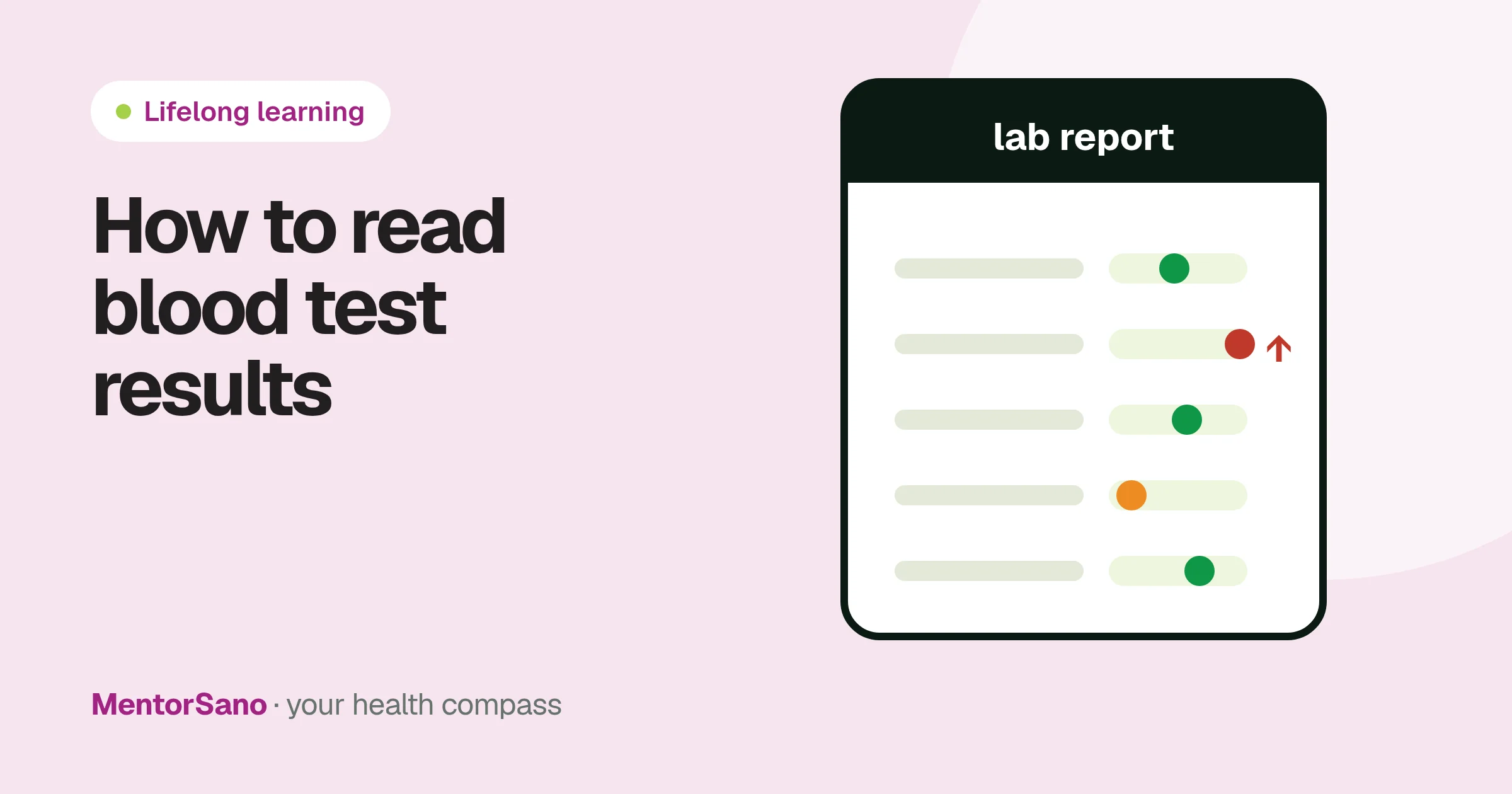
You get the report by email or in the lab's app. It's two pages of rows, a few values have an asterisk, one has an arrow pointing up, another is in bold. The first reaction is worry. The second is searching online, which usually brings even more worry.
A report usually has the same columns, whichever lab did it. If you know what each one is, you can read any row.
| Column | What it means |
|---|---|
| Test name | what was measured: glucose, haemoglobin, TSH, ferritin |
| Result | your value, from the sample taken that day |
| Unit | what it was measured in: mg/dL, mmol/L, µg/L, ng/mL |
| Reference range | the values most healthy people fall between, at that lab |
| Asterisk, arrow, H or L | the result is above (H, ↑) or below (L, ↓) the reference range |
| Method | how the analyser worked; it explains why ranges differ between labs |
Some tests don't give a number but an answer: "negative", "positive" or "inconclusive". Negative means the test didn't find what it was looking for. Inconclusive means it can't be said, and the test is usually repeated.
What is a reference range?
A reference range is set by measuring the same test in a large group of healthy people. Laboratory guidelines recommend at least 120 people. Then the middle is kept: 95% of the results. The lowest 2.5% and the highest 2.5% are left out.
This leads to something few people know: roughly one healthy person in 20 has a result outside the range for any given test. Not because they're ill, but because that's how the range is built. The more tests you have at once, the more likely it is that one of them comes back with an asterisk.
The US medical library MedlinePlus says the same: it's common for healthy people to sometimes have results outside the range. And a result within the range doesn't mean for certain that everything is fine, especially if you have symptoms.
Why does the range differ from one lab to another?
Labs use different analysers and methods. The same blood sample, measured in two places, can give slightly different numbers. That's why each lab prints its own range, matched to its method.
What this means for you:
- you compare your result only with the range on your own report, not with one you found online;
- you don't line up numbers from different labs as if they were the same measurement;
- if you want to follow a value over time, go to the same lab whenever you can.
The range can also change with age and sex. Children have different ranges from adults, and some tests have separate ranges for women and men.
What do the units mean?
The same substance can be measured in different units. Blood glucose, for example, is reported in mg/dL by many labs in Romania and in mmol/L in the UK and other countries. A glucose of 90 mg/dL is about 5 mmol/L. Both numbers describe the same blood.
When you compare two reports, look at the unit first. A number that looks ten times bigger may simply be written in a different unit.
Reference range or decision threshold?
For some tests, the line on the report doesn't come from healthy people but from studies on risk. Cholesterol and HbA1c are examples. There, the limit says from which value doctors recommend a particular decision, not what most of the population has.
The difference matters. A cholesterol value "within range" may not be the right target for someone at high heart risk. And a value above the threshold for HbA1c has a meaning set by studies, not just by statistics. Your doctor knows which is which.
What does a value slightly outside the range mean?
Most of the time, a value slightly above or below the range, in a person without symptoms, doesn't mean an illness. It may be the normal variation from one day to the next. It may also be something about the day the sample was taken.
| What can change a result | What you do next time |
|---|---|
| What you ate or drank beforehand | fast, if you were asked to |
| Medicines or supplements | tell your doctor and the lab about all of them |
| Hard exercise the day before | put off the hard workout until after the test |
| Your period | mention it; for some tests the day of the cycle matters |
| A recent cold or infection | ask whether the test is worth repeating in a few weeks |
Your doctor doesn't look at one row on its own. They look at how far the value is from the range, what the other tests show, how you feel and what treatments you take. A value far outside the range, or several values moving in the same direction, need attention sooner.
Why does the trend over time matter?
One test is a snapshot. Three tests, a few months apart, at the same lab, show the direction. Take a made-up example, with a value that stays "within range" the whole time:
| Report | Value | What you see |
|---|---|---|
| two years ago | in the middle of the range | nothing to watch |
| a year ago | in the lower third | it has dropped, no asterisk |
| now | close to the lower limit | still no asterisk, but falling steadily |
No report has an asterisk, but the direction tells you something. The other way round, an asterisk that shows up once, after years of good values, is often just variation. That's why it's worth keeping your old reports and taking them to your doctor.
If you feel tired even though your results come back fine, we've written separately about normal blood tests but still tired.
What should you ask your GP?
Appointments are short. A few questions prepared in advance help you leave with answers, not just "it's fine":
- Which of these values matter for me, with my history?
- Is the value with the asterisk a variation, or should it be repeated? When?
- Could it be caused by a medicine, a supplement or a cold?
- How does it compare with my results from last year?
- At what value should we be concerned?
- What can I change, in sleep, meals or movement, before my next tests?
How to read blood test results with MentorSano
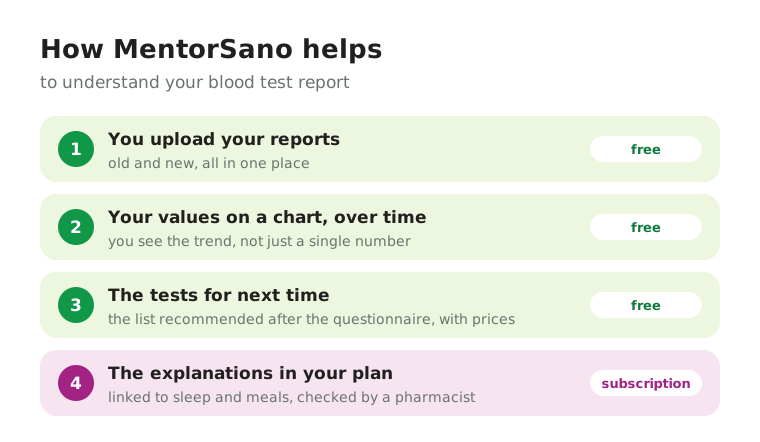
- You upload your reports, old and new, in one place, not in drawers.
- Your values appear on a chart, over time, the old ones next to the new ones, grouped by topic. You see the trend, not just a single number.
- After the questionnaire you get a list of recommended tests for next time: which ones you can usually get through your GP and which ones you pay for, with an approximate price.
- With the subscription, the AI reads your tests together with your answers and your journal, and Adrian Ienin, a pharmacist, checks the explanations. You learn how your values connect with sleep, meals and energy. Diagnosis is for your doctor.
To see your values on a chart, create your free MentorSano account and upload your first report. You don't need new tests to start.
How do you prepare for your next blood tests?
Reading starts before the sample is taken. A few things make results easier to compare:
- go to the same lab, so the ranges and methods stay the same;
- have the test in the morning, fasting, if that's what you were told;
- don't do hard exercise the day before;
- write down the medicines and supplements you take;
- bring your old reports, so your doctor can see the direction.
If you don't know which tests to ask for, read which blood tests to get, then talk the list through with your GP.
When to see a doctor
Your report is interpreted by a doctor. See or call your GP:
- if a value is far outside the range or the lab has called you about a result;
- if several values fall outside the range in the same direction;
- if you have symptoms, even with results within range;
- if a value keeps falling or rising from one report to the next;
- before starting, stopping or changing a treatment because of your results.
Frequently asked questions
What does the asterisk on a blood test report mean?
The asterisk, the arrow or the letters H and L show that the value is above or below the lab's reference range. It doesn't say how important the difference is. Your doctor judges that, together with your other results and how you feel.
Can I be healthy and have a value outside the range?
Yes. The range covers 95% of results from healthy people, so roughly one in 20 falls outside it for any given test without being ill. The more tests you have, the more likely an asterisk becomes.
Why do I get different values at different labs?
Labs use different analysers and methods, sometimes different units too. That's why each has its own range. To follow a value over time, go to the same lab whenever you can.
If all my results are within range, does that mean I'm healthy?
Not necessarily. Routine tests don't measure everything, and a result within range doesn't rule out a problem if you have symptoms. Tell your doctor how you feel, not just what the report says.
How often should I repeat my blood tests?
It depends on your age, your history and what was found. For a value slightly outside the range, your doctor may ask you to repeat it in a few weeks or months. For routine tests, they'll tell you the right interval.
Can I interpret my own results with MentorSano?
You can see them on a chart, over time, and understand what each one measures. With the subscription you get explanations linked to your answers and your journal, checked by a pharmacist. Diagnosis and treatment stay with your doctor.
Start from where you are today
MentorSano brings together your blood tests, sleep, meals, movement and habits, and Adrian Ienin checks your plan before it reaches you.
- 15-minute questionnaire
- Blood tests, explained
- Daily journal
- Lesson of the day
- An expert by your side
Adrian Ienin
Naturopathic pharmacist, nutrition and holistic health consultant, co-founder of MentorSano. He checks the articles here and the plans in the platform before they reach people.