Exercise after 50: how to start without getting injured
 Checked by Adrian Ienin, pharmacist · updated
For exercise after 50 it isn't too late, and you don't need a gym. The World Health Organization recommends 150–300 minutes a week of moderate activity, strength exercises at least twice a week and, from 65, balance exercises at least 3 times a week. You start with 10-minute walks, build up gradually and talk to your GP first if you have a long-term condition.
Want to see what this means for you? Start for free →
Why are you afraid to start?
"I'm 55, I haven't exercised for years and I'm afraid of getting injured." We hear this often. The fear has real reasons. Your knees aren't what they were at 30. Maybe your blood pressure is up. Maybe you once had a strain that lasted weeks. And you've seen people take up running overnight and stop a month later with tendonitis.
Injuries usually happen for the same reason: too much, too soon. The body adapts to effort, but it needs time. Muscles respond within a few weeks. Tendons and joints get used to it more slowly. If you start gently and build up gradually, the risk drops a lot.
What changes in the body after 50?
With every decade without movement you lose muscle mass and strength. Balance declines too, and reactions get slower. This is where many falls in later life come from. The World Health Organization reports that after 60, more and more people move too little, women and men alike.
Strength and balance can be regained at any age. The WHO links regular activity in adults and older adults to a lower risk of heart disease, high blood pressure, type 2 diabetes and falls, plus better sleep and a clearer mind. People who are not active enough have a 20–30% higher risk of death than people who are.
What does the WHO recommend for exercise after 50?
The WHO's 2020 guidelines have three parts. They are the same for adults up to 64. From 65, balance exercises are added.
| Type of activity | How much | Examples |
|---|---|---|
| Aerobic, moderate | 150–300 minutes a week, or 75–150 minutes of vigorous activity | brisk walking, cycling, swimming, dancing |
| Strength | at least 2 days a week | sit-to-stands from a chair, wall push-ups, resistance bands, digging in the garden |
| Balance and strength together (from 65) | at least 3 days a week | standing on one leg, walking along a line, tai chi |
| Less sitting | every day | get up every hour, walk around the house |
Moderate means you breathe faster and feel warmer, but you can still talk. The NHS gives a simple test: if you can talk but not sing, you're at the right intensity. You don't have to reach the figures in the table in the first month. The WHO says plainly that any activity is better than none.
What should you check with your GP first?
The NHS advises speaking to a GP first if you haven't exercised for some time or if you have a long-term condition. Your GP can tell you what is safe for you and what to avoid at the start. It's worth asking about:
- Heart and blood pressure: if you have high blood pressure, angina, an irregular heartbeat or have had a heart attack, what level of effort suits you and which signs tell you to stop.
- Diabetes: if you take insulin or medicines that lower blood sugar, how to avoid your blood sugar dropping too low while you exercise.
- Joints: painful knees, hips or back, arthritis, an old operation. Which movements spare them.
- Bones: if you have osteoporosis, which strength and balance exercises are safe for you.
- Medicines: some lower your pulse or blood pressure, and that changes how effort feels.
Basic blood tests, such as blood sugar and cholesterol, can usually be arranged through your GP. They give you a starting point. A few months later you can see whether anything has changed.
What do the first 8 weeks look like?
An example pace for someone starting from zero. If a week feels hard, repeat it before moving on to the next.
| Weeks | Walking | Strength and balance |
|---|---|---|
| 1–2 | 10 minutes a day, at your own pace, 5 days a week | sit-to-stands from a chair, 2 sets of 5, twice a week |
| 3–4 | 15–20 minutes, a little brisker | add wall push-ups and standing on one leg, holding on to a chair |
| 5–6 | 20–30 minutes, at a "can talk but not sing" pace | 3 sets, 2–3 times a week |
| 7–8 | 30 minutes, 5 days a week, which makes 150 minutes | a resistance band or two water bottles as weights |
After the 8 weeks you've reached the WHO minimum for the aerobic part. For more strength ideas, see the article on strength exercises at home. If you'd rather count steps, read how many steps a day are enough.
How do you avoid injuries?
- Warm up for 5 minutes. Easy walking, shoulder rolls, rising onto your toes. Warm muscles are harder to strain.
- Increase one thing at a time. Duration, pace or weight. Not all of them in the same week.
- Leave a rest day between two strength sessions for the same muscles.
- Listen to pain. Mild muscle soreness the next day is normal. A sharp pain in a joint that doesn't settle within a few days is not.
- Good shoes for walking, with soles that cushion your steps.
- Drink water before and after, especially in summer.
If you're worried about falling, the NHS says exercises that improve strength, balance and flexibility make you stronger and more confident on your feet. At first, do them next to a wall or a sturdy chair you can hold on to.
How does MentorSano help you start exercise after 50?
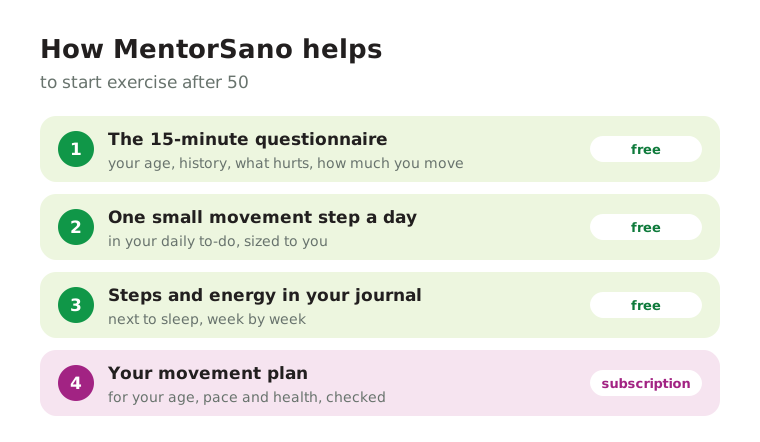
- The 15-minute questionnaire brings together your age, your history, what hurts and how much you move now. Your recommendations start from there.
- One small movement step a day appears in your daily to-do, sized to you: at first a 10-minute walk or a few sit-to-stands from a chair. You tick it off when it's done.
- Steps and energy in your journal sit next to sleep, so you see week by week how your activity grows and what it changes.
- With the subscription you get a movement plan that fits your age, pace and health, checked by an expert and linked to your sleep, meals and tests.
It all starts for free: create your free MentorSano account, fill in the questionnaire and get your first movement step, matched to where you're starting from.
What if something hurts after the first few days?
Muscle soreness usually appears the day after a new kind of effort and settles on its own. It isn't a sign that you have to stop. On that day, go for an easy walk instead of the strength exercises.
It's different if a joint swells, if the pain is sharp or wakes you at night. Then stop the exercise that caused it and ask your GP for advice. When you come back, start with an easier version, not where you left off.
When to see a doctor
- You have heart disease, high blood pressure or diabetes and want to start moving a lot more than you do now.
- You feel pain or tightness in your chest, dizziness or palpitations during effort.
- You get very breathless with little effort, such as climbing one flight of stairs.
- A joint swells or has a sharp pain after exercise and doesn't recover within a few days.
- You've had a fall in the past year or feel unsteady on your feet.
- You have osteoporosis and don't know which exercises are safe for you.
Frequently asked questions
I'm 55. Isn't it too late to start exercising?
No. Strength, balance and stamina can improve at any age. What matters is starting from your current level and building up gradually over a few weeks.
What kind of exercise suits people over 50?
Brisk walking is the easiest to start with. Cycling and swimming are gentle on the joints. Add strength exercises twice a week and, especially after 65, balance exercises.
Do I need to see my GP before I start?
The NHS advises it if you haven't exercised for some time or if you have a long-term condition, such as heart disease, high blood pressure, diabetes or arthritis. Your GP tells you what is safe for you.
Can I do strength exercises if my knees hurt?
Often yes, with adapted exercises: sit-to-stands from a higher chair, movements without jumping, light resistance bands. If the pain gets worse after exercise, ask your GP or a physiotherapist.
How often should I exercise at the start?
To begin with, 10 minutes of walking on 5 days a week and two short strength sessions. Then add a few minutes a week until you reach 150 minutes.
How do I know the effort is too much?
If you can't talk at all, if you have chest pain, dizziness or a sharp pain in a joint, stop. At moderate effort you can talk but not sing.
Start from where you are today
MentorSano brings together your blood tests, sleep, meals, movement and habits, and Adrian Ienin checks your plan before it reaches you.
- 15-minute questionnaire
- Blood tests, explained
- Daily journal
- Lesson of the day
- An expert by your side
Adrian Ienin
Naturopathic pharmacist, nutrition and holistic health consultant, co-founder of MentorSano. He checks the articles here and the plans in the platform before they reach people. About Adrian and how we write our articles →