Walking after meals: what it does for blood sugar and how long to walk
 Checked by Adrian Ienin, pharmacist · updated
Walking after meals is one of the simplest things you can do for your blood sugar. In a study published in Diabetologia, 10 minutes of walking after each main meal lowered blood sugar after meals by 12% compared with 30 minutes of walking once a day. After dinner, the difference was 22%. You don't have to walk fast. What matters is getting up soon after you've eaten.
Want to see what this means for you? Start for free →
Why do you feel heavy after eating?
"After dinner I sit on the sofa and feel heavy. At my last blood test, my blood sugar came back borderline." This is very common. After a big meal, especially one with bread, pasta, potatoes or dessert, the sugar in your blood rises. Your body releases insulin to move it into your cells. If you sit for hours straight after eating, your blood sugar rises higher and comes down more slowly.
In the evening it all adds up. Dinner is often the largest meal, and after it come the TV, the phone and then bed. Just when your body has the most sugar to deal with, your muscles are still.
What does walking do for blood sugar?
Working muscles take sugar from the blood to use as fuel. Some of it gets into muscle cells even without much insulin. That's why a walk taken while your blood sugar is rising after a meal makes it rise less.
It doesn't take much effort. Your leg muscles are the largest in your body, and walking at a normal pace puts them to work enough to make a difference.
What do studies show about walking after meals?
| Study | Who took part | What they compared | What they found |
|---|---|---|---|
| Reynolds et al., Diabetologia, 2016 | 41 adults with type 2 diabetes | 10 minutes of walking after each main meal, versus 30 minutes of walking once a day | blood sugar after meals 12% lower; after dinner, 22% lower |
| DiPietro et al., Diabetes Care, 2013 | 10 people over 60, with fasting blood sugar between 105 and 125 mg/dL | 15 minutes of walking after each meal, versus 45 minutes of walking once a day | both lowered 24-hour blood sugar; after dinner, the short walks lowered it more |
| Buffey et al., Sports Medicine, 2022 | an analysis of 7 studies | breaks of light walking or standing, versus sitting without a break | light walking lowered blood sugar and insulin after meals; standing helped less |
These are small, short-term studies. They show what happens to blood sugar on days with a walk, not that walking alone prevents diabetes. But all three point the same way. A few minutes of walking after a meal helps blood sugar, and it helps most after dinner.
The second study was done on exactly the people with borderline blood sugar. Fasting values of 105–125 mg/dL (about 5.8–6.9 mmol/L) in the morning are above normal but still below the threshold for diabetes.
How long, when and how should you walk?
| What | What to try |
|---|---|
| How long | 10–15 minutes after a meal |
| When | soon after you finish eating, not two hours later |
| After which meal | dinner first, then lunch |
| Pace | normal or a little brisker; you can talk easily |
| How often | every day, ideally after each main meal |
If you feel too full to walk briskly, walk slowly. Moving matters more than speed.
What can you do when you can't go out?
Rain, cold, early darkness, children to put to bed. Your muscles don't know whether you're outside or indoors. A few options:
- After-dinner chores: clearing the table, the washing-up, a round with the vacuum cleaner. They keep you on your feet and moving.
- Walking around the house or on the spot while you're on the phone or watching the news.
- The stairs in your building, at your own pace, a few floors up and down.
- Sit-to-stands from a chair and rising onto your toes, a few sets of 10, if your knees are fine.
- At least stand up. Standing helps less than walking, but more than the sofa.
If you also sit a lot during the rest of the day, read the article on sitting too much. For a picture of your blood sugar over the past few months, not just one morning, look at HbA1c.
How does MentorSano help with walking after meals?
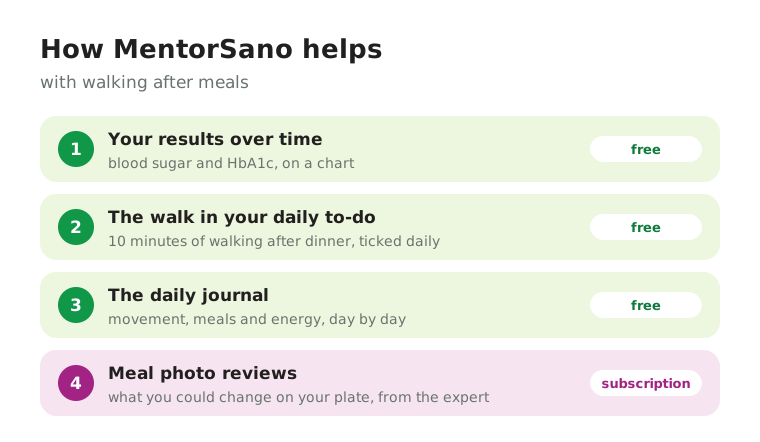
- Your results over time: upload your reports and see blood sugar and HbA1c on a chart, the old ones next to the new.
- The walk in your daily to-do: a small habit, such as 10 minutes of walking after dinner, that you tick off every day.
- The daily journal keeps track of movement, meals and energy, day by day, so you see how you feel on evenings with a walk.
- With the subscription you send photos of your meals and get the expert's review: what's good on the plate and what you could change next time.
The basics are free: create your free MentorSano account, upload your test results and put the after-dinner walk on your daily list.
How do you turn the walk into a habit?
Tie it to something you do anyway. "After dinner I put my shoes on and walk to the corner" is easier to keep than "I'll walk more". Keep your shoes by the door. Take someone from home with you. In the first week, 5 minutes is enough. Walk longer once the walk has become part of your evening.
Then look at the numbers. Blood sugar and HbA1c repeated a few months later, when your GP advises, show you whether the new habits have changed anything.
When to see a doctor
- Your fasting blood sugar came back above normal and you haven't yet discussed the result with your GP.
- You're very thirsty, pee often, especially at night, or are losing weight without trying.
- You take insulin or medicines that lower blood sugar and want to start moving a lot more.
- You get chest pain or tightness, dizziness or are very breathless when you walk after a meal.
- Your legs hurt when you walk, the pain makes you stop and it eases with rest.
Frequently asked questions
How long should I walk after a meal for it to help my blood sugar?
In studies, 10–15 minutes after each main meal was enough. In a study of people with type 2 diabetes, 10 minutes after each meal lowered blood sugar after meals more than 30 minutes of walking once a day.
Do I have to walk fast?
No. A normal or slightly brisker pace is enough. The 2022 analysis found an effect even with light walking that broke up sitting.
After which meal does walking help most?
After dinner. It is usually the biggest meal, and it's followed by the most sitting. In the <i>Diabetologia</i> study, the difference after dinner was 22%.
Is it bad to move straight after eating?
Light walking is fine for most people. Hard exercise straight after a big meal can be uncomfortable. If you have heart disease, ask your GP what level of effort suits you after meals.
Does walking after meals help if my blood sugar is borderline?
One of the studies was done on exactly this group: people over 60 with borderline fasting blood sugar. 15-minute walks after meals lowered their 24-hour blood sugar. But walking doesn't replace check-ups and repeat tests with your GP.
What can I do if I can't go out after a meal?
Housework, walking around the house, the stairs or a few sit-to-stands from a chair put your muscles to work. Even standing helps a little compared with the sofa.
Start from where you are today
MentorSano brings together your blood tests, sleep, meals, movement and habits, and Adrian Ienin checks your plan before it reaches you.
- 15-minute questionnaire
- Blood tests, explained
- Daily journal
- Lesson of the day
- An expert by your side
Adrian Ienin
Naturopathic pharmacist, nutrition and holistic health consultant, co-founder of MentorSano. He checks the articles here and the plans in the platform before they reach people.
Sources
- Reynolds et al. Advice to walk after meals is more effective for lowering postprandial glycaemia in type 2 diabetes mellitus than advice that does not specify timing: a randomised crossover study, Diabetologia, 2016
- DiPietro et al. Three 15-min bouts of moderate postmeal walking significantly improves 24-h glycemic control in older people at risk for impaired glucose tolerance, Diabetes Care, 2013
- Buffey et al. The acute effects of interrupting prolonged sitting time in adults with standing and light-intensity walking on biomarkers of cardiometabolic health: a systematic review and meta-analysis, Sports Medicine, 2022