Sleeping in at weekends: why Mondays feel awful and how to reset
 Checked by Adrian Ienin, pharmacist · updated
Sleeping in at weekends feels like catching up, but on Monday you feel worse. If you sleep 6 hours on weekdays and get up 3–4 hours later on Saturday, your body clock shifts towards the evening. On Sunday you can't fall asleep, and Monday morning feels like flying across time zones. This is called social jetlag. What helps is a nearly fixed wake-up time, at most an hour later at weekends, and a bedtime moved gradually earlier.
Want to see what this means for you? Start for free →
Why do you feel awful on Monday after a weekend of long lie-ins?
From Monday to Friday you sleep about 6 hours. On Saturday and Sunday you wake up at 11 or at midday and feel as if you've caught up. But on Sunday night you're not sleepy at 11 pm, you fall asleep after 1 am, and the alarm still goes off at 6:30. On Monday morning you feel worse than you did on Friday.
The explanation lies in your body clock. It resets every day, mostly by morning light and by the time you wake up. When you sleep until midday two days running, morning light reaches you several hours later and the clock shifts towards the evening. On Sunday night your body thinks it's earlier than the clock on the wall says. That's why you can't fall asleep, and the night before Monday gets even shorter.
What is social jetlag?
Researchers call this gap "social jetlag": the difference between when you sleep on work days and when you sleep on free days. The simplest way to work it out is from the midpoint of your sleep, the time halfway between falling asleep and waking up.
| Days | You go to bed | You wake up | Midpoint of sleep |
|---|---|---|---|
| Monday–Friday | 12:30 am | 6:30 am | 3:30 am |
| Saturday–Sunday | 2:00 am | 11:00 am | 6:30 am |
| The difference | 3 hours of social jetlag |
It's as if you crossed three time zones every weekend and flew back every Monday. The study that introduced the term, in 501 people, found the biggest gaps in people who are naturally evening types. In the same study, the links with poorer sleep, with mood and with coffee, alcohol and smoking were strongest in teenagers and young adults up to the age of 25. A later, much larger study also linked social jetlag with a higher body mass index. These are associations, not proof that the gap causes them on its own.
Why doesn't sleeping in at weekends make up for lost sleep?
The idea of "catching up" assumes that lost sleep builds up like a debt you pay off on Saturday. The body doesn't quite work like that. A 2019 laboratory study followed healthy young adults who had 5 hours of sleep a night on work days and could sleep as long as they liked at the weekend.
- Over the weekend they slept, in total, about 1.1 hours more than on the nights at the start of the study. Much less than they had lost.
- After the weekend, their body clock had shifted later.
- During the short nights after the weekend they ate more after dinner and put on weight.
- Insulin sensitivity fell by 9–27% compared with the start, so the body handled blood sugar less well.
The study was small, with 14 people in the weekend recovery group, but the authors' conclusion is clear: weekend recovery sleep was not an effective way to prevent the effects of too little sleep during the week. The weekend makes you feel less sleepy for a while. The underlying problem is still the 6 hours during the week.
What does a fixed wake-up time look like in practice?
NHS advice says the same thing: wake up at the same time every day, including days when you're not working, and don't sleep in after a bad night. Your wake-up time is what keeps your body clock in place. Your bedtime then sorts itself out, because you get sleepy earlier in the evening.
- Pick a time you can keep on Saturday too. If you get up at 6:30 on weekdays, get up by 7:30 at the latest at weekends.
- Light in the first half hour. Open the curtains or step outside for a few minutes. Morning light is the strongest signal for your body clock.
- A weekend morning worth getting up for. Your favourite breakfast, a walk, a coffee on the balcony. It's easier to get up when there's a reason to.
- If you're tired on Saturday, a short nap early in the afternoon disturbs your clock less than waking up at midday. MedlinePlus advises not napping after 3 pm.
How do you move your bedtime gradually?
A fixed wake-up time fixes Monday. To stop sleeping only 6 hours, you need to go to bed earlier. If you try two hours earlier all at once, you'll most likely lie in bed awake. Small steps work better: a quarter of an hour at a time, kept for a few days before the next step.
| Week | Weekday bedtime | Wake-up, Monday–Friday | Wake-up at weekends |
|---|---|---|---|
| 1 | 12:15 am | 6:30 am | 7:30 am at the latest |
| 2 | 12:00 am | 6:30 am | 7:30 am at the latest |
| 3 | 11:45 pm | 6:30 am | 7:30 am at the latest |
| 4 | 11:30 pm | 6:30 am | 7:30 am at the latest |
After four weeks you have an extra hour of sleep every work night, without changing your alarm. To make the steps stick:
- set an alarm for bedtime, not just for waking up;
- an hour before bed, dim the lights at home and put your phone away;
- move dinner and your last coffee earlier too, not just your bedtime;
- if you can't fall asleep in about 20 minutes, get up and do something calm (the bed rule is explained in the article on how to fall asleep faster).
How does MentorSano help if you're sleeping in at weekends?
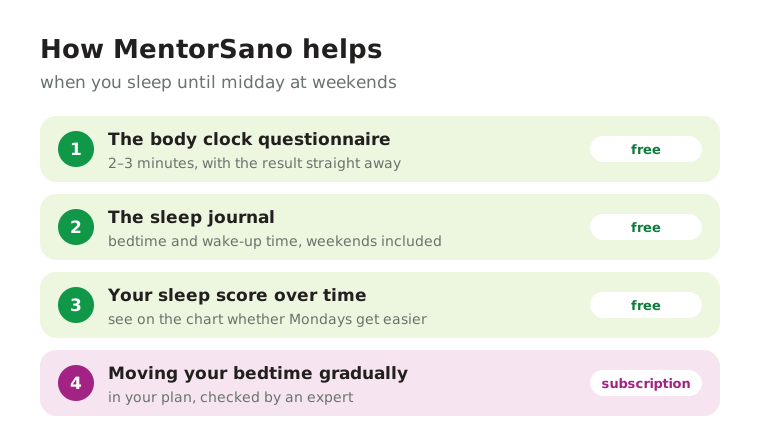
- The short body clock questionnaire takes 2–3 minutes and gives you the result straight away: you find out how far your rhythm shifts between work days and free days.
- The sleep journal keeps your bedtime, wake-up time and how you feel, every day, weekends included, in a minute or two.
- Your sleep score is calculated from the journal, and the chart shows you, week by week, whether Mondays are getting easier.
- With the subscription you get the steps for moving your bedtime gradually, fitted to your schedule, in a personal plan checked by an expert.
The sleep journal is free. Create your free MentorSano account and note your wake-up time for four weeks, Saturdays included. You'll see on the chart how the gap between Monday and Saturday closes.
What do you do on Sunday evening to make Monday easier?
Sunday evening is when Monday gets decided. A few things help most people:
- you got up on Sunday at your usual time, or at most an hour later;
- you went outside in daylight, for at least half an hour;
- you had a light dinner, not right before bed, and no alcohol;
- you get your clothes and bag ready for Monday the evening before, so there's nothing left on your mind;
- you go to bed at the time in your plan, even if you're not very sleepy, and leave your phone in another room.
The first weekend without a midday lie-in is the hardest. From the second one, you usually get sleepy earlier on Sunday night, and Monday morning no longer feels like landing after a long flight.
When to see a doctor
- You need many extra hours of sleep every weekend, even though you sleep 7–8 hours on weekdays.
- You fall asleep during the day without meaning to, for example while driving or in meetings.
- You snore loudly and someone has noticed you stop breathing in your sleep.
- You can't fall asleep before 2–3 am however hard you try, for months, and it affects your work.
- The tiredness doesn't go away after a few weeks of regular sleep times.
- You've felt low or lost interest in things for several weeks.
Frequently asked questions
Can I catch up at the weekend on sleep I lost during the week?
Only a little. In a laboratory study, people who had slept 5 hours a night slept only about an hour more in total over the weekend, and afterwards their body clock had shifted later. It's more useful to sleep longer on work nights.
How much later can I get up at weekends?
At most an hour later than on work days. Bigger gaps shift your body clock and make it hard to fall asleep on Sunday night.
What is social jetlag?
It's the difference between when you sleep on work days and when you sleep on free days. It's worked out from the midpoint of your sleep. A gap of 2–3 hours feels like a small jet lag every Monday.
Does a nap on Saturday help?
A short nap early in the afternoon disturbs you less than waking up at midday. Avoid napping after 3 pm, so you're sleepy in the evening.
How long does it take for my rhythm to settle?
Usually 2–4 weeks, if you keep your wake-up time and move your bedtime a quarter of an hour at a time. The first weekend is the hardest.
I'm an evening person. Do I have to get up early at weekends too?
Not necessarily early, but at the same time. If your schedule allows it, you can choose a later time, as long as it's the same every day. The difference between days matters more than the time itself.
Start from where you are today
MentorSano brings together your blood tests, sleep, meals, movement and habits, and Adrian Ienin checks your plan before it reaches you.
- 15-minute questionnaire
- Blood tests, explained
- Daily journal
- Lesson of the day
- An expert by your side
Adrian Ienin
Naturopathic pharmacist, nutrition and holistic health consultant, co-founder of MentorSano. He checks the articles here and the plans in the platform before they reach people.
Sources
- NHS Every Mind Matters: How to fall asleep faster and sleep better
- Depner et al. Ad libitum weekend recovery sleep fails to prevent metabolic dysregulation during a repeating pattern of insufficient sleep and weekend recovery sleep, Curr Biol, 2019
- Wittmann et al. Social jetlag: misalignment of biological and social time, Chronobiol Int, 2006
- Roenneberg et al. Social jetlag and obesity, Curr Biol, 2012
- NHS: Insomnia
- MedlinePlus: Healthy Sleep