High creatinine on a blood test: what it means for your kidneys
 Checked by Adrian Ienin, pharmacist · updated
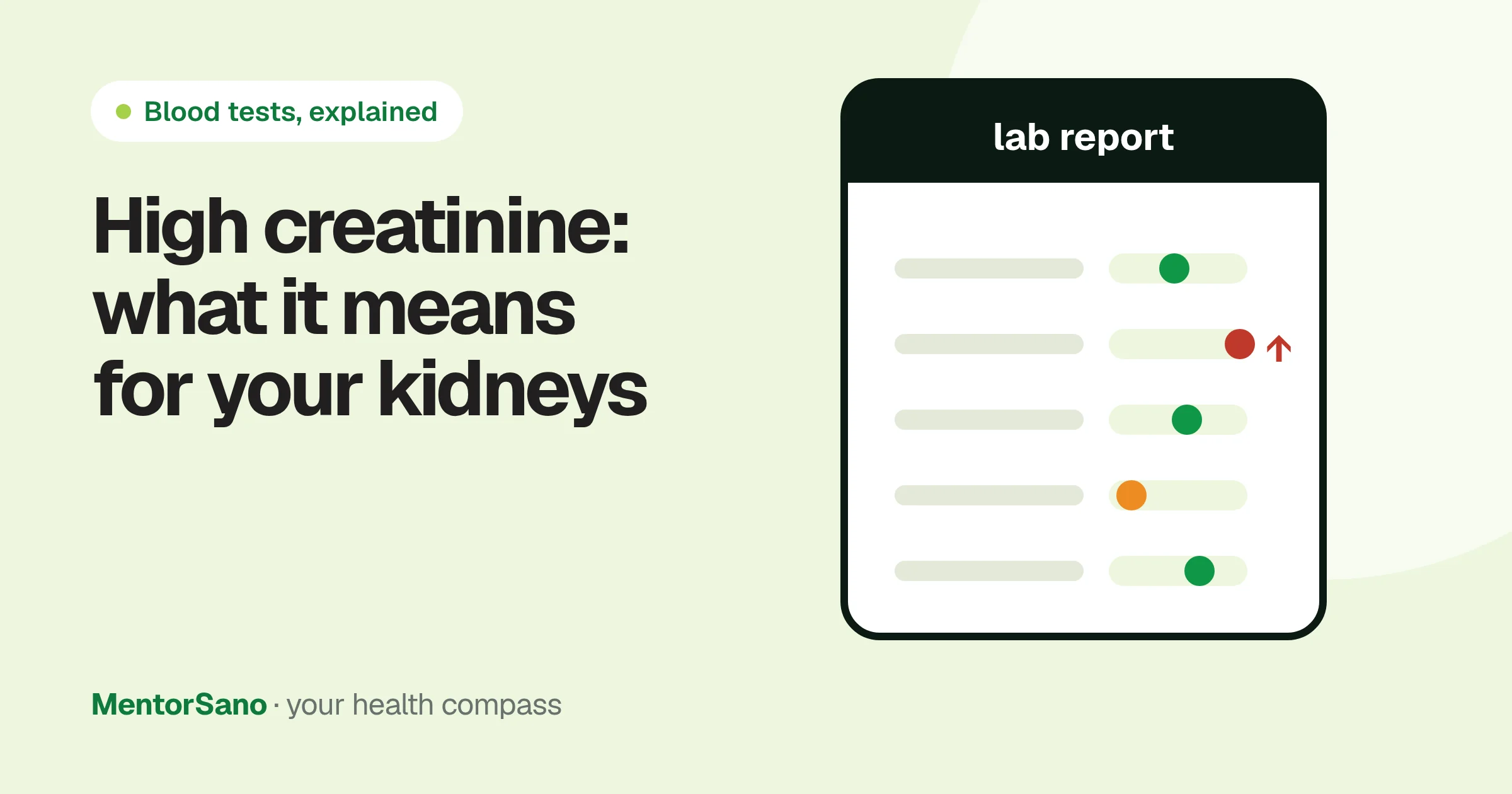
High creatinine doesn't, on its own, mean kidney disease. Creatinine comes from your muscles, so it depends on how much muscle you have, your age, your sex, meat eaten beforehand, hard exercise and how much water you've drunk. Your eGFR, calculated from it, says more, together with a urine test. A value slightly above the range is usually repeated. Your doctor tells you what it means for you.
Want to see what this means for you? Start for free →
What is creatinine, and why is yours high?
You've had routine blood tests. On the report, next to creatinine, there's an asterisk: the value is slightly above the range. The first question is a simple one: is something wrong with my kidneys?
Creatinine is a waste product. The US National Library of Medicine (MedlinePlus) explains where it comes from: your muscles make it all the time, as they work and as some of their tissue breaks down. Your kidneys filter it out of the blood and pass it out in your urine. If the kidneys filter less, creatinine builds up in the blood.
That's the link with the kidneys. But MedlinePlus also says the second part: creatinine on its own isn't the best way to see how well your kidneys work. Each person makes a different amount, depending on how much muscle they have, what they eat, their age and how active they are. And a single high result can't diagnose anything by itself. Usually a repeat test and a few other tests follow.
If you'd first like to know how to read any report, with reference ranges and units, start with the guide how to read blood test results.
What does your creatinine level depend on?
MedlinePlus gives typical normal values of 0.7–1.3 mg/dL (62–115 µmol/L) for men and 0.5–0.95 mg/dL (44–84 µmol/L) for women. Women usually have lower values because they have, on average, less muscle mass. The range on your own report may be slightly different, and that's the one that counts.
What can move the value without your kidneys being the cause:
| What affects creatinine | How it moves it |
|---|---|
| Muscle mass | more muscle means more creatinine; in very muscular people the value can come out high, and in people with little muscle, low |
| Sex and age | men usually have higher values; that's why the kidney formula takes them into account |
| Meat eaten beforehand | cooked meat can raise creatinine for a short time; the UK's NICE guideline advises not eating meat in the 12 hours before the test |
| Hard exercise | a very hard workout in the days before can shift the result; tell your doctor if you've had one |
| Too little fluid | dehydration, for example after diarrhoea, vomiting or a hot day without water, is listed by MedlinePlus among the causes of high creatinine |
| Some medicines | the NHS names non-steroidal anti-inflammatory drugs (ibuprofen, diclofenac), lithium and long-term omeprazole among those that call for kidney checks |
MedlinePlus says one more thing that seems the wrong way round: early in kidney disease, creatinine can stay within range. It only rises as the problem progresses. That's why your doctor doesn't look at it alone, whether it's high or normal.
What is eGFR, and why does it matter more than creatinine?
On many reports, under creatinine, there's a line called eGFR. It's the estimated glomerular filtration rate: how many millilitres of blood your kidneys clean per minute. The lab calculates it with a formula that puts together your creatinine, age and sex. That way it accounts for some of the differences between people.
The NHS says healthy kidneys filter more than 90 ml/min. The values fall into stages:
| eGFR (ml/min/1.73 m²) | Stage | What the NHS says |
|---|---|---|
| above 90 | G1 | normal filtering; it only matters if other tests show signs of damage |
| 60–89 | G2 | slightly reduced; it only matters together with other signs of damage |
| 45–59 | G3a | moderately reduced |
| 30–44 | G3b | moderately to severely reduced |
| 15–29 | G4 | severely reduced |
| below 15 | G5 | the kidneys have lost almost all of their function |
An eGFR between 60 and 89, with no other signs in the urine, isn't called chronic kidney disease. NICE defines chronic kidney disease as a change that lasts more than 3 months: an eGFR below 60 on at least two tests at least 90 days apart, or signs of kidney damage, such as albumin in the urine.
The formula has its limits too. NICE warns that in bodybuilders the eGFR can come out lower than it really is, and in people with very little muscle, higher. In cases like these, your doctor may ask for cystatin C. MedlinePlus explains why: cystatin C doesn't depend on muscle size, age or diet.
What do urea and the urine test tell you?
Urea often appears next to creatinine. It's also a waste product, made when the body breaks down protein, and the kidneys remove it too. MedlinePlus says urea also rises when you have too little fluid in your body, eat a lot of protein or take certain medicines, and that it usually goes up with age. Slightly high urea next to slightly high creatinine, after a day with little water, says something different from both being high on repeated tests.
The urine test completes the picture. The NHS says that, alongside your eGFR, urine tests give a more accurate picture of your kidneys. The most useful one measures albumin in the urine compared with creatinine in the urine. On the report it may appear as the albumin:creatinine ratio, or ACR.
| Albumin:creatinine ratio (mg/mmol) | Stage |
|---|---|
| below 3 | A1, within range |
| 3–30 | A2, moderately raised |
| above 30 | A3, severely raised |
Some labs give the result in mg/g, with different cut-offs. Look at the range on your own report. NICE advises that a value between 3 and 70 mg/mmol is confirmed on an early morning urine sample. MedlinePlus adds that hard exercise can raise urine albumin for a short time.
Why is a test with high creatinine repeated?
Because a single value can be moved by things that have nothing to do with your kidneys: last night's meat, yesterday's workout, a day with little water, a cold. NICE advises that an eGFR below 60, found for the first time, is confirmed with a new test within 2 weeks. The guideline also allows for the fact that creatinine results vary by around 5% from one measurement to the next anyway.
For the repeat test to tell you something, have it under conditions that are as clean as possible:
- don't eat meat in the 12 hours before, as NICE advises; MedlinePlus says some doctors ask for 24 hours;
- avoid a very hard workout the day before;
- drink water as usual, not much more and not less;
- don't go in the middle of a cold, with diarrhoea or a fever, unless your doctor has told you otherwise;
- tell your doctor which medicines you take, including ones without a prescription, but don't stop any of them without talking to your doctor.
If the repeat creatinine is back within range and the eGFR is good, most of the time the first value was moved by one of the factors above. If it stays high, your doctor usually asks for a urine test and, if needed, an ultrasound scan.
How does MentorSano help when you have high creatinine?
MentorSano doesn't diagnose and doesn't take the place of your doctor. It helps you see your creatinine over time, next to what you did in the days before the test, and go to your appointment with clear questions.
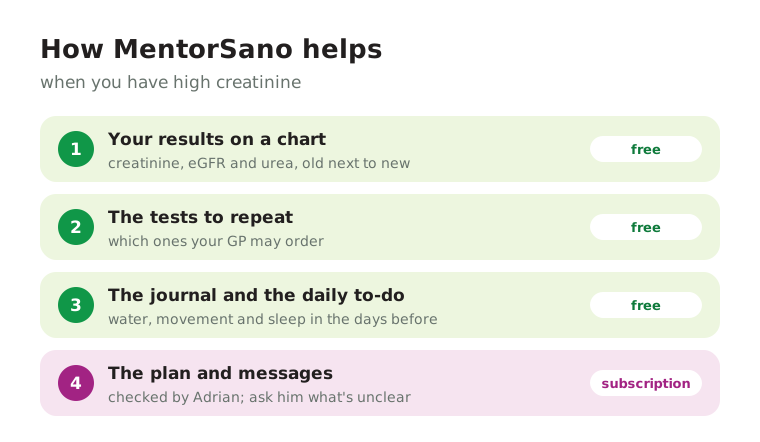
- You upload your blood tests and your creatinine, eGFR and urea appear on a chart, report after report. You see whether the value is new or one you've had, unchanged, for years.
- After the 15-minute questionnaire you get a list of recommended tests. You find out which ones are worth repeating and which ones your GP may order.
- The daily journal and your daily to-do keep track of water, movement and sleep. When you repeat the test, you know what you did in the days before.
- With the subscription, the AI reads your results together with your answers and your journal, and Adrian Ienin, a pharmacist, checks the "What matters now" plan. You can message him about anything on your report you didn't understand.
To see your creatinine on a chart, create your free MentorSano account. Uploading your results, the questionnaire and the journal are free.
What do you ask your GP when you have high creatinine?
Take your new report to the appointment and, if you have them, your old results too. A creatinine that has been the same for five years says something different from one that has risen since the last test. A few useful questions:
- "What is my eGFR, and which stage am I in?"
- "Should the test be repeated? When, and how do I prepare?"
- "Is it worth having a urine test for the albumin:creatinine ratio?"
- "Can the medicines I take change the result or put a strain on my kidneys?"
- "Do I need my blood pressure and blood sugar checked?"
Also tell your GP what you did in the days before the test: whether you ate meat the evening before, had a hard workout, drank little water or were ill. Tell them if anyone in your family has kidney disease. The NHS recommends regular kidney checks for people with high blood pressure, diabetes, heart disease or a family history of kidney disease.
When to see a doctor
- Your creatinine is high again on the repeat test, or rises from one test to the next.
- Your eGFR is below 60, or you have albumin, protein or blood in your urine.
- You pee much less than usual, or your urine is dark or has blood in it.
- Your ankles, feet or hands are swollen, you're short of breath or very tired.
- You have high blood pressure, diabetes or heart disease and haven't had your kidneys checked for a long time.
- You have severe muscle pain and very dark urine after extreme exercise, or you pee very little after severe diarrhoea. These can be emergencies: call 999 or 112, or go to A&E.
Frequently asked questions
Does high creatinine mean I have kidney disease?
Not necessarily. Creatinine depends on muscle, meat eaten beforehand, exercise and how much water you've drunk. Your doctor looks at your eGFR, repeats the test and usually asks for a urine test before drawing a conclusion.
What is eGFR on my report?
It's the estimated glomerular filtration rate, calculated from creatinine, age and sex. It shows how many millilitres of blood your kidneys filter per minute. The NHS says healthy kidneys filter more than 90 ml/min.
Can my creatinine be high because I exercise?
Yes. People with a lot of muscle make more creatinine, and a very hard workout in the days before can shift the result. Tell your doctor how much you train and anything you take for the gym.
How do I prepare for the repeat test?
Don't eat meat in the 12 hours before, avoid very hard exercise the day before and drink water as usual. Don't stop any medicine without talking to your doctor.
If I drink more water, will my creatinine go down?
If the value rose because of dehydration, it usually comes back down once you drink normally. Don't drink much more than usual before the test: you want a result that shows how you really are.
How is urea linked to creatinine?
Both are waste products your kidneys remove. Urea also rises when you have too little fluid, eat a lot of protein or take certain medicines. Your doctor reads them together, next to your eGFR and urine test.
Start from where you are today
MentorSano brings together your blood tests, sleep, meals, movement and habits, and Adrian Ienin checks your plan before it reaches you.
- 15-minute questionnaire
- Blood tests, explained
- Daily journal
- Lesson of the day
- An expert by your side
Adrian Ienin
Naturopathic pharmacist, nutrition and holistic health consultant, co-founder of MentorSano. He checks the articles here and the plans in the platform before they reach people. About Adrian and how we write our articles →
Sources
- MedlinePlus: Creatinine Test
- MedlinePlus: Creatinine blood test (normal values)
- MedlinePlus: Estimated Glomerular Filtration Rate (eGFR) and GFR Tests
- NHS: Chronic kidney disease, Diagnosis
- NICE NG203: Chronic kidney disease, assessment and management
- MedlinePlus: BUN (Blood Urea Nitrogen)
- MedlinePlus: Microalbumin Creatinine Ratio