Full blood count explained: what each abbreviation means
 Checked by Adrian Ienin, pharmacist · updated
A full blood count counts the cells in your blood: red blood cells and haemoglobin, white blood cells split into five types, and platelets. The lines are read together, not one at a time. A value slightly outside the range is common, even in healthy people. What matters is how far it is, how many lines move together and how it changes from one test to the next. Your doctor tells you what it means for you.
Want to see what this means for you? Start for free →
What is a full blood count, and why does it have so many lines?
You've got your results back. The first page is full of abbreviations: RBC, HGB, HCT, MCV, MCH, MCHC, WBC, NEU, LYM, PLT. Some have an arrow or an asterisk next to them. You don't know which ones matter and which are just another number.
A full blood count, also called a complete blood count or FBC, counts and measures the cells in your blood. The US National Library of Medicine (MedlinePlus) describes it as one of the most commonly ordered tests. Doctors ask for it at routine check-ups, when you have tiredness, fever or unexplained bruising, or to follow a condition or a treatment.
The lines fall into three families:
- red cells: red blood cells and haemoglobin, which carry oxygen;
- white cells: white blood cells, which defend the body against infection;
- platelets, which help your blood clot when you cut yourself.
If you'd first like to understand how to read any report, with reference ranges and units, start with the guide how to read blood test results. Here we only look at the lines of the full blood count.
What do the abbreviations in a full blood count mean?
The table below lists the usual lines, with the typical normal values given by MedlinePlus. The range on your own report may be slightly different; that's the one that counts.
| Line on the report | What it measures | Typical normal values (MedlinePlus) |
|---|---|---|
| Red blood cells (RBC) | how many red blood cells you have | men 4.6–6.2 million/µL; women 4.2–5.4 million/µL |
| Haemoglobin (HGB, Hb) | the protein that carries oxygen | men 13–18 g/dL; women 12–16 g/dL |
| Haematocrit (HCT) | what share of your blood is made up of red cells | men 40–55%; women 36–48% |
| MCV | how big a red blood cell is, on average | 80–100 fL |
| MCH | how much haemoglobin a red cell holds, on average | 27–32 pg |
| MCHC | how concentrated the haemoglobin is inside the cell | 32–36 g/dL |
| White blood cells (WBC) | how many white blood cells you have, in total | 4,500–11,000/µL |
| Platelets (PLT) | how many platelets you have | 150,000–400,000/µL |
Many labs write the same figures differently. White cells often appear as 4.5–11 × 10⁹/L and platelets as 150–400 × 10⁹/L. In the UK, haemoglobin is usually given in g/L, so 130 g/L is the same as 13 g/dL.
Your report may also show RDW, which shows how much the red cells differ in size from one another, and MPV, the average size of the platelets. Your doctor reads them together with the other lines, not on their own.
What do the red cells tell you?
The first lines are read together. Haemoglobin, haematocrit and the red cell count usually go up and down in the same direction.
MedlinePlus says low values on these three lines are a sign of anaemia. Anaemia has many causes. Among them: blood loss, for example heavy periods over a long time, a lack of iron, folate or vitamin B12, chronic kidney disease or long-lasting inflammation.
High values can appear when the body has too little fluid, for example after diarrhoea or heavy sweating, in smokers, in people who live at altitude or in some heart, lung or bone marrow conditions.
MCV, MCH and MCHC describe what the red cells look like. They help your doctor look for a cause, not name one on their own:
- small cells with little haemoglobin often appear when iron is lacking;
- large cells often appear when vitamin B12 or folate is lacking, but also in people who drink a lot of alcohol or take some medicines;
- early in iron deficiency, haemoglobin can still be normal while the iron store is already low.
There's a separate article on that last case: low ferritin explains why your iron store can run down before anything shows in haemoglobin.
What do white cells and the differential tell you?
White blood cells are the body's defence. The total count says little on its own. That's why the report also has a differential: the split into five types, as a percentage and as an absolute number.
| Type (abbreviation) | What it does, according to MedlinePlus |
|---|---|
| Neutrophils (NEU) | the most common white cells; the first line of defence, especially against bacteria |
| Lymphocytes (LYM) | B cells and T cells; antibodies and defence against viruses |
| Monocytes (MONO) | kill bacteria, viruses and other germs |
| Eosinophils (EOS) | defend against parasites; also go up in allergies |
| Basophils (BAS) | release substances during allergic reactions and asthma |
White cells often go up with an infection, with severe physical or emotional stress, after a burn or with some medicines, such as corticosteroids. They go down in some viral infections, in autoimmune diseases, with heavy alcohol use or with some treatments. The list comes from MedlinePlus and shows one simple thing: the same number can have many explanations.
The absolute number matters more than the percentage. If your total white cell count is low, the percentage of lymphocytes can come out high without their number having gone up.
What do platelets tell you?
Platelets stop bleeding. MedlinePlus lists bleeding, iron deficiency and some blood or bone marrow conditions among the causes of a high count. A low count can appear in pregnancy, when the spleen is enlarged, with some treatments or when platelets are destroyed faster.
With a value slightly outside the range, and no bruising or bleeding, your doctor will usually ask for the test to be repeated before any further tests.
What does a value slightly outside the range mean?
Most of the time, not much. MedlinePlus says the ranges come from the results of large groups of healthy people, and that it's common for healthy people to sometimes have results outside them.
What matters more:
- how far the value is from the range: just over the limit isn't the same as twice the limit;
- how many lines move together: low haemoglobin with a low MCV says more than a single line;
- the trend: a value that falls from one test to the next matters more than one that goes up and down;
- how you feel: tiredness, fever, bruising or bleeding change how your doctor reads the numbers.
A cold, hard exercise, too little fluid or a sleepless night can shift a few lines for a few days. That's why your doctor often repeats the test before drawing a conclusion.
How does MentorSano help you understand your full blood count?
MentorSano doesn't diagnose. It helps you see the lines of your full blood count over time and go to your GP with clear questions.
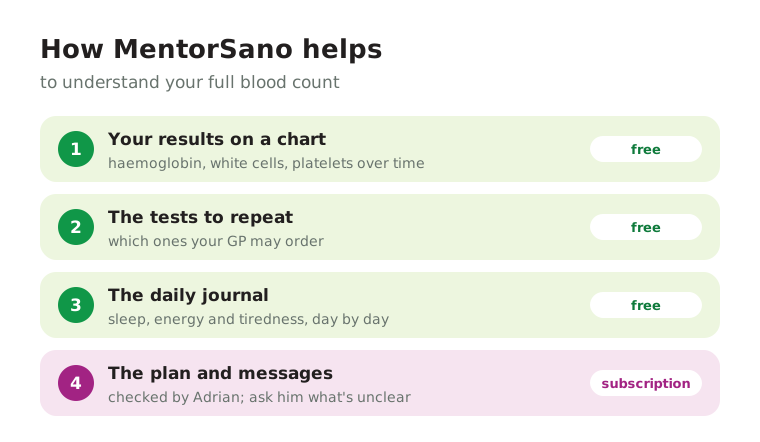
- You upload your blood tests and haemoglobin, white cells, platelets and the other lines appear on a chart, report after report. You see whether a value is new or one you've had for years.
- After the 15-minute questionnaire you get a list of recommended tests. You find out which ones are worth repeating and which ones your GP may order.
- The daily journal keeps track of your sleep, energy and tiredness in a minute or two a day. When you see your GP, you have more than "I've been tired for a while".
- With the subscription, the AI reads your results together with your answers and your journal, and Adrian Ienin, a pharmacist, checks the "What matters now" plan. You can message him directly about anything you didn't understand.
To see your full blood count on a chart, create your free MentorSano account. Uploading your results, the questionnaire and the journal are free.
What do you ask your GP when you have your full blood count in hand?
Take your new report to the appointment and, if you have them, your old results too. A few useful questions:
- "Do the values outside the range matter in my case, or are they normal variation?"
- "Should the test be repeated? When?"
- "Is it worth checking ferritin, vitamin B12 or folate as well?"
- "Can the medicines I take change the result?"
Also tell your GP what you've noticed: tiredness, heavy periods, bruising easily, frequent infections, losing weight without trying. All of it helps in reading the numbers.
Next time, have the test under similar conditions: in the morning, after a night's sleep, without hard exercise the day before and not in the middle of a cold, unless your doctor has told you otherwise.
When to see a doctor
- Your haemoglobin comes out well below the range or falls from one test to the next.
- You have severe tiredness, breathlessness on effort, dizziness or palpitations.
- You bruise easily, have nosebleeds or bleeding gums, or small red spots on your skin.
- You have a fever, frequent infections, night sweats or lose weight without trying.
- You have very heavy periods or blood in your poo.
- You have heavy bleeding, a high fever and feel very unwell, or chest pain. These are emergencies: call 999 or 112.
Frequently asked questions
What is a full blood count?
It's the test that counts the cells in your blood: red blood cells and haemoglobin, white blood cells by type, and platelets. It's done from an ordinary blood sample.
Do I need to fast for a full blood count?
For a full blood count on its own, usually not. But it's often done together with other tests, such as blood sugar, that need you to fast. Ask the lab what you need.
What do MCV, MCH and MCHC mean?
They're the red cell indices. MCV shows how big a red cell is, MCH how much haemoglobin it holds and MCHC how concentrated the haemoglobin is inside it. They help your doctor look for the cause of anaemia.
My white cells are slightly high. Is it serious?
Most of the time it isn't. White cells often go up with an infection, after hard exercise or with stress. Your doctor also looks at the differential and may repeat the test once you feel well.
Does normal haemoglobin mean I have enough iron?
Not necessarily. Your iron store, measured by ferritin, can fall before haemoglobin does. If you're tired or have heavy periods, ask your GP about ferritin.
How often should I have a full blood count?
There's no single schedule. In a healthy person it's usually done at a routine check-up. If a value comes out of range, your doctor tells you when to repeat it.
Start from where you are today
MentorSano brings together your blood tests, sleep, meals, movement and habits, and Adrian Ienin checks your plan before it reaches you.
- 15-minute questionnaire
- Blood tests, explained
- Daily journal
- Lesson of the day
- An expert by your side
Adrian Ienin
Naturopathic pharmacist, nutrition and holistic health consultant, co-founder of MentorSano. He checks the articles here and the plans in the platform before they reach people. About Adrian and how we write our articles →