Mobility exercises: a 10-minute routine for when you feel stiff
 Checked by Adrian Ienin, pharmacist · updated
Mobility exercises are slow movements, with no weights, that take your joints through the full range you have now, without pain. Eight movements, from your neck to your ankles, fit into 10 minutes. The NHS recommends flexibility exercises at least twice a week. They don't replace strength work or breaks from your desk, and pain that doesn't go away needs your GP.
Want to see what this means for you? Start for free →
Why do you feel stiff in the morning and after a day at the desk?
You get out of bed and your first steps feel rigid. In the evening, after eight hours in a chair, you bend down to tie your shoelaces and feel your back pull. For many people this is an ordinary feeling, not a sign of illness.
Your body adapts to what you do most. If you spend hours in the same position, with your hips bent and your shoulders rounded forward, your muscles and joints get used to it. At night you move very little in your sleep, so in the morning you need a few minutes to "get going". Something similar happens after a day in a chair.
Movement usually makes the difference. The NHS says that with ordinary back pain it helps to stay active and carry on with your daily activities, rather than keep still.
What are mobility exercises and how are they different from strength?
Mobility means how easily and how far you can move a joint: how far you turn your neck, how far you bend from the hip, how high you lift your arms above your head. Mobility exercises are slow, controlled movements done through the full range you have now, without pain.
| Mobility | Strength | |
|---|---|---|
| What it works on | how freely your joints move | how strong your muscles are |
| What it looks like | slow movements, no weights, repeated a few times | effort with your body weight or with weights, until you tire |
| How long | 5–10 minutes | 20–30 minutes |
| How often | daily, if you like | at least 2 days a week, according to the NHS |
One doesn't replace the other. Mobility helps you move more freely, and strength helps you carry things, climb stairs and keep your body stable. A simple strength circuit with no equipment is in the article on strength exercises at home.
A 10-minute routine of mobility exercises
The routine below has eight movements, from your neck down to your ankles. Do them in order, slowly, breathing normally. The first two are also described by the NHS in its series of flexibility exercises.
| Movement | How to do it | How much |
|---|---|---|
| 1. Neck rotation | Sit or stand upright with your shoulders down. Slowly turn your head towards your left shoulder as far as is comfortable, hold for 5 seconds and come back. Then to the right. | 3 on each side |
| 2. Sideways bend | Stand with your feet hip-width apart. Slide your left hand down the side of your thigh as far as is comfortable. You feel the stretch on the opposite side. Come back, then do the right. | 5 on each side |
| 3. Shoulder rolls and arm circles | Lift your shoulders towards your ears, take them back and lower them. Then make big circles with straight arms, forwards and backwards. | 10 shoulder rolls, 5 arm circles each way |
| 4. Cat and camel | On all fours, hands under your shoulders and knees under your hips. Slowly round your back upwards, chin towards your chest. Then lower your chest and look up. | 8 slow ones |
| 5. Side-lying chest rotation | Lie on your left side, knees bent and arms straight out in front. Open your right arm like a book, towards the back, following it with your eyes. Keep your knees together. Come back. | 5 on each side |
| 6. Hip hinge | Stand with your hands on your thighs and knees slightly bent. Push your bottom back and lean forward from the hip, back straight, until you feel the stretch at the back of your thighs. Stand up by squeezing your buttocks. | 8 slow ones |
| 7. Kneeling hip stretch | One knee on a cushion, the other foot in front. Slowly push your hips forward, keeping your upper body upright, until you feel the stretch at the front of the lower hip. | 30 seconds on each side |
| 8. Calf stretch against a wall | Hands on the wall, one leg straight behind you with the heel on the floor. The front leg is bent. You feel the stretch in the back calf. | 30 seconds on each side |
The hip hinge (movement 6) is how you bend using your hips, not just your back. If you practise it without any weight, it gets easier to use it when you pick something up from the floor.
How often should you do mobility exercises?
The NHS recommends flexibility exercises at least twice a week, alongside strength and balance exercises. The routine above is short, so you can do it every day too. It's easiest to keep up if you tie it to a fixed moment:
- In the morning, after you wake up, before coffee or while the kettle boils.
- In the afternoon, at work, only movements 1–3 and 6, which you do standing.
- In the evening, the whole routine, on a mat, after a long day in a chair.
Start with fewer repetitions than the table says and build up gradually, as the NHS also advises. If you sit a lot, the routine doesn't replace breaks during the day. What to do at your desk, between hours of sitting, is in the article on sitting too much.
What shouldn't you force?
- Pain. It's fine to feel a stretch. It's not fine to feel a sharp pain. If it comes, make the movement smaller or skip it.
- Bouncing. Don't bounce or push at the end of the movement to go further. Go slowly as far as you can and come back.
- Breathing. Don't hold your breath. Breathe out during the hard part of the movement.
- Comparing. Don't try to reach as far as someone else, or as far as you could ten years ago. Your range grows gradually, not in a day.
- Your neck. Don't roll it in a full circle, backwards. Only turn it left and right, as in the table.
If you're over 50 and haven't exercised for a long time, what to check first and how to build up is in the article on exercise after 50.
What do you do if your back hurts when you bend?
The NHS says back pain often improves on its own within a few weeks. Until then, it recommends staying active rather than staying in bed. Mobility exercises can be part of that, in the gentle version: small movements, with no sharp pain.
They don't treat a disease and they aren't a diagnosis. If the pain doesn't go away after a few weeks, if it wakes you at night or comes with numbness in your legs, see your GP. The full list is below, under "When to see a doctor".
How does MentorSano help you do mobility exercises every day?
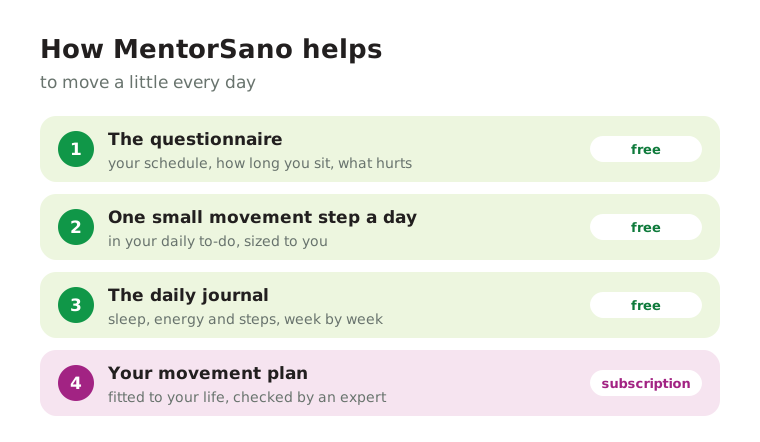
- The questionnaire gathers in one place your schedule, how long you sit, what hurts and how much you move now. The recommendations start from there.
- One small movement step a day appears in your daily to-do, sized to you: a few minutes of movement or a short walk. You tick it off when you've done it.
- The daily journal keeps your sleep, energy and steps, so you can see week by week how the days you move are different.
- With the subscription you get a movement plan that fits your life, checked by an expert and linked to your sleep, meals and blood tests.
Everything starts for free: create your free MentorSano account, fill in the questionnaire and get your first movement step, suited to your day.
How do you fit the routine into your day, from tomorrow?
- Choose the moment. Morning or evening, but the same one every day.
- Get the space ready. A mat or a towel next to the bed and a clear bit of wall.
- Start with half. In the first week, four movements out of eight. In the second week, all of them.
- Write down how you feel in the morning, before and after two or three weeks. That way you see whether it helps, not just whether it seems to.
- Add strength twice a week, once the routine has become a habit.
When to see a doctor
See your GP if:
- your back pain doesn't improve after a few weeks or stops you doing your day-to-day activities;
- the pain is worse at night or doesn't improve with rest;
- morning stiffness lasts longer than half an hour and your joints are swollen, warm or tender;
- you've lost weight without trying or have a fever along with back pain;
- you have pain, tingling, weakness or numbness in both legs;
- you have problems peeing or pooing, or numbness around your genitals. Then call 999 or go to A&E.
Frequently asked questions
What are mobility exercises?
Slow, controlled movements with no weights that take your joints through the full range you have now, without pain. Examples: neck rotation, cat and camel, the hip hinge.
How often should I do mobility exercises?
The NHS recommends flexibility exercises at least twice a week. You can do a 10-minute routine every day, in the morning or the evening.
Is it better in the morning or the evening?
Doing them regularly matters more than the time of day. In the morning they help you get going more easily, in the evening they help after a day in a chair. Choose the moment you can stick to.
Does mobility replace strength exercises?
No. Mobility works on how freely your joints move, strength works your muscles. The NHS recommends strengthening activities for all the major muscle groups on at least 2 days a week.
Can I do mobility exercises if my back hurts?
The NHS says that staying active helps with ordinary back pain. Keep the movements small and without sharp pain. If the pain is severe, doesn't go away within a few weeks or comes with numbness, see your GP first.
How soon will I notice a difference?
It varies from person to person. Write down how you feel in the morning now and again after two or three weeks of the routine. That way you see for yourself whether it helps.
Start from where you are today
MentorSano brings together your blood tests, sleep, meals, movement and habits, and Adrian Ienin checks your plan before it reaches you.
- 15-minute questionnaire
- Blood tests, explained
- Daily journal
- Lesson of the day
- An expert by your side
Adrian Ienin
Naturopathic pharmacist, nutrition and holistic health consultant, co-founder of MentorSano. He checks the articles here and the plans in the platform before they reach people. About Adrian and how we write our articles →