Walking for weight loss: how much it helps, how much to walk and what matters more
 Checked by Adrian Ienin, pharmacist · updated
Walking for weight loss helps, but less than you might think if you don't also change what you eat. In an analysis of 9 pedometer studies with no diet, people lost 1.27 kg on average, about 50 grams a week. Walking counts for much more when you pair it with better meals and build up gradually to over 250 minutes a week.
Want to see what this means for you? Start for free →
Does walking help if you don't like the gym?
"I want to lose weight, but I don't like the gym. Does walking help?" Yes, it does. You don't need a membership, equipment or a fixed timetable. Walking is the activity you can do most often, for years, and that matters more than a big effort kept up for two weeks.
Still, it's worth knowing from the start how much walking can do on its own and how much your plate does. Otherwise, after a month of daily walks and scales that have barely moved, you give up, convinced that "it doesn't work for me".
How much does walking matter compared with food?
For weight loss, food does most of the work. The CDC, the US public health agency, says that to lose weight and keep it off you need a lot of physical activity, unless you also change what you eat and drink.
The study figures show the same thing. An analysis of 9 studies in which people walked more, with a pedometer and no diet at all, found an average loss of 1.27 kg. The programmes lasted from 4 weeks to a year, most often around 16 weeks. That works out at about 50 grams a week. Longer programmes brought more.
Where walking really helps:
- It helps you not put weight on. Regular walking, adding up to 150–250 minutes a week, prevented weight gain in the studies reviewed by the American College of Sports Medicine.
- It helps you keep the weight off after losing it. People who kept their weight down after losing it usually moved for more than 250 minutes a week.
- It does more alongside better meals. Next to moderately cutting back on food, walking increased the weight lost.
- It helps even when the scales don't move. An analysis of 24 studies found that brisk walking in inactive people lowered weight, body fat and diastolic blood pressure, and improved fitness.
How many calories do you burn walking?
It depends on your pace and on how much you weigh. The CDC gives these approximate figures for a person weighing 70 kg:
| What you do | Calories in 30 minutes | Calories in an hour |
|---|---|---|
| Walking at 5.6 km/h (3.5 mph, moderate pace) | about 140 | about 280 |
| Walking at 7.2 km/h (4.5 mph, very brisk pace) | about 230 | about 460 |
If you weigh more than 70 kg, you burn a bit more; if you weigh less, a bit less. For comparison, a slice of cake or a large handful of nuts can hold as much as an hour's walk. That's why a walk doesn't "cancel out" a meal that was too big. Walking and meals work together, not one instead of the other.
How much should you walk for it to count?
| Minutes a week | What it means per day | What studies show |
|---|---|---|
| under 150 | under 20–25 minutes | a good start; for weight, studies needed more |
| 150–250 | 30–35 minutes every day | prevents weight gain; modest weight loss, more if you also eat less |
| over 250 | over 35–40 minutes every day | weight loss that counts and weight kept off afterwards |
The minutes add up. Two 20-minute walks count the same as one 40-minute walk. For how many steps that means and what studies show about step counts, read how many steps a day.
What does a brisk pace mean?
The NHS says brisk walking is about 3 mph (about 5 km/h), faster than a stroll. The simple test: you can talk, but you couldn't sing. If you can sing, you're walking too slowly for it to count as brisk. If you can no longer talk in sentences, you've moved on to hard effort.
You don't have to walk briskly all the time. Start at your own pace and speed up for a few minutes of each walk. As your fitness improves, the brisk pace becomes your normal pace.
How do you build up gradually without giving up?
The most common mistake is to start with an hour a day, get sore muscles or blisters and stop after a week. An example of building up, for someone who walks little at the moment:
| Weeks | Per day | Days |
|---|---|---|
| 1–2 | 10–15 minutes | 5 |
| 3–4 | 20 minutes | 5 |
| 5–8 | 30 minutes, with a few brisk minutes | 5–6 |
| after 8 | 35–45 minutes, in chunks if needed | 6–7 |
The NHS recommends comfortable shoes that support your feet and don't cause blisters, and increasing your distance gradually. If something hurts, stay at the previous level for a week.
How do you make walking a habit?
The walking that lasts is the walking tied to your day, not the walking you make special time for. A few ideas:
- Short journeys on foot: to the shop, to school, to the next bus stop.
- The after-dinner walk, which also helps blood sugar. The details are in the article on walking after meals.
- Long phone calls taken while walking.
- Someone with you: a friend, your partner, the dog. It's harder to cancel.
- A fixed time in your calendar, like an appointment.
If you've already tried diets that didn't last, also read why diets fail. Walking works on the same principle: a small habit, kept up for months.
How does MentorSano help with walking for weight loss?
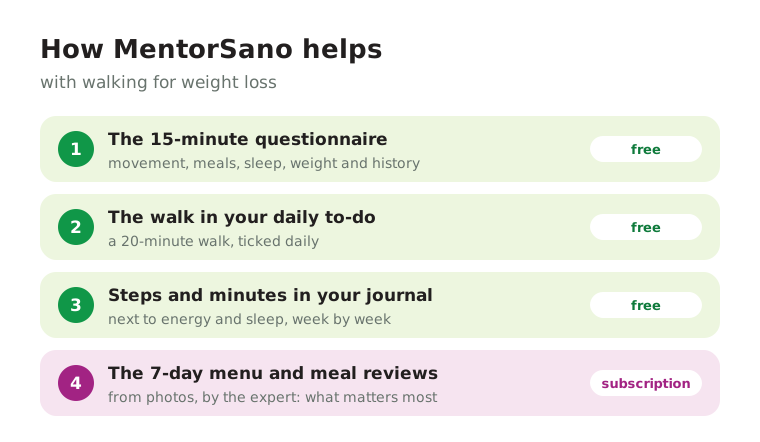
- The 15-minute questionnaire asks about your movement, meals, sleep, weight and history, so you know where you're starting from.
- The walk in your daily to-do: a small habit, such as a 20-minute walk, that you tick off every day.
- The daily journal keeps your steps and minutes of activity, next to your energy and sleep, so you see how you build up week by week.
- With the subscription you get a 7-day menu to your taste, and you send photos of your meals to get the expert's review: the part that matters most for weight loss.
The movement part is free: create your free MentorSano account, put the walk on your daily list and track your minutes for a few weeks.
What should you track besides the scales?
The scales move slowly and jump from day to day because of water and food. Look at other signs too. Do you climb stairs more easily? Can you reach 30 minutes of walking without getting tired? Do your trousers fit differently at the waist? Do you sleep better on days with a walk?
Note your walking minutes every week and weigh yourself once a week, on the same day, at the same time. After 2–3 months you have a real picture. If your weight doesn't change at all although you walk steadily, look at your meals first, not your steps.
When to see a doctor
- You get chest pain or tightness, dizziness or are very breathless when you walk.
- Your legs hurt when you walk, the pain makes you stop and it eases when you rest.
- You have heart disease, untreated high blood pressure or diabetes treated with insulin and want to increase your activity a lot.
- You have knee, hip or back pain that gets worse with every walk.
- You've gained or lost a lot of weight in a few months without changing anything.
- You have a lot of weight to lose and want a weight-loss plan that's safe for you; your GP can help.
Frequently asked questions
Can I lose weight just by walking, without changing what I eat?
A little. In an analysis of 9 pedometer studies with no diet, the average loss was 1.27 kg, about 50 grams a week. With better meals alongside walking, the result is much bigger.
How much should I walk a day to lose weight?
Studies show weight loss that counts only above 250 minutes a week, which is over 35–40 minutes every day. Between 150 and 250 minutes, walking helps you not put weight on and gives modest weight loss.
How many calories do I burn in an hour of walking?
According to the CDC, a person weighing 70 kg burns about 280 calories in an hour of walking at 5.6 km/h (3.5 mph) and about 460 at 7.2 km/h (4.5 mph). Someone who weighs more burns a bit more.
Does it matter if I walk once for 40 minutes or twice for 20?
For calories and for your weekly minutes, not really. The total is what counts. Choose the option you can keep up day after day.
How do I know if I'm walking fast enough?
Brisk walking means about 3 mph (about 5 km/h). You can talk, but you couldn't sing. If you can sing easily, speed up a little.
Why am I not losing weight even though I walk every day?
An hour's walk can be worth about a slice of cake, and activity sometimes makes you hungrier too. Look at your meals first. Walking still helps: fitness, blood pressure and body fat can improve even when the scales move slowly.
Start from where you are today
MentorSano brings together your blood tests, sleep, meals, movement and habits, and Adrian Ienin checks your plan before it reaches you.
- 15-minute questionnaire
- Blood tests, explained
- Daily journal
- Lesson of the day
- An expert by your side
Adrian Ienin
Naturopathic pharmacist, nutrition and holistic health consultant, co-founder of MentorSano. He checks the articles here and the plans in the platform before they reach people. About Adrian and how we write our articles →
Sources
- Donnelly et al. American College of Sports Medicine Position Stand. Appropriate physical activity intervention strategies for weight loss and prevention of weight regain for adults, Medicine & Science in Sports & Exercise, 2009
- Richardson et al. A meta-analysis of pedometer-based walking interventions and weight loss, Annals of Family Medicine, 2008
- Murphy et al. The effect of walking on fitness, fatness and resting blood pressure: a meta-analysis of randomised, controlled trials, Preventive Medicine, 2007
- CDC: Physical Activity and Your Weight and Health
- NHS: Walking for health