Napping: how long to nap, when, and when it ruins your night
 Checked by Adrian Ienin, pharmacist · updated
Napping helps if the nap is short. In a study of adults who had slept only 5 hours the night before, a 10-minute nap made them more alert straight away, and the effect lasted up to two and a half hours. After 30 minutes of sleep, people woke up groggy and needed time to recover. If you have insomnia, it's better not to nap at all.
Want to see what this means for you? Start for free →
Why do you get sleepy in the afternoon?
"After lunch my eyes start closing. If I sleep for 20 minutes, is that fine or will it ruin my night?" This is a very common question. The answer depends on how long you sleep, at what time and how you sleep at night.
Afternoon sleepiness has two causes that add up. The first is your body clock. In most people, alertness dips a little in the early afternoon, even after a good night. The second is the sleep you're missing. The less you slept at night, the stronger the need to sleep during the day.
Lunch isn't the main cause, but it plays a part. A big meal with lots of bread, pasta or dessert, plus a warm room and a long meeting, make the dip easier to feel.
How long should napping last?
The length of a nap is the best-studied question. In an Australian study, 24 young adults who usually slept well slept only about 5 hours at night. The next day, at 3 pm, they took naps of 5, 10, 20 and 30 minutes in turn, plus one day with no nap.
| How long they slept | What happened afterwards |
|---|---|
| 5 minutes | hardly any difference from the day with no nap |
| 10 minutes | more alert and less tired straight away; the effect lasted up to 155 minutes |
| 20 minutes | the effect only appeared after 35 minutes and lasted up to 125 minutes |
| 30 minutes | first a spell of grogginess and poorer alertness, then the effect lasted up to 155 minutes |
The study is small and done on young people who didn't usually nap. But a 2006 review reaches the same conclusion: naps under 30 minutes help alertness and learning, while longer naps bring grogginess and a less productive afternoon.
Why do you wake up groggy after an hour's sleep?
Sleep has stages. In the first few minutes you sleep lightly and wake up easily. If you sleep longer, you go into deep sleep. When you're woken from deep sleep, your brain needs time to get going. You feel heavy, confused, sometimes more tired than before. This is called sleep inertia.
That's where the feeling "if I sleep during the day, I feel worse" comes from. Usually the problem isn't the nap itself but its length. A one-hour nap often wakes you right out of deep sleep.
What time is best for a nap?
A daytime nap lowers the sleep pressure you build up during the day. That same pressure helps you fall asleep at night. The closer to evening you nap, the less of it you have left at bedtime, and falling asleep gets harder.
- Early in the afternoon, shortly after lunch, when the dip in alertness comes anyway.
- Not towards evening. A nap at 6 pm or nodding off in front of the TV after dinner pushes your sleep later.
- With an alarm. Set it for 20 minutes from when you lie down. That keeps you in light sleep.
- Not necessarily in bed. An armchair or a sofa helps you not slide into a long sleep.
When does an afternoon nap help, and when is it a warning sign?
| Situation | What it means | What to try |
|---|---|---|
| You sleep well at night and want a short break | the nap is a choice, not a need | 10–20 minutes, early in the afternoon |
| You had a bad night, once in a while | a short nap helps you get through the day | a short nap, then bed at your usual time |
| You need a nap every day to function | your nights are probably too short or your sleep isn't refreshing | look at the night first, not the afternoon |
| You struggle to fall asleep or wake up at night | daytime sleep may take from your night's sleep | stop napping for a while |
| You fall asleep without meaning to, even after long nights | sleepiness that needs to be checked | talk to your GP |
If you need a nap every afternoon, first ask yourself how many hours you sleep at night. The article on how many hours of sleep an adult needs helps you do the sums. If you sleep enough hours and still wake up struggling, read waking up tired.
Who should avoid napping?
People with insomnia. If you struggle to fall asleep, wake up at night and can't get back to sleep, or wake far too early, a daytime nap takes away from your need for sleep in the evening. The NHS advice for insomnia says directly: do not nap during the day. The first few days feel hard. After a few days, night-time sleep usually comes together better.
Afternoon coffee can play the same role from the other side. If you drink coffee to get through the after-lunch dip, read tiredness and coffee.
Long, frequent napping also deserves a closer look in older people. Population studies have linked long and frequent naps with more health problems. That doesn't mean naps cause them. Often, the need for long daytime sleep is a sign of a problem that's already there.
How does MentorSano help with napping?
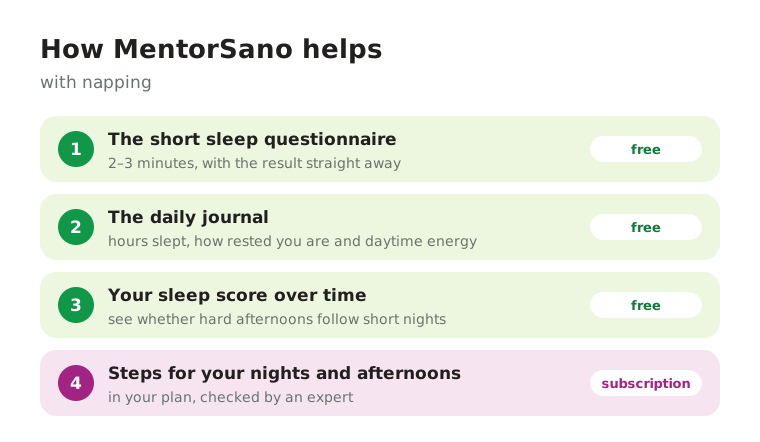
- The short sleep questionnaire takes 2–3 minutes and gives you the result straight away: you find out where to start.
- The daily journal keeps how many hours you slept, how rested you woke up, your energy during the day and whether you had an energy slump.
- Your sleep score is worked out from the journal, and the chart shows you whether the hard afternoons follow the short nights.
- With the subscription you get simple steps for your nights and afternoons, in a personal plan checked by an expert and linked to your meals and your stress.
The sleep journal is free. Create your free MentorSano account and note for two weeks how you sleep and how your afternoons go.
How do you try it for a week without ruining your nights?
Pick a fixed time, early in the afternoon. Set the alarm for 20 minutes. It doesn't matter whether you really fall asleep: resting with your eyes closed is a break too. When the alarm goes off, get up, drink some water and go out into the daylight for a few minutes.
In the evening, go to bed at your usual time. In the morning, note how long you slept and how you feel. After a week, compare the nights after days with a nap with those without. If you fall asleep later or wake more often, stop napping and put your effort into the night. If your nights stay the same and your afternoons feel easier, a 20-minute nap suits you.
When to see a doctor
- You fall asleep during the day without meaning to, even after nights when you slept enough hours.
- You've nodded off at the wheel or nearly fallen asleep while driving.
- You snore loudly and someone has noticed you stop breathing or choke in your sleep.
- You sleep long at night, nap during the day too, and still wake up confused or unrefreshed.
- Your need for daytime sleep started suddenly, along with a new medicine, a low mood that won't lift or other symptoms.
- You've struggled to fall asleep or stay asleep for several months and it affects your day.
Frequently asked questions
How long should an afternoon nap be?
Around 10–20 minutes. In a study of adults who had slept little the night before, 10 minutes helped straight away. After 30 minutes, people woke up groggy and needed time to recover.
Does napping ruin your night's sleep?
A short nap early in the afternoon usually doesn't. Long naps or evening naps lower your need for sleep at bedtime and can make it harder to fall asleep. If you have insomnia, it's better not to nap.
Why do I feel worse after an hour's nap?
Because you woke up from deep sleep. Your brain needs time to get going, and for a while you feel heavy and confused. It's called sleep inertia and it passes, but a shorter nap avoids it.
If I can't fall asleep, is there any point lying down?
Yes. A few minutes of rest with your eyes closed, somewhere quiet, is still a break. Don't force yourself to sleep, and get up when the alarm goes off.
Is it normal to need a nap every afternoon?
A slight dip in alertness in the afternoon is normal. If you can't function without a nap, you're most likely sleeping too little at night or your sleep isn't refreshing. If you sleep enough hours and still fall asleep during the day without meaning to, talk to your GP.
What time is too late for a nap?
The closer to evening, the more it takes from your night's sleep. Early afternoon is the safest. Nodding off in front of the TV after dinner usually pushes your sleep later.
Start from where you are today
MentorSano brings together your blood tests, sleep, meals, movement and habits, and Adrian Ienin checks your plan before it reaches you.
- 15-minute questionnaire
- Blood tests, explained
- Daily journal
- Lesson of the day
- An expert by your side
Adrian Ienin
Naturopathic pharmacist, nutrition and holistic health consultant, co-founder of MentorSano. He checks the articles here and the plans in the platform before they reach people. About Adrian and how we write our articles →
Sources
- Brooks, Lack. A brief afternoon nap following nocturnal sleep restriction: which nap duration is most recuperative?, Sleep, 2006
- Dhand, Sohal. Good sleep, bad sleep! The role of daytime naps in healthy adults, Current Opinion in Pulmonary Medicine, 2006
- Milner, Cote. Benefits of napping in healthy adults: impact of nap length, time of day, age, and experience with napping, Journal of Sleep Research, 2009
- NHS: Insomnia
- NHS: Hypersomnia