Shift work and sleep: how to sleep in the day after a night shift
 Checked by Adrian Ienin, pharmacist · updated
Shift work and sleep clash because your internal clock is set by light and asks for sleep at night. Most shift workers sleep 1–4 hours less than people who work during the day. What helps: sunglasses on the way home, a dark and quiet bedroom, a fixed bedtime after each shift, a short sleep before the shift and coffee only at the start. If you still can't sleep after a month, talk to your GP.
Want to see what this means for you? Start for free →
Why can't you sleep during the day after a night shift?
"I work night shifts. I get home at 8, I'm exhausted, I go to bed and three hours later I'm wide awake. The rest of the day I drag myself around." This is very common. It isn't about willpower, and it doesn't mean you're sleeping "wrong".
Your body has an internal clock that runs on a cycle of roughly 24 hours. The American Academy of Sleep Medicine (AASM) explains that this clock is set mainly by light. Light tells the brain it's daytime, and darkness signals it to make melatonin, the hormone that prepares you for sleep. When you work at night, your clock asks for sleep while you're at work. When you get home, in the morning light, it wants you awake.
A review published in 2012 by Smith and Eastman, researchers in biological rhythms, puts the problems of night work down to three things that add up:
- an internal clock out of step with your hours of work, sleep and meals;
- sleep that is too short, day after day, which builds up into a sleep debt;
- light at night, which stops melatonin just when your body would need it.
On top of that comes daytime life: street noise, children, the phone, deliveries. Cleveland Clinic writes that most shift workers sleep 1–4 hours less than people who work during the day.
How common is the problem?
A 2017 review in the journal Chest says that nearly one in five employees in industrialised countries works some form of schedule outside normal hours. Cleveland Clinic estimates that shift work sleep disorder affects 10–40% of them. So not everyone who works nights sleeps badly. Some people adapt more easily. The AASM says people who usually go to bed late cope better with evening shifts, and early risers with early morning shifts.
If you're wondering whether it's just a hard week or something that lasts, the AASM gives a simple marker: sleep problems linked to your work schedule that have lasted at least a month and affect your family life, social life or work are worth discussing with your doctor.
What helps shift work and sleep fit together?
You can't change what your internal clock asks for, but you can help it move at least part of the way. The tips below come from the AASM, Cleveland Clinic and the review by Smith and Eastman.
| What you do | Why it helps |
|---|---|
| Wear sunglasses on the way home | morning light tells your clock the day has started; sunglasses reduce it and you fall asleep faster |
| Make the bedroom as dark as possible: blackout curtains or an eye mask | darkness lets your body make melatonin, even though it's daytime outside |
| Ask the people at home for quiet and put your phone on silent | daytime sleep is lighter and breaks more easily with noise |
| Go to bed at the same time after every shift | your internal clock shifts more easily when it gets the same signals |
| Drink coffee at the start of your shift, not towards the end | coffee late in the shift spoils the sleep that follows |
| Sleep for 20–30 minutes before your shift or during a break | the AASM says even a short nap improves alertness at work |
| Don't drive when you're drowsy | the drive home after a night's work is a time with a risk of accidents |
Don't change everything at once. Start with light and the bedroom: they usually make the biggest difference.
How do you split your sleep between shifts?
Many people can't sleep 7–8 hours in one go during the day. Cleveland Clinic points out that shift workers also need 7–9 hours of sleep a day. If you can't get them in one block, you can split them:
- your main sleep, straight after the shift, at the same time each time, as long as you manage;
- a short sleep before the shift, in the afternoon or evening, so you start the night more rested.
The short sleep before a shift follows the same rules as an ordinary nap. The details on how long it should last, and why you wake up groggy after an hour, are in the article on napping.
On days off, it's tempting to switch straight back to a daytime schedule or sleep until midday. The AASM advises keeping a similar schedule on days off as far as you can. If that isn't possible, move your bedtime gradually. The mechanism is the same as with a long Saturday lie-in, explained in sleeping in at weekends.
If you work rotating shifts, the AASM suggests asking, if possible, for a "clockwise" rotation: from mornings to afternoons, then to nights. It's easier to stay up later than to go to bed earlier. Cleveland Clinic adds a few markers for your rota, to discuss with your employer: no more than 5 nights in a row, no more than 4 twelve-hour shifts in a row and, after a run of nights, more than 48 hours off.
What should you eat and drink on a night shift?
Your internal clock doesn't only control sleep. Smith and Eastman also list mealtimes among the activities that fall out of step with it on night shifts. Many people feel heavy after a big meal at 3 in the morning. A few practical points:
- have your main meal before your shift, not in the middle of the night;
- during the shift, choose something smaller and lighter that you can bring from home;
- drink water throughout the shift, not just coffee;
- don't get home hungry: a small snack before sleep is better than a big meal;
- don't use alcohol to fall asleep: the AASM lists using alcohol or other substances to sleep among the risks of shift work.
Coffee deserves extra care. The AASM and Cleveland Clinic advise moderate amounts at the start of the shift and stopping in the later part. If you feel you can't get through the night without coffee, also read tiredness and coffee.
How does MentorSano help with shift work and sleep?
MentorSano doesn't diagnose. It helps you see how you sleep after each shift and which change works for you.
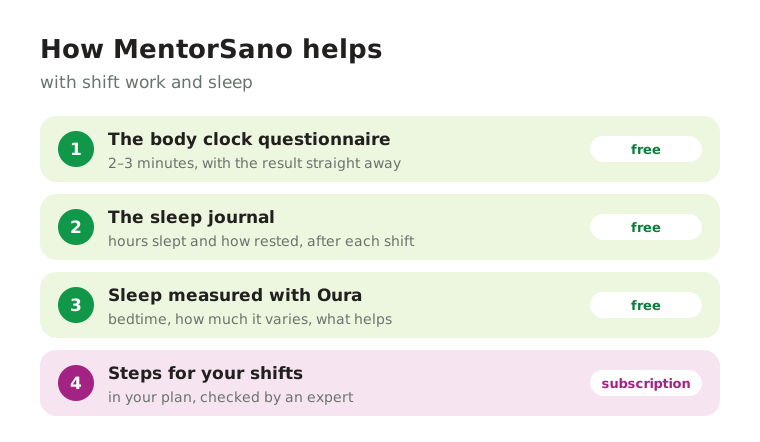
- The body clock questionnaire takes 2–3 minutes and gives you the result straight away: you find out where you stand with light, sleep times and your internal clock.
- The sleep journal keeps track of how many hours you slept and how rested you woke up, after each shift. After two weeks you see which days went better.
- With an Oura ring, "Your sleep" shows your measured nights, your bedtime and how much it varies, and "What helps you sleep" puts sleep after a habit next to sleep without it.
- With the subscription you get steps for your shifts, in a personalised plan checked by an expert: bedtime, light, coffee and meals.
The sleep journal is free. Create your free MentorSano account and write down for two weeks how you sleep after your shifts.
What does a trial week of night shifts look like?
Pick two changes and keep them for one week of shifts. For example: sunglasses on the way home and the curtains drawn in the bedroom. Everything else stays the same.
After each main sleep, write down:
- what time you went to bed and what time you woke up;
- how many times you woke up and what woke you: noise, light, hunger, your phone;
- what time you had your last coffee on the shift;
- whether you also slept before the shift, and for how long;
- how rested you feel, from 1 to 10.
At the end, compare with the week before. If your main sleep has got longer or you wake up less often, keep the changes and add one more, for example stopping coffee earlier. If nothing has changed after a few weeks, take your notes to your GP. The AASM says your doctor may ask you to keep a two-week sleep diary before the appointment anyway.
When to see a doctor
- You haven't been able to sleep, or have felt very tired, for at least a month, even though you've tried changing the light, the bedroom and your hours.
- You've nodded off at the wheel or nearly fallen asleep driving home.
- You're making mistakes at work or have had accidents because of tiredness.
- You snore loudly and someone has noticed you stop breathing in your sleep.
- You've felt low, irritable or hopeless for several weeks.
- You use alcohol or over-the-counter pills to fall asleep.
Frequently asked questions
Why can't I sleep during the day after a night shift?
Because your internal clock is set by light. Morning light tells the brain it's daytime and stops melatonin. On top of that, noise and daily life around you make daytime sleep lighter and shorter.
How many hours should I sleep if I work shifts?
The same as other adults, 7–9 hours a day, says Cleveland Clinic. If you can't get them in one go, you can split them into a main sleep after the shift and a short one before the next shift.
Is it good to sleep before a night shift?
Yes, a short sleep before the shift helps. The AASM says even 20–30 minutes of sleep improves alertness at work.
How do I sleep in the day with light and noise?
Blackout curtains or an eye mask for the light, quiet at home, your phone on silent. Sunglasses on the way home help you fall asleep faster.
When should I have my last coffee on a night shift?
The AASM and Cleveland Clinic advise moderate amounts at the start of the shift and stopping coffee in the later part, so it doesn't spoil the sleep that follows.
What should I do on my days off?
Keep a schedule similar to your working days as far as you can. If you need to go back to a daytime schedule, move your bedtime gradually, not all at once.
Start from where you are today
MentorSano brings together your blood tests, sleep, meals, movement and habits, and Adrian Ienin checks your plan before it reaches you.
- 15-minute questionnaire
- Blood tests, explained
- Daily journal
- Lesson of the day
- An expert by your side
Adrian Ienin
Naturopathic pharmacist, nutrition and holistic health consultant, co-founder of MentorSano. He checks the articles here and the plans in the platform before they reach people. About Adrian and how we write our articles →
Sources
- American Academy of Sleep Medicine: Shift Work
- Cleveland Clinic: Shift Work Sleep Disorder
- Smith, Eastman. Shift work: health, performance and safety problems, traditional countermeasures, and innovative management strategies to reduce circadian misalignment, Nature and Science of Sleep, 2012
- Wickwire et al. Shift Work and Shift Work Sleep Disorder: Clinical and Organizational Perspectives, Chest, 2017