Resting heart rate and HRV on your watch: what the numbers mean
 Checked by Adrian Ienin, pharmacist · updated
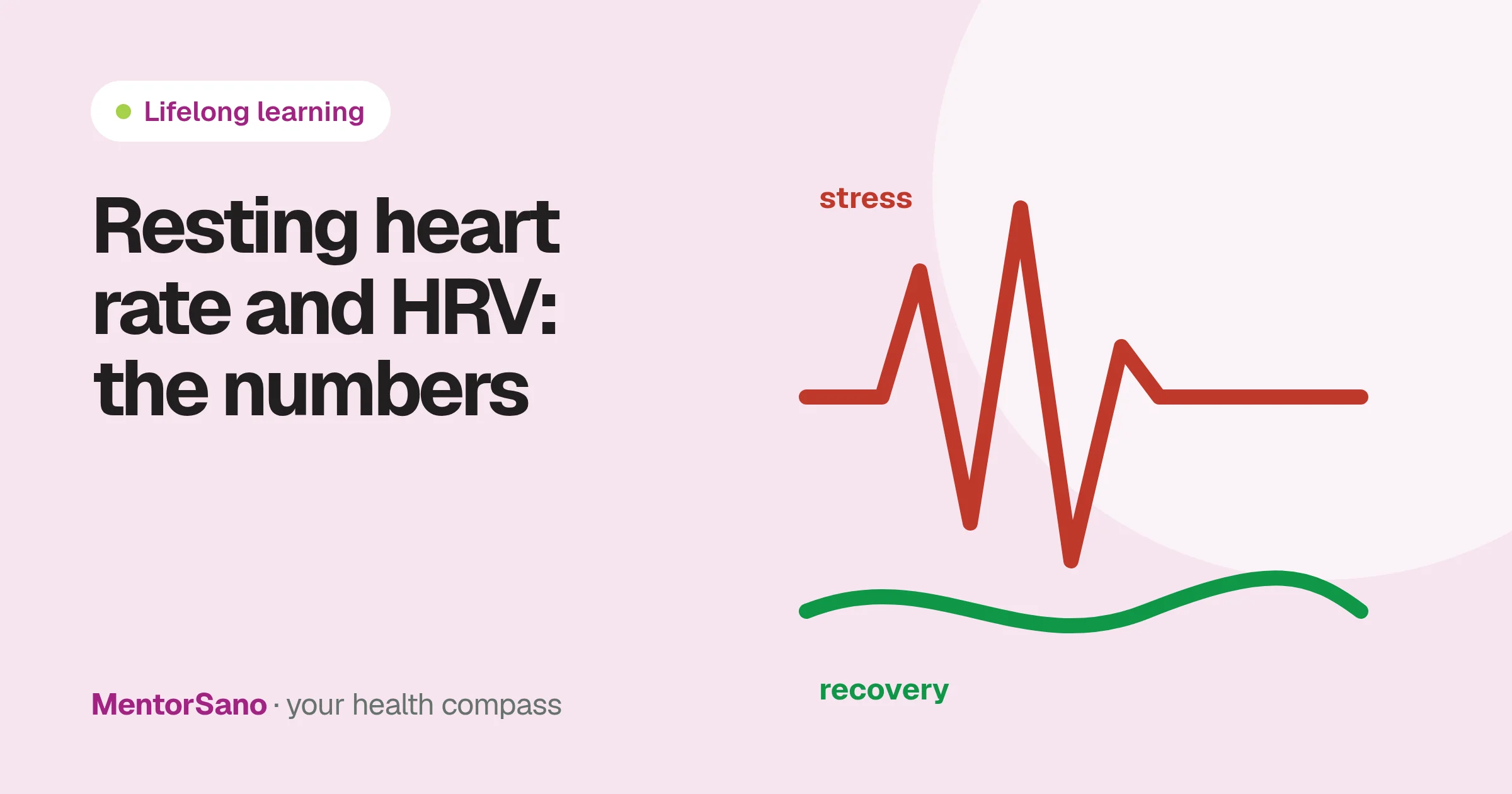
Resting heart rate is the number of times your heart beats per minute while you're sitting or lying quietly. In adults it's usually between 60 and 100, and in very fit people it can drop to 40–60. HRV shows how much the time between two beats varies. Poor sleep, alcohol, stress and a cold push your heart rate up and your HRV down for a few days. The numbers only mean something next to your own usual values, not someone else's.
Want to see what this means for you? Start for free →
What does your watch show you in the morning?
You wake up, open your watch or ring app and see two numbers: resting heart rate 58, HRV 42. Yesterday they were 54 and 51. The app puts an arrow or a colour next to them, but it doesn't tell you what they mean for you or whether you need to do anything.
Both numbers are useful. They're just read differently from a blood test. There's no "good" HRV value that applies to everyone, and a day with a higher heart rate isn't an illness. Below you'll find what each one measures, what changes them and how to use them.
What is resting heart rate?
Resting heart rate is the number of heartbeats per minute when you've been still for at least a few minutes: sitting, lying down or just after waking, before you get out of bed. MedlinePlus, the information service of the US National Library of Medicine, gives these ranges:
| Who | Usual resting heart rate |
|---|---|
| Children aged 10 and over, and adults, including older adults | 60–100 beats per minute |
| Very well-trained athletes | 40–60 beats per minute |
| Children aged 7–9 | 70–110 beats per minute |
The adult range is wide. Someone at 55 beats and someone at 75 can be equally healthy. What matters more is how your heart rate moves compared with your own usual value.
Watches and rings usually measure heart rate during the night and take the lowest value or the average during sleep. It usually comes out lower than the heart rate you measure sitting during the day. Don't compare the two. Compare tonight with your previous nights, on the same device.
How do you measure your own resting heart rate?
You don't need a watch. MedlinePlus says that for a resting heart rate you should have been resting for at least 10 minutes. Then:
- put the tips of your index and middle fingers on your wrist, below your thumb, or on your neck, beside your windpipe;
- count the beats for 15 seconds and multiply by 4, or for 30 seconds and multiply by 2;
- measure in the morning, before coffee and before you get out of bed, for a few days in a row, at the same time;
- write the number down. One reading tells you little. A week of readings shows you your usual value.
While you count, pay attention to the rhythm too. The beats should come at regular intervals. An irregular pulse, with beats that seem to skip, is a reason to see your GP, even if you feel well.
What pushes resting heart rate up from one day to the next?
| What happens | What you usually see | How long it lasts |
|---|---|---|
| Alcohol in the evening | higher heart rate and lower HRV in the first part of the night | usually one night |
| Short sleep or a restless night | higher heart rate the next day | one or two days |
| A cold, flu, a fever | higher heart rate, lower HRV | as long as the illness |
| Too little fluid, or a very hot day | higher heart rate | until you drink enough |
| Stress, a hard spell at work | slightly higher heart rate, lower HRV | as long as the spell lasts |
| A hard workout | higher heart rate and lower HRV the next day | one or two days |
| A big, late dinner | higher heart rate in the first part of the night | one night |
| Regular exercise, for months | heart rate slowly comes down | for as long as you keep it up |
MedlinePlus lists infection and dehydration among the reasons for a fast pulse. For alcohol, there's a study of 4,098 employees in Finland who wore a device that recorded every heartbeat, for days at a time. On nights after drinking, even a small amount, the recovery measured in the first three hours of sleep went down. The more they drank, the more it went down. The effect was also seen in people who exercised regularly. More on the evening drink in cutting down on alcohol.
What is HRV, in plain words?
Your heart doesn't beat like a metronome. There might be 0.9 seconds between two beats, 1.0 seconds between the next two, then 0.95. HRV (heart rate variability) measures how much these intervals vary. Watches usually give it in milliseconds.
The variation comes from the part of your nervous system that works without you deciding. One side of it gets you ready for effort and stress. The other helps you rest and digest. When you're rested and calm, the intervals vary more and HRV is higher. When you're tired, ill, stressed or have been drinking, the intervals become more even and HRV drops.
A review published in Frontiers in Public Health shows that HRV values differ a lot from one person to another. They depend on age, on how they're measured and on how long the recording lasts. That's why there's no point comparing your HRV of 35 with a friend's HRV of 80. An HRV lower than other people's isn't a diagnosis.
Why do you compare only with yourself?
Resting heart rate and HRV make sense when you put them next to your usual values. The simplest way is to look at an average or the median of the last 30 nights and see how far tonight is from it.
- One night with a higher heart rate usually has an explanation: a late dinner, a glass of wine, short sleep. You don't change anything because of it.
- Two or three nights in a row with your heart rate above usual and your HRV below it tell you something is putting a load on you. Maybe a cold starting, maybe a hard week. It's worth sleeping more and moving the hard workout to another day.
- Weeks in a row of a higher heart rate with no reason you know of is something to discuss with your GP.
Keep the device in mind too. Night-time heart rate is generally measured fairly well, but sleep stages much less so. What you can and can't trust on a watch is covered in the article on sleep tracker accuracy.
How does MentorSano help you understand your resting heart rate?
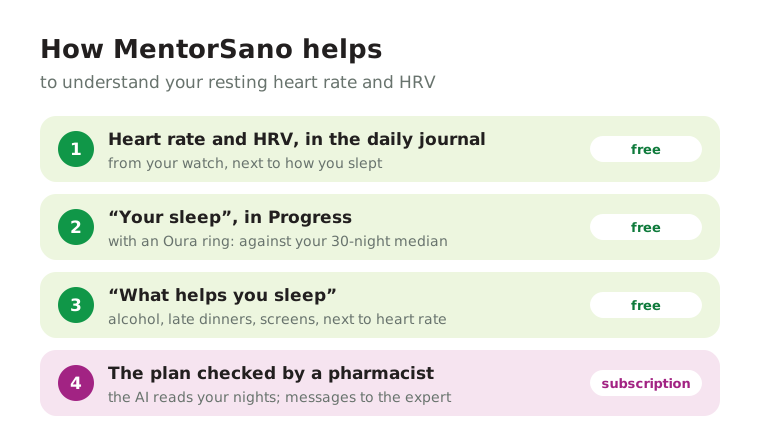
MentorSano doesn't diagnose and doesn't give you a "heart score". It puts the numbers next to your usual values and next to what you did in the days before:
- For free, in the daily journal you write down the resting heart rate and HRV from your watch, whichever one it is, next to how you slept and how rested you feel.
- For free, if you've connected an Oura ring, "Your sleep" in Progress shows each night's heart rate and HRV compared with your usual: the median of your last 30 nights.
- For free, "What helps you sleep" puts nights after alcohol, a late dinner or screens next to the others, so you can see what pushes your heart rate up.
- With the subscription, the AI reads your nights together with your journal and blood tests, and Adrian Ienin, a pharmacist, checks your "What matters now" plan. You can also message him directly if a number worries you.
To see your numbers next to your usual, create your free MentorSano account and write down your resting heart rate from the first morning.
What can you do with your watch numbers this week?
- Write them down seven mornings in a row, heart rate and HRV, without changing anything. See what your usual is.
- Next to each night, note anything unusual: alcohol, a late dinner, a workout, a tense day.
- After a week, look for the links. Many people see in numbers, for the first time, what a glass of wine or a 10 pm dinner costs them.
- Don't check the numbers several times a day. Your heart rate goes up when you worry about it too.
- Take your own pulse with your fingers once a week. That way you check the rhythm, not just the number.
If you had a cold this week or a hard spell, don't draw conclusions. Keep notes for another week. Your usual values only show after a few ordinary weeks.
When to see a doctor
- Your resting heart rate is often above 100 beats per minute, with no fever, exercise or coffee to explain it.
- Your heart rate is below 60 and you feel dizzy, very tired or faint, especially if you're not an endurance athlete.
- Your pulse is irregular, or you feel your heart skipping, racing or pausing for a moment.
- You feel dizzy, short of breath or like you might faint, together with a very fast or very slow heart rate.
- You have chest pain or tightness: call 999 (or your local emergency number), don't wait.
- Your resting heart rate has gone up for weeks with no reason you know of.
- Your watch keeps giving you irregular rhythm alerts.
Frequently asked questions
What is a normal resting heart rate for adults?
According to MedlinePlus, resting heart rate in adults is usually between 60 and 100 beats per minute. In very well-trained athletes it can be 40–60. Within that range, what matters more is how your heart rate changes compared with your own usual value.
What is a good HRV?
There's no good value for everyone. HRV differs a lot from person to person and goes down with age. Compare it with the average or median of your own nights, on the same device.
Why is the heart rate on my watch lower than when I measure it during the day?
Many watches and rings take the lowest heart rate or the average during sleep, when your body is at its calmest. During the day, even sitting down, your heart rate is usually a few beats higher.
Why does my heart rate go up after drinking alcohol?
Alcohol keeps your body more active in the first part of the night. In a study of more than 4,000 employees in Finland, recovery in the first three hours of sleep went down after alcohol, even after a small amount.
Can my heart rate tell me I'm getting a cold?
In some people, night-time heart rate goes up and HRV drops when a cold is starting. MedlinePlus lists infection among the reasons for a fast pulse. But a watch doesn't diagnose anything. A few nights with your heart rate above usual are just a sign that it's worth resting.
How accurate is the heart rate measured by a watch?
Night-time heart rate is generally measured fairly well by watches and rings. If you want to check, count your own pulse at your wrist after 10 minutes of sitting still.
Start from where you are today
MentorSano brings together your blood tests, sleep, meals, movement and habits, and Adrian Ienin checks your plan before it reaches you.
- 15-minute questionnaire
- Blood tests, explained
- Daily journal
- Lesson of the day
- An expert by your side
Adrian Ienin
Naturopathic pharmacist, nutrition and holistic health consultant, co-founder of MentorSano. He checks the articles here and the plans in the platform before they reach people. About Adrian and how we write our articles →
Sources
- MedlinePlus: Pulse
- Shaffer, Ginsberg. An Overview of Heart Rate Variability Metrics and Norms, Frontiers in Public Health, 2017
- Pietilä et al. Acute Effect of Alcohol Intake on Cardiovascular Autonomic Regulation During the First Hours of Sleep in a Large Real-World Sample of Finnish Employees, JMIR Mental Health, 2018
- NHS: Atrial fibrillation