Morning routine: a calm start instead of a rush, in small steps
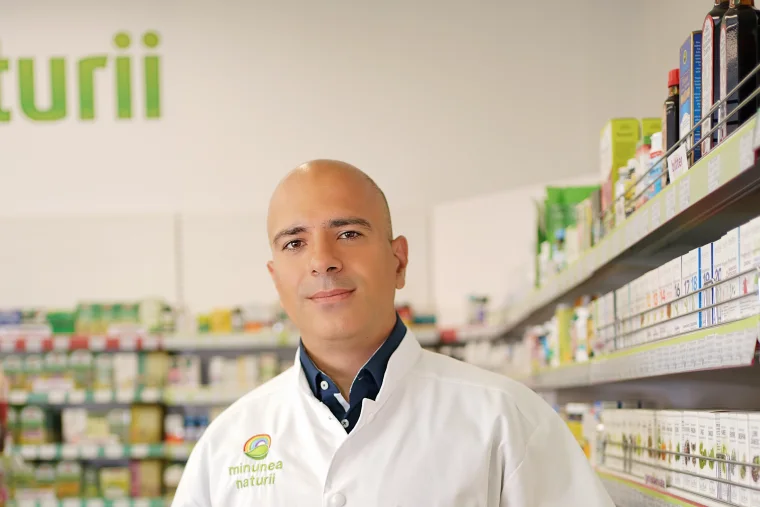 Checked by Adrian Ienin, pharmacist · updated
A good morning routine doesn't take two hours. Five or six small steps are enough, done in the same order: you wake up at the same time, get outside into daylight, drink water, have a breakfast with protein, drink your coffee after it and move for a few minutes. Each step is linked to something you already do, so it doesn't depend on willpower. Start with one step and add the next once the first happens on its own.
Want to see what this means for you? Start for free →
Why does your morning start in a rush?
The alarm goes off, you hit snooze twice, then jump out of bed. The first thing in your hand is your phone: messages, news, emails. You drink a coffee standing up, on an empty stomach, and leave. Breakfast stays "for later", and by 11 you're hungry and on edge.
It isn't a character flaw. Your morning has too many last-minute decisions and nothing that happens on its own. A morning routine fixes exactly that: a few steps, always the same, that you no longer have to decide on every day.
The internet is full of two-hour routines, with meditation, journalling, a workout, a cold shower and a green smoothie. For someone leaving at 7:30 with two children to get to school, they aren't realistic. The routine below fits into 20–30 minutes and works in a studio flat or with children around the house.
What happens in your body in the morning?
Your body has an internal clock that resets every day according to light and dark. A review in the journal Somnologie explains that light reaches, through the eyes, the part of the brain that keeps this clock and syncs it with the 24-hour day. Evening light pushes it later. Morning light helps keep it in place.
The time you wake up matters too. The NHS advises people who sleep badly to wake up and get out of bed at the same time every day. A wake-up time is easier to keep than a bedtime, and sleep comes more easily in the evening when the morning started at the same time.
The third thing is habit. A paper in the British Journal of General Practice explains that a habit forms when you repeat the same thing in the same context: after brushing your teeth, after putting the kettle on, when you leave the building. The context triggers the action, without you having to think about it.
What makes a realistic morning routine?
| The step | How long it takes | Why you do it | What you link it to |
|---|---|---|---|
| Wake up at the same time, weekends included (no more than an hour's difference) | 0 minutes | your internal clock stays in place, and you fall asleep more easily at night | the alarm, placed in another room or away from the bed |
| Get outside into daylight for 10–15 minutes | 10–15 minutes | morning light keeps your internal clock on daytime | walking to work, coffee on the balcony, the dog |
| Drink a glass or two of water | 1 minute | you haven't drunk anything for 7–8 hours | a glass left by the sink or the bed the night before |
| Have breakfast, with protein | 10 minutes | it keeps you full until lunch | after your shower or after getting dressed |
| Drink your coffee after breakfast | 5 minutes | it no longer replaces a meal | make the coffee only when the plate is on the table |
| Move for a few minutes | 5 minutes | you properly wake up | straight after getting up, or on the way to the bus |
You don't need every step from day one. Pick one and do it for two or three weeks, until you stop thinking about it. Then add the next.
How do you link the steps to what you already do?
A new habit sticks better when it has a clear "after I". Instead of "I'll drink more water", you say "after I switch off the alarm, I drink the glass of water on my bedside table". Instead of "I'll move in the morning", you say "after I brush my teeth, I do ten squats".
A few things that help you not rely on willpower:
- Get ready the night before. The glass of water, the oats in a bowl, the clothes on a chair. In the morning you don't choose anything.
- Keep your phone away from the bed. If your alarm is on your phone, put it on a shelf. When you get up to switch it off, you're already on your feet. Read your messages after breakfast.
- Do the steps in the same order. A fixed order saves you decisions. One step sets off the next.
- Don't start with every step. Five new things at once fall apart by day three.
How long it takes for a habit to become automatic, and why people give up after a week, is covered in the article how to build a habit.
What about coffee on an empty stomach?
For many people, coffee is breakfast. It keeps hunger away for an hour, then hunger arrives all at once, usually around 10 or 11, when pastries and biscuits are within reach. Coffee on an empty stomach gives some people heartburn or a jittery feeling.
You don't have to give up coffee. Just move it to after breakfast. The European Food Safety Authority (EFSA) says that for a healthy adult up to 400mg of caffeine a day, from all sources, raises no safety concerns, except for pregnant women. An espresso has about 80mg, and a 200ml cup of filter coffee about 90mg. Two coffees a day are well below that limit.
Timing matters too. EFSA notes that 100mg of caffeine taken close to bedtime can shorten sleep in some adults. A coffee in the morning, rather than late in the afternoon, does less harm to your night. If you feel you can't get going at all without coffee, read about the cycle of tiredness and coffee.
What breakfast fits into a busy morning?
Breakfast doesn't have to be cooked. It needs protein and something that fills you up. A few 5–10 minute options:
- Greek yoghurt with oats and a piece of fruit;
- two eggs boiled the night before, with a slice of wholemeal bread and a tomato;
- cheese with wholemeal bread and cucumber;
- overnight oats in milk or yoghurt, with nuts.
What to avoid in the morning, and more ideas, are in the guide to a healthy breakfast. If you forget to drink water during the day, see also how much water to drink.
How does MentorSano help with your morning routine?
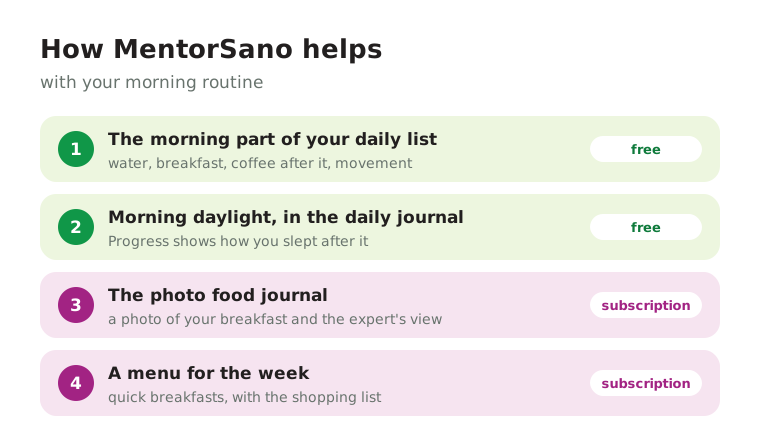
MentorSano doesn't give you a two-hour routine. It gives you a few steps to tick off and shows you what changes after them:
- For free, the daily list has its own morning part: water after waking up, a breakfast with protein and no sugar, coffee only after it, your planned exercise. You tick off what you did in a minute.
- For free, in the daily journal you also tick off morning daylight, and after a few weeks Progress shows how you slept after mornings with daylight compared with the rest.
- With the subscription, in the food journal you take a photo of your breakfast and get the expert's view: what's good and what you could change next time.
- With the subscription, the weekly menu has quick breakfasts, to your taste and schedule, with the shopping list ready.
Start with a single step: create your free MentorSano account and from tomorrow tick off coffee after breakfast.
What does a 25-minute morning look like?
- 6:45, the alarm, on a shelf, not by the bed. You get up to switch it off.
- 6:46, the glass of water you set out the night before.
- 6:50, ten squats and a few stretches while the shower warms up.
- 7:00, breakfast: yoghurt with oats and an apple. Then coffee.
- 7:20, out of the door. Walk 10 minutes to the bus, in daylight. Your phone stays in your pocket until you arrive.
Your times can be different. What matters is that they're the same every day. If one morning slips, don't "make up for it" the next day with a longer routine. Go back to your usual steps, in the same order.
Look at the evening before. Many rushed mornings start with a late night. If you wake up tired even after eight hours in bed, your morning routine isn't the problem, and that's worth talking to your GP about.
When to see a doctor
- You wake up tired almost every morning, even though you sleep 7–9 hours.
- You snore loudly, wake up gasping, or someone has told you that you stop breathing in your sleep.
- You have a headache almost every morning.
- You have heartburn, nausea or stomach pain in the morning, even after eating.
- You get palpitations or shaking after coffee, even after just one cup.
- You've felt low and uninterested in things for several weeks, and mornings are the hardest part of the day.
Frequently asked questions
How long should a morning routine take?
As long as your schedule allows. For most people, 20–30 minutes is enough for water, breakfast, a little movement and a few minutes in daylight. A short routine you keep every day helps you more than a long one you give up.
Do I have to get up early to have a morning routine?
No. What matters is waking up at the same time every day, weekends included, with no more than an hour's difference. You choose the exact time to suit your schedule.
Is it bad to drink coffee on an empty stomach?
It gives some people heartburn or the jitters, and not others. The more common problem is that a coffee replaces breakfast, and hunger then arrives later, all at once. If you drink your coffee after breakfast, you avoid both.
What if I don't have time for breakfast?
Prepare it the night before: overnight oats, boiled eggs, yoghurt with fruit in a tub. You can eat it at your desk in the first hour. The important thing is not to reach lunch on just a coffee.
Why does morning light matter?
Light reaches your body's internal clock through your eyes and matches it to the day. Ten to fifteen minutes outside in the morning, even when it's cloudy, helps keep the clock in place.
How do I stop reaching for my phone as soon as I wake up?
Keep it away from the bed and use an alarm clock if you can. If your alarm is on your phone, put it on a shelf and read your messages only after breakfast. If it isn't within reach, you stop picking it up out of habit.
Start from where you are today
MentorSano brings together your blood tests, sleep, meals, movement and habits, and Adrian Ienin checks your plan before it reaches you.
- 15-minute questionnaire
- Blood tests, explained
- Daily journal
- Lesson of the day
- An expert by your side
Adrian Ienin
Naturopathic pharmacist, nutrition and holistic health consultant, co-founder of MentorSano. He checks the articles here and the plans in the platform before they reach people. About Adrian and how we write our articles →